



 22.26°C Kathmandu
Wed, Oct 21, 2026
Money
Surging fuel prices are squeezing Nepal’s middle class
As conflict in West Asia drives up petrol and diesel prices, those who depend on two-wheelers and public transport are bearing the heaviest burden — but the switch to electric remains out of reach for most.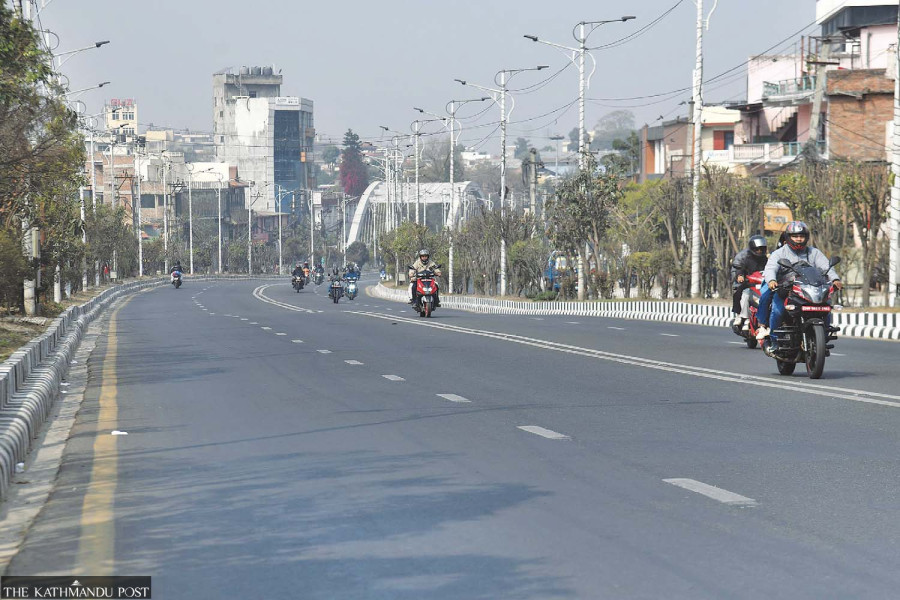
bookmark
Seema Tamang
Published at : May 10, 2026
Updated at : May 11, 2026 07:31
Kathmandu
When the conflict in West Asia began, Anil Neupane didn’t think it would reach into his wallet in Kathmandu. But the Dolakha native, who commutes from Shankhamul to a driving center where he works in Radheradhe, Bhaktapur, now spends nearly 35 percent more on fuel than he used to.
What once cost him Rs500 to 800 a week has crept up to Rs1,000 to 1,100. “Whatever little I used to save goes into petrol now,” he said, adding that his monthly fuel bill has hit Rs4,500.
Neupane is far from alone. Since the West Asian conflict broke out, fuel prices across Nepal have climbed sharply. Petrol, which was Rs157 a litre before the tension, now stands at Rs217. Diesel has jumped from Rs142 to Rs225—making it, for the moment, more expensive than petrol, a fact that has not gone unnoticed on social media. “Petrol is cheaper than Punte beer now—you decide, drive or drink,” read one widely shared post.
Supply, for now, is not the problem. There are no queues at pumps. The squeeze is purely about skyrocketing prices of petroleum products.
And the burden is falling unevenly. According to customs department data, electric vehicles now account for 71 percent of four-wheeler sales, with petrol and diesel vehicles making up just 29 percent.
But for two-wheelers—the vehicle of choice for much of Nepal’s middle class and daily wage earners—electric bikes account for only around 6 percent of the market. It is this group, along with public transport users, that is absorbing the sharpest pain.
The government has already raised public transport fares by an average of 16.71 percent. When petrol hit Rs187 per litre, Pratibha Poudel parked her scooter and switched to the passenger bus. But bus fares had gone up too. And as a central secretary of All Nepal National Independent Students Union-Revolutionary, she has seen how the ripple effects reach further—student discounts on public buses have become harder to come by. “Students and daily wage workers are the most affected,” she asserted.
For those who rely on ride-sharing to make it to work on time, the costs have also surged. Radha Khatiwada of Tarakeshwar in Kathmandu, who books rides every morning to reach her office by 9am, says her monthly ride-sharing bill has gone from Rs11,000 to Rs15,500.
Ride-sharing drivers, caught between rising fuel costs and platform-set fares, have taken to the streets in protest. “Petrol expensive, fares cheap,” read their placards. “Stop exploiting riders.”
To ease pressure on supply and curb consumption, the government has started giving an additional weekly holiday on Sundays.
It is not that the country lacks alternatives to petroleum-powered vehicles. Electric vehicles ranging from two-wheelers to big buses can be used instead of petroleum-powered vehicles. Scooters and bikes from brands including Yadia, NIU, Super Soco, Ather, Bajaj Chetak, Gogoro, Segway and TVS iQube are available in the Nepali market. The country produces enough clean energy domestically. Imports face no major barriers at the moment.
But ‘range anxiety’ is keeping buyers away, according to sellers. Umid Shrestha, director of Kuju Nepal, the authorised distributor for Yadia, hears the same questions from every prospective buyer: What if it runs out of charge mid-journey? What if it can’t handle a double load? Where’s the nearest workshop? Will it manage off-road?
Segway brand manager Dhirendra Kushawaha puts it plainly: most people who buy electric two-wheelers are treating them as an alternative vehicle, not a primary one. “Someone already has a petrol four-wheeler at home, and they think—let me get an electric one as the second,” he said. His brand has seen 20 to 30 percent market growth, but he notes that demand for electric vehicles tends to spike during energy crises—as it did during the blockade—and then taper off.
Petrol two-wheeler sales, meanwhile, appear unmoved. Bishnu Agarwal, managing director of MAW Group, the authorised Yamaha dealer, said sales are tracking exactly as projected. “Price increases or energy crises—none of it shows up in our numbers. Yamaha sales remain normal,” he said.
Nepal has improbably become a global story in EV adoption. According to data from Ember, a global energy think tank, in 2025, more than 70 percent of new car sales in Nepal were electric—second in the world only to Norway, which sits at 97 percent. Nepal has overtaken Denmark, Sweden and Iceland, and is well ahead of the UK, Germany and the United States in the percentage of EV adoption. For electric four-wheelers, at least, the transition is well underway. However, for two-wheelers, the figure remains quite low.
The headline and sub-headline of the story have been updated for clarity.
Seema Tamang
Seema covers business and economy for Kantipur Publications.

Most Read from Money
Nepal travel agents threaten to stop selling Thailand trips over visa rules

Why does an hour long flight to Dhangadhi cost more than a flight to New Delhi?
Malaysia rejects Nepal’s demand to open recruitment to all manpower agencies

No school, but a graduation cap for women dairy farmers
Nepal arrests four medical service providers as Malaysia recruitment row deepens
Editor's Picks




E-PAPER | October 21, 2026

×