Insurance push brings new hope to disaster-hit Bajhang farmers
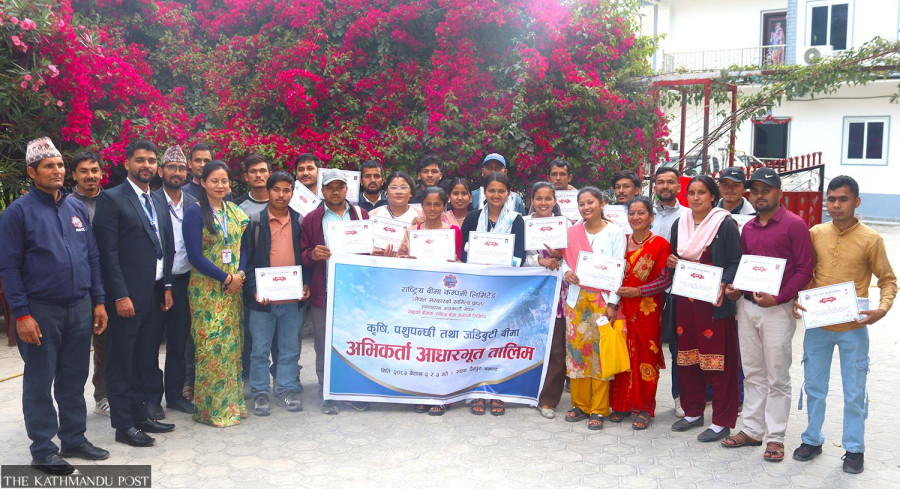
Subsidised scheme targets crop, livestock and herb losses as new diseases and climate risks rise in the remote mountain district. Agricultural technicians pose for a group photo after completing their insurance agent training in Chainpur, Bajhang on April 16. Basanta Pratap Singh/TKP
Farmers in Bajhang, a remote mountain district in far-western Nepal bordering Tibet to the north, have long endured recurring agricultural losses due to disasters. The district—considered the second least developed among the nine in Sudurpaschim province—has in recent years also witnessed a surge in new crop diseases. This has compounded risks for farmers.
But a new initiative promises relief. Farmers will now be able to access agricultural insurance services, marking a significant shift in how risks in the district’s largely subsistence farming system are managed.
According to the National Statistics Office, mountain regions like Bajhang have seen the highest incidence of new crop diseases at 68.7 percent, compared to 50.3 percent in the hills and 46.3 percent in the Tarai. The data underscores the growing vulnerability of high-altitude farming systems to emerging biological threats.
The survey further shows that households located between 1,500 metres and 2,000 metres above sea level reported a 60.2 percent rise in new crop diseases over the past 25 years.
In Bajhang, where most farmers depend on wheat, maize, potato, paddy and millet, the risks are particularly acute. Farming remains largely subsistence-based, with only about one-third of cultivated land having access to irrigation.
Climate-induced hazards such as droughts, floods and landslides frequently disrupt production, leaving farmers exposed to heavy losses.
The District Agriculture Knowledge Centre has now stepped in with a plan to expand insurance coverage across the district. Officials say a dedicated agricultural insurance campaign will be launched as a major intervention to protect farmers from mounting risks.
In coordination with the National Insurance Company Limited, the centre has already trained 25 insurance agents. While livestock insurance has seen limited uptake in the past, there has been virtually no coverage for crops and medicinal herbs—two key components of the local agricultural economy.
This lack of insurance has meant that farmers engaged in commercial agriculture have repeatedly suffered financial setbacks due to seasonal disasters, fires and disease outbreaks. Authorities say the new campaign aims to reverse this trend by building trust and awareness around insurance.
Janak Bahadur Singh, chief of the centre, said low awareness has been the main barrier. “Crops and medicinal herbs have not been insured so far because farmers were not informed about the benefits,” he said. “The trained agents will now reach out to farmers and encourage wider participation.”
The campaign introduces a key policy shift: farmers receiving government subsidies will be required to insure their agricultural activities. “We are making insurance mandatory for subsidy recipients,” Singh said. “At the same time, agents will also encourage farmers outside the subsidy system to enroll voluntarily.”
All trained agents are agricultural technicians deployed across local units, a move officials believe will ensure wider outreach and effective implementation throughout the district.
Under the scheme, agents will assess the value of crops and livestock, based on which the insurance premium will be calculated. Farmers will need to pay 7 percent of the total valuation as the premium. However, with the government subsidising 80 percent of the cost, farmers will bear only 20 percent of the premium.
Ishwar Darlami, one of the trained insurance agents, said the scheme has been designed to be accessible even to small farmers. “For just an additional Rs2, farmers can also get personal accident insurance,” he said.
Farmers will have the flexibility to insure either their production costs or expected returns, depending on their preference. “Whether it is small-scale farming or large commercial operations, insurance will be available after proper valuation,” Darlami said. “This flexibility allows farmers to choose coverage that best suits their needs.”
He added that the heavy government subsidy is expected to encourage widespread participation.
Kavita Lama, manager at the Insurance Board, said the initiative is particularly crucial for a remote and climate-vulnerable district like Bajhang. “Having trained agents at the local level will make insurance services more accessible,” she said.
“Once agents are available within municipalities, they can educate farmers about insurance and help reduce risks associated with agriculture, livestock and medicinal herbs,” Lama said. “Insurance not only protects small farmers but also reduces investment risks for those involved in larger agricultural ventures.”
According to Lama, improved access to insurance could also attract new investment into the sector, which has long been constrained by high risk and uncertainty.
So far, around 1,500 farmers in Bajhang have enrolled in livestock insurance schemes. However, coverage for crops and medicinal herbs remains negligible. Officials hope the new campaign will significantly expand participation in these areas.
Under the scheme, insured farmers will be eligible to receive compensation of up to 90 percent in the event of losses. The inclusion of accident insurance is also expected to benefit farmers with limited financial capacity who depend entirely on agriculture for their livelihoods.
“We believe this campaign will not only provide financial security but also restore confidence in agriculture,” Lama said. “It has the potential to create new hope in a sector that has long been defined by uncertainty.”




 25.89°C Kathmandu