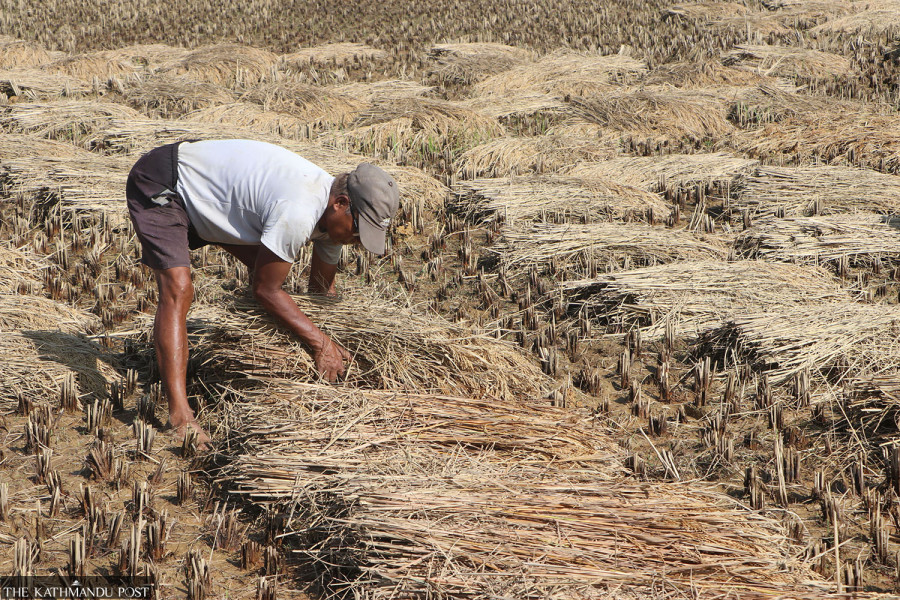
First-quarter review trims policy rate to revive investment amid slowing private-sector spending. Delayed and erratic monsoons have been affecting agriculture in Nepal in recent years. A farmer arranges bundles of recently harvested paddy, in this undated photo. Post file photo
Nepal’s central bank on Monday reduced the policy rate from 4.50 percent to 4.25 percent in the first-quarter review of the monetary policy, aiming to increase credit flow and revive economic activity that has struggled to gather momentum despite a surplus of liquidity in the banking system.
Citing inflation at a two-decade low, record foreign exchange reserves, and broader macroeconomic and financial-sector conditions, the Nepal Rastra Bank said it would continue the cautious and flexible monetary policy stance adopted for the current fiscal year.
The first-quarter review, covering the period ending mid-October, introduces a series of regulatory adjustments.
According to the central bank, lowering the policy rate—which guides the rates at which banks can deposit and borrow funds—will push down commercial lending rates, encouraging borrowing and investment.
As part of its effort to gradually narrow the width of the interest rate corridor and keep the policy rate at its midpoint, the upper bound—the Standing Liquidity Facility (SLF) rate—has been reduced from 6.00 percent to 5.75 percent.
This, the bank said, will also help reduce banks’ interest expenses. The lower bound—the Standing Deposit Facility (SDF) rate—remains unchanged at 2.75 percent.
The mandatory cash reserve ratio and statutory liquidity ratio requirements are unchanged.
One key change is the revocation of the rule requiring banks and financial institutions to keep the interest rate on institutional fixed deposits at least 1 percentage point lower than the rate on individual fixed deposits.
The ceiling on personal overdraft loans has been doubled—from Rs5 million to Rs10 million.
Microfinance institutions will now be allowed to provide collateral-backed loans of up to Rs1.5 million, up from Rs700,000. To ease repayment pressures on microfinance borrowers, the central bank will permit rescheduling of their loan repayment schedules.
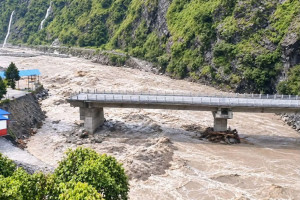
Furthermore, banks and financial institutions will be allowed to restructure or reschedule loans once for businesses and enterprises in flood- and landslide-affected districts, including Ilam, with a minimum interest rate of 10 percent applied to the revised loan.
“The monetary policy review tends to increase the flow of capital in the market, which is positive,” said Santosh Koirala, president of Nepal Bankers Association and CEO of Machhapuchchhre Bank.
He said doubling the personal overdraft ceiling to Rs10 million comes at a time when private-sector investment has slowed significantly.
Increasing credit facilities through microfinance institutions, he added, will support agriculture and women entrepreneurs. “These provisions are geared towards flexibility and aimed at improving the investment environment.”
To strengthen transparency, accountability, and governance in the banking sector, the central bank plans to introduce Anti-Bribery and Corruption Policy mechanisms, drawing from international best practices and existing internal procedures.
The review notes that the government formed in the wake of the Gen Z protests this year has prioritised governance reforms and a more conducive business environment. Combined with the central bank’s monetary easing, these developments are expected to support a gradual strengthening of the economy, the central bank said.
International credit rating agency Fitch recently maintained Nepal’s sovereign rating at “BB-”, unchanged from last year.
Although some hotels suffered damage during the September protests, tourist arrivals have continued to rise. Nepal welcomed 944,000 foreign visitors in the first ten months of 2025, compared with 941,000 in the same period last year, according to the Nepal Tourism Board.
Hydropower generation is progressing, with an additional 309 MW added to the national grid in the first quarter of the current fiscal year.
The government has curbed recurrent spending and halted small or unprepared capital projects, prioritising national-priority schemes, near-completion projects, and post-disaster reconstruction. This, the central bank said, is expected to have a favourable impact on the economy.
However, delayed monsoon during the paddy-planting season, followed by heavy rainfall, floods, and landslides, have affected agriculture and other sectors. As a result, the central bank expects economic growth to fall slightly below the fiscal-year target.
Consumer inflation in India remains below target, and the Reserve Bank of India has projected inflation at 2.6 percent for 2025-26.
Global petroleum prices are expected to ease further. Domestically, however, lower paddy output and election-related spending could exert mild upward pressure.
Overall inflation for 2025-26 is projected at around 4 percent.
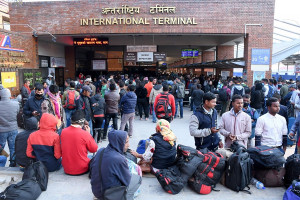
The outflow of Nepalis for foreign employment continues to rise, and if current trends—characterised by strong remittance inflows and moderate imports—persist, foreign exchange reserves are expected to remain comfortable throughout the fiscal year.
The banking sector continues to face excess liquidity and low interest rates. Weighted average interest rates on deposits and loans are declining, though real deposit rates remain positive. While non-performing loans have edged up, average capital adequacy remains above the regulatory minimum.
The monetary policy announced on July 11 prioritised price stability and external balance while supporting growth.
The central bank noted that since then, political developments—including the Gen Z protests—had disrupted life and property.
“After the protests, the government restored law and order and focused on good governance, reconstruction, and business-friendly reforms. The central bank also adopted regulatory flexibility, which is expected to support economic activity,” the review said.
“Overall financial stability has been maintained. The banking sector has ample liquidity, and interest rates are low. However, credit expansion has not occurred as expected.”
In the first quarter of 2025-26, total merchandise exports surged by 89.6 percent to Rs72.78 billion, while imports rose 19.8 percent to Rs468.08 billion. The merchandise trade deficit widened by 12.2 percent to Rs395.30 billion.
The current account recorded a substantial surplus of Rs237.59 billion, while the balance of payments posted a surplus of Rs264.03 billion. During the same period last fiscal year, the current account surplus was Rs115.36 billion and the balance of payment surplus was Rs184.99 billion.
Remittance inflows grew by 35.4 percent to Rs553.31 billion, compared with 11.9 percent growth and Rs408.77 billion in the same period last year.
According to the Ministry of Finance, total government expenditure in the first quarter increased by 10.8 percent, while revenue mobilisation rose by 0.3 percent. Of the total expenditure of Rs364.59 billion, recurrent spending amounted to Rs256.81 billion, capital expenditure to Rs19.18 billion, and financing expenditure to Rs88.60 billion.
Sangam Prasain is Business Editor at The Kathmandu Post, covering tourism, agriculture, mountaineering, aviation, infrastructure and other economic affairs. He joined The Kathmandu Post in October 2009.




 23.7°C Kathmandu