Clash at Chinese-funded meat factory site in Sindhuli leaves seven injured
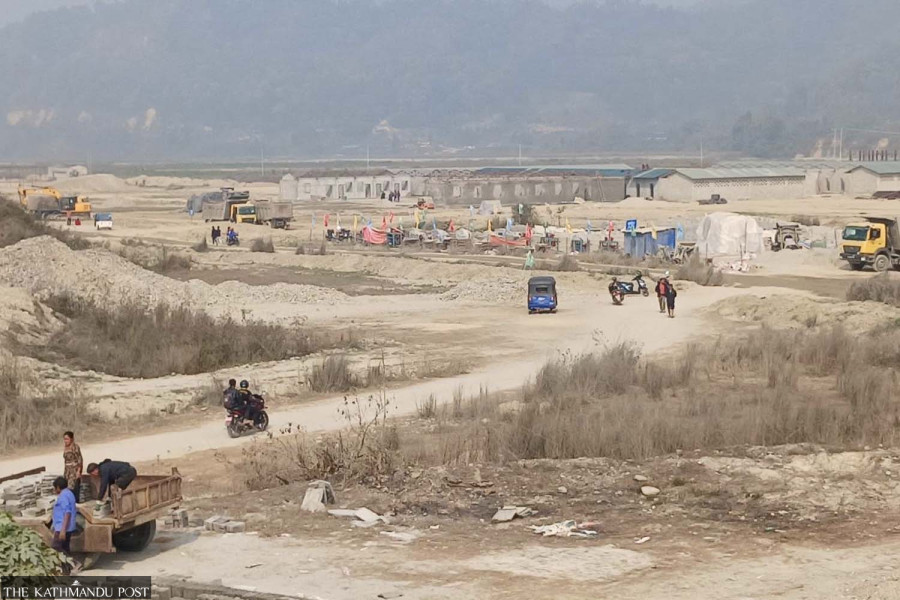
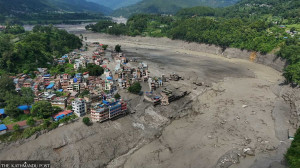
Altercation over dismissal of a local truck driver triggered violence. Three seriously injured. Police have tightened security at under-construction plant. The construction site of the buffalo meat processing plant, the Himalayan Food International, in Marin Rural Municipality in Sindhuli. Post Photo
Two Nepali and five Chinese workers were injured after a clash broke out on Monday morning at an under-construction factory site in the Marin Rural Municipality of Sindhuli district, police said. The incident occurred following a dispute over the removal of a local truck driver employed at the project.
According to Lal Dhoj Subedi, superintendent of police at the District Police Office, Sindhuli, the confrontation began when 30-year-old Nabaraj Bamjan, a resident of Dhamile-6 in Marin Rural Municipality, returned to the site after being dismissed from his job by the company on Sunday.
Bamjan reportedly attempted to resume work on Monday morning despite being informed that his services were no longer required.
“When Bamjan forcefully decided to drive the truck, Chinese workers stationed at the site blocked him, leading to a verbal altercation between Nepali and Chinese workers,” Subedi said.
Police said the argument quickly escalated into a physical fight.
During the scuffle, several workers from both sides sustained injuries. Authorities stated that the Chinese workers allegedly attacked the Nepali workers after tensions intensified.
The workers were engaged in constructing a processing plant of Himalayan Food International, a company preparing to export buffalo meat to China under a major Chinese investment initiative.
The project has been described as one of the largest foreign direct investments in Nepal’s agro-processing sector.
Police confirmed that two Nepali nationals and five Chinese nationals were injured in the incident. Among them, two Chinese workers and one Nepali suffered serious head injuries and were referred to Medicity Hospital in Kathmandu for advanced treatment.
The remaining injured were initially treated at a local primary health centre and later at Sindhuli Hospital.
The injured Nepalis have been identified as Bamjan and 22-year-old Gokarna Katuwal, a resident of Katari Municipality in Udayapur district. The injured Chinese workers include Yang, 38; Yang Haibo, 45; Xiang Chong, 40; Chujen, 46; and Leusensi, 31.
Police said they received information about the incident at around 9:20 am and immediately mobilised security personnel to the construction site. “The situation is under control now,” Subedi said, adding that additional police forces have been deployed to prevent further unrest.
However, some locals expressed concern that tensions could resurface.
Basu Mainali, a resident of the area, said the company had not been adequately coordinating with local communities. “If proper dialogue is not maintained with locals and workers, such clashes may happen again,” he said.
The Post’s attempts to contact Navin Kumar Sharma, chairman of Himalayan Food International, for comment were unsuccessful.
On December 16, 2023, Himalayan Food International signed a business-to-business agreement in Kathmandu with Shanghai Ziyan Food to export buffalo meat to China. Chinese officials have described the agreement as part of Beijing’s “soft trade diplomacy,” signalling plans to import up to $1.5 billion worth of buffalo meat annually from Nepal.
The deal has been projected as a potential game changer in bilateral trade between the two countries.
The factory under construction in Sindhuli is spread across 140 bigas of land, with around 55 bigas allocated for the main processing facility and the remaining land designated for quarantine and related infrastructure.
The company has secured approval for Chinese investment worth Rs21 billion for the project.
Of the approved amount, nearly Rs2 billion has already been spent. According to company sources, around Rs1 billion was used for land acquisition, approximately Rs500 million for equipment procurement and construction of labour quarters, while the remaining amount has gone toward design, planning and preparatory works.
In December 2024, China formally expanded trade opportunities with Nepal by opening its market to water buffalo meat, moving beyond traditional imports such as handicrafts.
The development followed then-prime minister KP Sharma Oli’s official visit to China, during which Beijing agreed to facilitate meat imports from Nepal.
Company officials have previously stated that total Chinese investment in Nepal’s meat sector could reach around Rs27 billion in the near future, covering both meat processing facilities and animal rearing operations.
The company aims to export 900 tonnes of buffalo meat daily once the plant becomes operational. Meeting that target would require the slaughter and processing of nearly 7,000 buffaloes each day.
Export pricing, according to the company, will be determined three months prior to shipment and is expected to remain slightly higher than the prevailing domestic wholesale rate.
Monday’s clash, however, has cast a shadow over the ambitious project, highlighting tensions at large foreign-funded industrial sites where labour disputes and local concerns can quickly escalate without effective communication and grievance mechanisms.
Police said they are monitoring the situation closely and have urged both management and workers to resolve disputes through dialogue.




 20.85°C Kathmandu