Dengue cases have declined significantly this year compared to the previous few years, offering relief to health authorities who had long been criticised for not doing enough to stop the disease.
According to the data of the Epidemiology and Disease Control Division, six people died and 8,109 others tested positive with dengue virus that has spread in 76 out of 77 districts throughout the country since January.
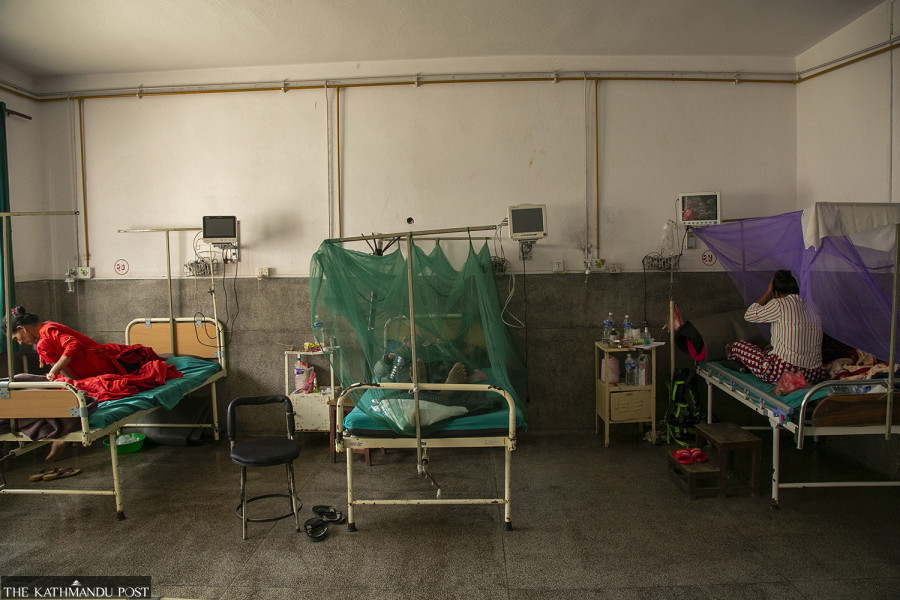
In 2024, 15 people died, and 41,865 others were infected as the virus spread to 76 districts. In 2023, 88 persons died and more than 54,000 were infected by the virus, which had spread to all 77 districts. At the time, hospitals in Kathmandu Valley were overwhelmed with dengue patients, and pharmacies had run out of paracetamol, the most widely used medicine to treat fever.
“This year the number of reported cases of dengue infection was very low, compared to previous years,” said Dr Gokarna Dahal, chief of the Vector Control Section at the division. “No major hotspot of the dengue infection was recorded this time.”
Dengue is a viral disease transmitted by female Aedes aegypti and Aedes albopictus mosquitoes. According to the World Health Organisation, the same vector also transmits chikungunya, yellow fever, and the Zika virus.
Experts say reported cases may represent only a small fraction of the true scale of infection, as around 90 percent of the infected people are asymptomatic, and many deaths and infections often go unreported.
Many people infected with dengue show mild symptoms, which do not need any treatment or can be managed with paracetamol at home.
Since dengue became endemic in Nepal years ago, meaning people get infected throughout the year, health officials no longer classify it as an outbreak of a deadly virus.
Infection of the deadly disease has continued unabated despite the declining temperature in recent days. According to the latest data of the division, 56 people tested positive for the infection of dengue virus in the past one week and six in the past 24 hours.
All mountain districts except Dolpa reported infection of dengue virus this year. It was considered that the dengue spreading mosquito vectors do not survive in the cold temperature thus there is no risk of dengue infection in mountainous districts and chilling weather conditions. However, the division’s data shows otherwise.
Experts say even if maximum temperatures have declined, they remain above 15 degree Celsius, which is enough for dengue spreading mosquitoes to survive.
Health officials say that they have been working on multiyear guideline and dengue control strategies, as even if cases of infection have declined, risk of massive spread of the disease has not lessened, as vectors spreading the deadly disease have spread all over the country.
“We will continuously alert agencies in the province and at the local level about the risk and encourage them to take mitigation measures,” said Dahal. “The situation could go out of control if concerned agencies stopped taking measures and the general public let the guard down.”
Dengue mosquitoes breed in clean water and bite during daytime. Uncovered water tanks and discarded objects such as plastic cups and bottles can serve as breeding grounds.
Symptoms of the disease include mild to high fever, severe muscle pain, rashes, severe headache and pain in the eyes, among other things. Doctors advise those with these symptoms to seek immediate treatment. While there is no specific cure for the disease, early detection and access to proper medical care can lower fatalities.
Many people infected with dengue show mild symptoms, which do not need any treatment or can be managed with paracetamol at home.
Nepal reported its first dengue case in a foreigner in 2004 in Chitwan district. Since then, an increasing number of dengue infections, including major outbreaks, have been reported from many districts.
The World Health Organisation says there is no specific cure for severe dengue, but early detection and access to proper medical care can save lives.




 15.71°C Kathmandu