



 17.65°C Kathmandu

Fri, Oct 16, 2026
Columns
The silence of the cuckoo bird and catastrophic floods warn Nepal’s climate future is already here
The behemoth in the room is the silent climate crisis, which manifests as the absence of the cuckoo’s call. If we don’t listen and change, the future is bleak, and it will be too late..png&w=900&height=601)
bookmark![]()
© Kate Raworth
Sophia L Pandé
Published at : August 29, 2026
Updated at : August 30, 2026 08:18
For the first time in over 45 years, the cuckoo didn’t arrive in our garden to herald the spring. The lapsi tree it usually sits in is there, as are the crows that it uses to nurse its young. I am not the only one who was left bereft. All over the Valley, people have missed this bird’s beloved kuohkuoh this year.
Over the years, closely watching unchecked climate change and broken carbon-emission control promises, I had dreaded the day the cuckoo would forsake us, due to a warmer spring and an increasingly hostile Valley with fewer and fewer green spaces. However, mourning the absence of the visiting cuckoo is not merely a lament about the loss of a songbird; it is a harbinger of how our climate has already changed to a dangerous point, even while most of the world blithely continues on its path, oblivious of the dire implications.
Nepal has been blessed with a rich biodiversity thanks to its geographic attributes, sitting at a sub-tropical latitude while paradoxically also in the lap of the Himalayas. It is a cradle of rapidly disappearing indigenous flora and fauna, and a major draw for domestic and international tourism, not to mention being home to two natural UNESCO World Heritage Sites: Sagarmatha and Chitwan National Parks. It also sits on the Third Pole.
Imagine a world without the treasures that we take for granted. The roaring flood last week seemed straight out of an apocalypse, unimaginable until it actually happened, seemingly out of the blue, but building up silently, manifesting with deadly horror as it swept through Rasuwa with no warning. Everything is now at stake with a rapidly changing climate: ancient pipal trees, iridescent birds, crystal waters in high-altitude lakes, icy mountains, hills covered by the storied deodar cedars, colourful vegetables bursting with flavour, regular, dramatic monsoons that clear the polluted air, the sanctity of human life and those birds and animals who live in the most vulnerable regions.
Because of our political upheavals and economic downturn, climate is often right at the back of our minds, even as we deal with floods, glacier melt, GLOFs, droughts and heatwaves. This article was drafted just before the horrifying floods in Rasuwa and shows how oblivious we have been to the huge role climate plays in our economic situation, not to mention the trauma to our national psyche, as we grapple with this natural disaster. With temperatures already 1.4 degrees Celsius higher (1.5 degrees Celsius is a number we are trying not to reach this century), climate change will continue to have a heavy impact on us here.
When we construct our yearly national budgets, plot our country strategy, and attempt to restructure our education system, a process that is currently underway, climate awareness and planning must be built in so that it becomes an essential part of how we function and provide for our future. While it matters that Nepal contributes little to global emissions, every person on the planet must hold themselves accountable for their impact for any real change to emerge; one only has to look at our plastic-ridden rivers to understand the cost of personal consumption and apathy.
The circular economy is a vital aspect of transitioning from consumer-heavy lives towards understanding that our waste has a direct impact on each of us. It is also crucial to understand that the growing climate crisis, already stemming from unequal consumption geographically as well as in terms of wealth, will continue to affect and widen the inequality gap.
People with means consume much more than people without. Emissions are also proportional to wealth, as is waste production. The obliviousness, however, in terms of impact, seems more or less the same across income strata. Our schools teach nothing of climate awareness, much less consumption patterns and impacts. The circular economy is a touted term in development fields, but means little to most people.
How exactly does one go about consuming responsibly anyway? How to sort and manage one’s waste if the municipality does not facilitate or encourage it? Separation bins cost money that most hand-to-mouth households are not willing to spend, seeing no benefit in something that costs them both effort, time and money.
Ellen Raworth’s Doughnut Economics: Seven Ways to Think Like a 21st-Century Economist (2017) has been a paradigm changer for those willing to listen to how economics is not just mathematics and the demand and supply curve, but rather a socio-political science that must deal with real-world inequalities, limited natural resources and political landscapes when forming macro-economic policies.
All of these great, transformational ideas cannot remain talking points in clever people’s heads. They need to be translated into workable policies and incorporated at every level across sectors so that all aspects of our lives, from education to waste management and consumption, vocational training, trade, taxation and tourism can reflect a pragmatic, durable approach to how we can change to adjust to a more sustainable way of using the planet’s resources, one that is equitable for all instead of just benefitting those with means and agency.
So what exactly is a circular economy? It might seem confusing since Doughnut Economics, another circle, is quite different, though there is some overlap.
In short, a circular economy contributes towards less waste. It means the strategic reuse of materials whenever possible, such as with mobile phones or recycling, instead of just tossing stuff into the bin and buying another new item. Jobs can be created within this system for adaptive reuse and sorting, but this is not an ideal or fix-all solution.
Doughnut economics instead outlines a place in the circle (a visual metaphor for our world) between those who don’t have access to water, food, education (think the UN Sustainable Development Goals), and the world’s finite resources.
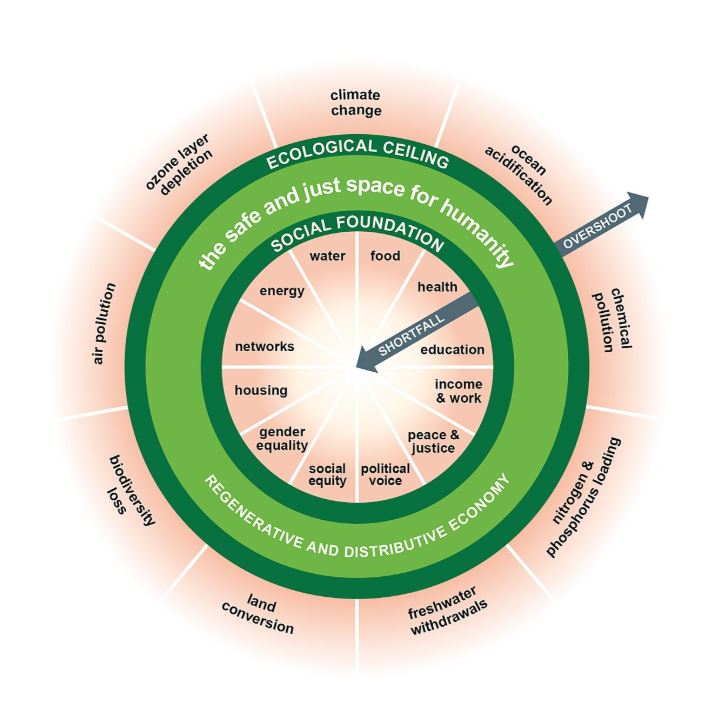
This model is one where we educate ourselves, train ourselves, to live in the green space that is sustainable, changing our overconsumption to fit, to adapt, to what we can actually afford to consume, not in terms of spending capacity, but in terms of moral, ethical and environmental boundaries.
This, of course, is again easier for the wealthy than for those already in need. That is when the state or government must step in to close that gap, providing healthcare, housing, waste management facilities, decent workspaces, education and sustainable cities (the list goes on).
Nepal has far to go. It cannot continue to ignore needful changes like education, social welfare and climate change at any level, personal or political. If you have the luxury of agency and have sleepless nights over the world going to hell in a handbasket due to carbon emissions and over-consumption, don’t behave like an ostrich and continue to go about your days hoping for the best. Change begins at home with teaching yourself and everyone around you how we can adapt to become a better, more responsible species, hopefully one that doesn’t consume, or willfully ignore, its way into extinction.
As for policy, with enough people asking for change, this government might listen. Our main problems, oft quoted, are outward migration, low investment and lack of opportunities. The behemoth in the room is the silent climate, which manifests as the absence of the call of the cuckoo bird. If we don’t listen and change, the future is bleak, and it will be too late. Just look at the horrifying event of this past week.
Pandé is a writer, art historian and filmmaker.
Sophia L Pandé
Pandé is a writer, art-historian and filmmaker advising on the economic and social potential of the Cultural and Creative Industries, Education Outreach, and Sustainable, Strategic Planning. She has consulted for IFC and UNESCO. She is Director of Development at the Kathmandu Valley Preservation Trust, and Founding Director of The Kalā Salon, a non-profit space for the arts. In the past, she has been a long-running columnist for The Kathmandu Post and the Nepali Times.




Most Read from Columns
Before you take credit for Khula Manch, read its history
Shah went to the UN to speak for Nepal, then left before he could make the most of it

Bhotekoshi flood wasn’t a freak event. It’s the Himalaya doing what it does
Lesson learned after the death of Ronaldo
Why passive neutrality won’t take Nepal anywhere
Editor's Picks

Constitutional Bench caught in seniority, ‘pick and choose’ dispute

A Dom boy’s long road to becoming a doctor

From blankets to handmade dolls, two foreign women bring comfort to flood survivors

News Analysis: When institutional defence exposes institutional fault lines

It’s a bird … it’s a plane … it’s the Indian ambassador’s farewell tweets
E-PAPER | October 16, 2026

×