



 23.63°C Kathmandu

Tue, Oct 20, 2026
Columns
The myth of compensation for wildlife-related damages
Modern conservation policies and strict wildlife protection laws have fundamentally altered the relationship between people and wildlife.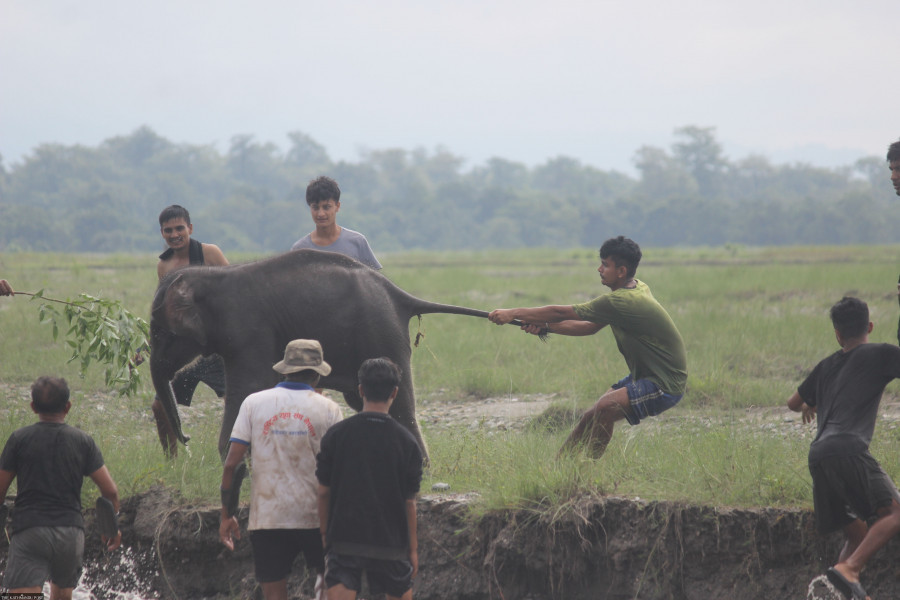
bookmark
Naya Sharma Paudel
Published at : June 23, 2026
Updated at : June 23, 2026 18:16
Dozens of MPs recently raised the issue of the monkey menace, urging immediate action. This reflects the growing pressure from farmers across the country, frustrated by monkeys stealing corn and other crops.
Farmers and people living in and around expanding forests have been putting pressure on local officials and political representatives, and organising protest rallies in search of permanent solutions to the problem. Some villages in western Nepal even quietly boycotted the last parliamentary election, expressing their frustration with the government despite repeated pleas for support.
Marauding Monkeys are not the only problem. Elephants, tigers and several other wildlife species destroy crops, livestock, property and even cause human injuries and death. Increasing animal attacks increasingly threaten human safety and make farming unprofitable, thus contributing to rural outmigration.
As communities bear a disproportionate share of conservation costs, farmers are growing mad, and anger at conservation policies is skyrocketing.
The government and conservation organisations have experimented with various mitigation measures. However, none has proven sufficiently successful or scalable to match the intensity and extent of the losses. In this context, the government and conservation organisations have promoted financial compensation for victims as a workable solution.
In 2009, the government introduced a Relief Guideline and revised it several times, most recently in 2023. Under this scheme, the government provides partial compensation for losses of crops, livestock, property and for human injury or death. However, this program has serious flaws.
Most Nepalis remain unaware of it. More importantly, the compensation process is cumbersome, slow and lengthy. Victims have to go to different offices to get reports and recommendations, furnish five to seven documents and wait for many months to receive payments. Because of the long and exhausting process to get a tiny payment, many victims do not bother to submit claims.
Unreasonable caps also limit the amount and frequency of compensation. Regardless of the actual loss, farmers cannot claim more than Rs10,000 for crop damage, and only once a year. A farmer gets a maximum of Rs 60,000 for the loss of a mature cattle or buffalo whose market value may be two to three times higher.
However, for officials, the big problem is the cost. The government can’t afford the payments. The number of claimants and the volume of claims are rising every year. In 2025, the government spent Rs136 million settling such claims. As the national budget comes under increasing strain, hundreds of thousands of claims remain pending. Officials are urging conservation organisations, local governments, buffer zone committees and community forest user groups to mobilise their own funds. Yet these resources are limited, fragmented and often short-term.
How much would Nepal need if it were to fully compensate wildlife-induced losses in the coming years?
Although there has been a surge in studies on human–wildlife conflict in recent years, Nepal still lacks systematic data on wildlife-induced losses. Anecdotal studies suggest that up to one-third of rural households are affected, with losses ranging from Rs3,000 to Rs20,000 per household per year. The cost of property damage caused by elephants or losses associated with human injury may exceed this range. Even a rough estimate would place the total loss at well over tens of billions of rupees annually, and the amount is increasing every year. Can the government realistically afford to pay this? Shouldn’t that money go to schools and hospitals?
Officials have called for alternative financing mechanisms that meet the scale and are sustainable. Participants at a 2025 workshop in Kathmandu floated ideas such as wildlife or landscape bonds, wildlife sponsorship, ecolabelling fees and insurance schemes. However, many of these innovative ideas face serious practical and institutional challenges and have hardly progressed beyond discussion.
In this context, the key question is whether financial compensation is truly a workable solution to wildlife-induced losses. Are there other agencies or organisations willing to support the government in addressing this challenge?
We know that the Nepal government is not alone in wildlife conservation. There is strong global interest in conserving biodiversity. As one senior government official remarked, Nepal does not protect tigers solely for its own national interest. As part of the global community, Nepal has made commitments to protect environmental goods of international value.
If the international community wants to protect wildlife, is it fully aware of the costs involved? Are international conservation agencies and their funders prepared to share the direct and indirect costs of conservation?
Throughout the history of modern conservation in Nepal and elsewhere, poor and vulnerable Indigenous peoples and local communities have borne the greatest costs of conservation. For communities living alongside wildlife, conservation often means watching months of hard work disappear overnight as monkeys raid fields, tigers kill buffalo, and encounters with elephant leave people injured or dead.
The paradox is striking: The world wants more tigers but is unwilling to finance the costs of coexistence. While conservation achievements are celebrated internationally, the farmers and rural families who bear the economic losses and safety risks receive little meaningful support.
The reality is uncomfortable but undeniable. The government does not possess capacity to pay the rapidly growing costs of wildlife damage, and the international community is hardly prepared to bridge the gap. Yet compensation remains the dominant policy prescription.
Paying compensation to only a small fraction of victims, and at amounts far below their actual losses, has created a profound sense of injustice among those most affected. Additionally, it has diverted public attention away from the deeper questions of governance and justice that lie at the heart of biodiversity conservation. Who sets the conservation agenda? Who decides what should be protected and how? And who bears the costs and reaps the benefits?
Modern conservation policies and strict wildlife protection laws have fundamentally altered the relationship between people and wildlife. By denying local communities the right to protect their lives and livelihoods, the state has transformed them from active resource users into powerless claimants, dependent on compensation for losses inflicted in the name of conservation.
Until we confront these issues, compensation will remain less a solution than a convenient myth—one that masks the true costs of conservation while leaving rural communities to shoulder them alone.
Naya Sharma Paudel
Paudel is a visiting fellow at the University of Kent in the UK.





Most Read from Columns




Editor's Picks




E-PAPER | October 20, 2026

×