



 23.73°C Kathmandu
Sun, Oct 18, 2026
Columns
This isn’t about the border—it’s about fear
Do we want to build a Nepal where freedom is curtailed in the name of security?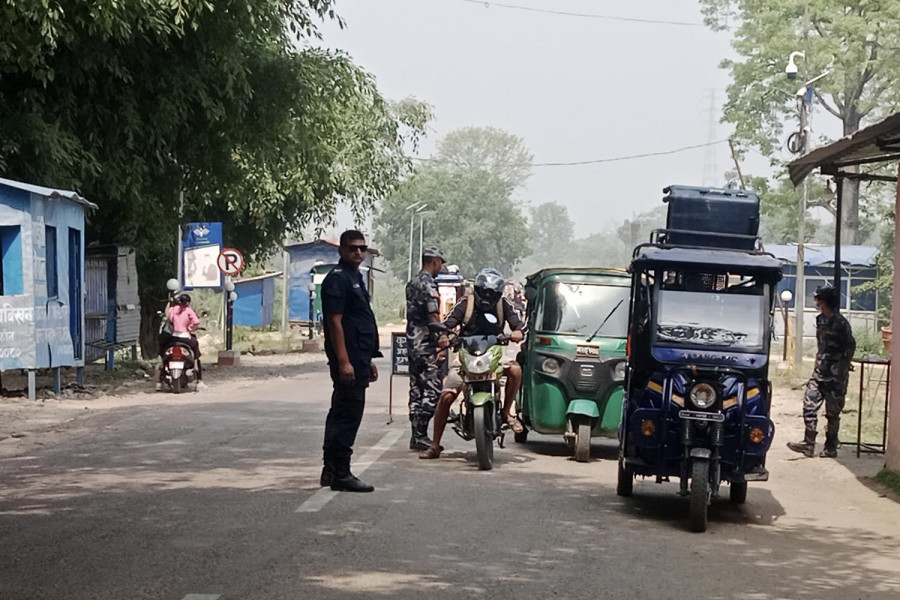
bookmark
Chandrakishore
Published at : April 20, 2026
Updated at : April 21, 2026 06:37
The government of Nepal’s decision to make it mandatory to pay customs duty on goods worth more than Rs100 brought through land routes from India may appear sudden and unexpected. But this is not merely a story about the border. This is a story of the politics of fear. The story of a state that has begun to fear its own citizens. This is not just a policy change. This is the decline of priorities.
The open Nepal-India border, once kept alive by relationships, roti (employment opportunities) and everyday life, has today become a ‘threat’ in the eyes of those in power. And when the state starts seeing its own people as a threat, it understands that the problem lies not at the border but in governance itself.
In Nepal, the priorities of the state often reveal its deepest fears. And these days, its biggest fear is the border. Increasing surveillance on the international border, expanding the security apparatus and turning the border geography into an almost militarised zone—these are but symptoms of a deep-seated mindset. The same mindset became more institutionalised after the 2015 Madhesh Movement, in which dialogue was replaced by control and participation was replaced by suspicion.
In addition to barbed wires or walls, this border has always been defined not by barbed wires or walls, but by trust, tradition and coexistence. It was bound by the footsteps of those who crossed it every day, without passports, without fear, without suspicion. Who does strict border control actually hurt? Not the rich. Not those with resources. It directly hurts the common person who has no alternatives. And this is the real face of this policy. It is an expansion of inequality. What we need today is ‘Border Justice’. That is why the demand for border restrictions is often made by the very class that never has to face those restrictions themselves.
The Tarai region, once called the ‘granary’ of Nepal, has today become a symbol of deep irony. Where government agricultural centres once conducted research, produced knowledge and nurtured possibilities for agro-based industries, there is now a permanent presence of security forces. This change is as symbolic as it is physical, with surveillance replacing knowledge, control replacing production, and security replacing development. This is a mirror of the state’s character. Where surveillance takes the place of knowledge, development dies.
This raises a fundamental question: What is the priority of the state? Does it want to empower farmers and workers, or does it want to view them with suspicion? In recent years, it has become clear that instead of making qualitative improvements in basic sectors like public education and health, increasing the number of security forces is considered more important. This is an imbalance of resources. It is a retreat from the responsibility of improving the lives of people living in border areas.
This border is not merely geography, it is a living stream of history, culture and human relationships. It has created a unique bond between the people of both countries. Here, movement holds economic as well as social and cultural necessity. The irony is that every debate related to this border is often narrowed down and dismissed as ‘the Madhesh problem’. This is a dangerous approach because it simplifies the issue and ignores its broader national dimensions. The border with India is not only Madhesh’s border; it is the border of the entire Nepal, and its benefits also reach the entire country.
History bears witness that policies related to the border directly affect the people of the border regions. During the Panchayat era, after Harka Gurung’s report, the political consciousness and discontent that emerged in Madhesh gave a new dimension to the politics of identity. It teaches us that whenever the state views border areas only through an administrative lens and ignores the emotions and needs of the people there, the result is discontent and conflict.
The Covid-19 period exposed this reality even more starkly. When the border was closed, the first to suffer were those who were already on the margins. Hunger defeated the law, and necessity defeated the border. People continued to cross through forests and rivers because the hunger in the belly does not respect any sovereignty.
The biggest truth of the open border is not only cultural or historical, but also a living economic system, which we can call ‘grassroots globalisation’. But it would be a mistake to see it merely as an academic term. This is not just a theory; it is everyday life. It is where local economies breathe even without any formal structure. But instead of understanding this vibrant system, the state is busy trying to control it. In doing so, it also limits the possibilities of its own people. The question should be, “How alive is the border?”
Today, we need ‘border security’ as urgently as ‘border governance’. It is important to understand this difference. The meaning of security should not be limited to surveillance and control. It should mean that people in border areas can live secure, dignified and prosperous lives. Border governance means promoting economic activities, respecting people’s dignity and connecting them to the mainstream of development—viewing the border as an opportunity.
If the open border between Nepal and India is managed sensitively and inclusively, it can become the backbone of peace, security and prosperity for both countries. For this, policymaking must be sensitive, and the voices of people from border areas must be included in the decision-making process.
The border is not just a line on a map; it is people’s lives. When this life is ignored, policies fail. This distance makes policies inhumane. Because a power that does not understand the land cannot understand its people either. The essence of democracy is accountability, and this accountability cannot be limited only to the capital. Citizens of border areas are as important as those in Kathmandu. Their dignity, their rights and their future, all of these are the responsibility of the state.
The open Nepal-India border is not a weakness. It is a strength. The world can learn from this model that borders can be bridges. This border is an emotion, and it exists not only between two countries, but also between people’s hearts. And till the time these hearts are connected, no border can truly be closed.
Ultimately, the question boils down not just to the border regulations but to the character of the state. Do we want to build a Nepal where freedom is curtailed in the name of security? Or a Nepal where both borders and possibilities remain open? The answer is for us to decide. Because the border is not just geography—it is a mirror of our democracy.
Chandrakishore
The author is a veteran journalist.



Most Read from Columns
Before you take credit for Khula Manch, read its history
Shah went to the UN to speak for Nepal, then left before he could make the most of it

Bhotekoshi flood wasn’t a freak event. It’s the Himalaya doing what it does
Lesson learned after the death of Ronaldo
Why passive neutrality won’t take Nepal anywhere
Editor's Picks

Dashain paints the country in festive colours
Buying a goat for Dashain? Look for the green mark

Explained: Why does an hour long flight to Dhangadhi cost more than a flight to New Delhi?
Bhotekoshi flood wasn’t a freak event. It’s the Himalaya doing what it does

How Tenzing Sherpa became Nepal’s breakout star at the Asian Games
E-PAPER | October 18, 2026

×