



 14.83°C Kathmandu

Sun, Oct 18, 2026
Columns
Open-air burning is choking our cities. It’s time to tackle it
People must be educated about the harm caused by open-air burning to themselves and others.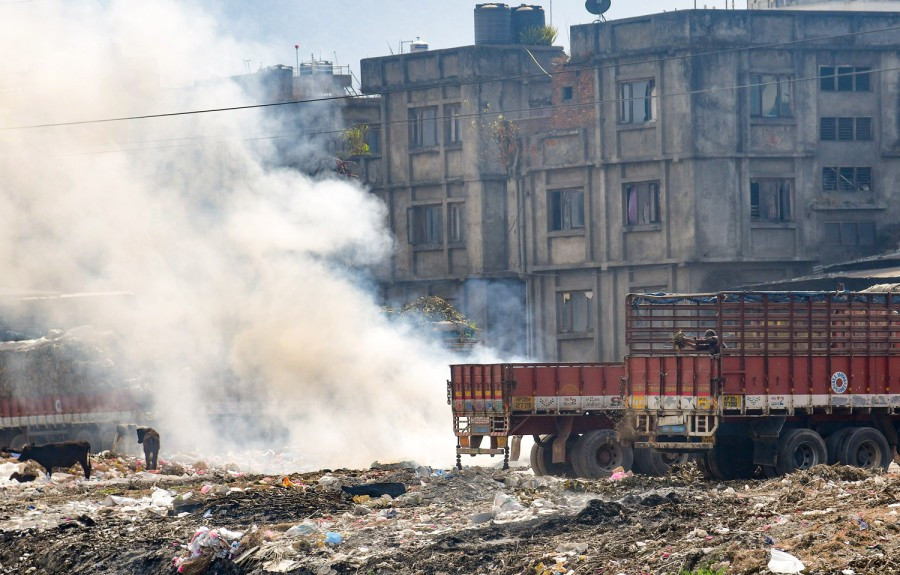
bookmark
Sophia L Pandé
Published at : April 17, 2026
Updated at : April 17, 2026 17:17
Bad air is now a problem in every major city in Nepal. For those of us living here, it is a disastrous aspect of our daily lives. It is sickening the pregnant, the young, the old and everyone in-between by the minute. For tourism, it is a death knell. The lofty plans to keep people in the Valley for cultural tourism longer than the token day or two before heading for trekking will fail categorically due to the unbreathable air.
We need not look far to understand the extent to which bad air affects our environment and how its impact extends beyond environmental concerns. Take Lumbini, where the air quality is appalling. While the recent Supreme Court decision to ban industries 15 kilometres around the Lumbini UNESCO World Heritage Site is necessary for health, tourism and cultural preservation, it is still deeply problematic in terms of how to reconcile the closing and relocation of industries with loss of livelihood and revenue at a time when GDP is projected to slow to an alarming 2.3 percent this year (down from 4.6 percent in 2025), showing how multi-faceted and complex it is to solve the problem of clean air.
With the previous governments, the case seemed hopeless; no one seemed to care despite the dire articles in newspapers and daily, firsthand exposure. Even with a new, potentially dynamic government, there is a real danger with the sluggish economy, the risk of inflation thanks to the war in Iran, jump-starting industry, and millions of other high-priority obligations, that this crucial ‘right to clean air’ will be ignored, only to get worse and worse with public and private apathy.
It is clear that industry and vehicular emissions, forest fires, agricultural crop residue burning, along with construction dust, and spillover of all the aforementioned from the Indo-Gangetic Plain affects air quality, but what is surprisingly under-reported is another, major, aspect of urban air pollution: The alarming trend of open-air burning of waste from households as well as workshops and factories.
This tendency, while always around on a smaller scale, emerged in force, at least in the Kathmandu Valley, when garbage collection had come to a standstill from 2021-22 due to disputes with the Sisdol community in the Kakani area, where our rubbish was being dumped without a care for the residents who lived nearby.
During that time, the thrifty residents of this Valley, rich and poor, realised that they could simply dispose of their waste by burning it outside their homes, either in their gardens or in empty plots of land. Organic waste, along with plastic and rubber effluence, is burned at close quarters to people despite the eye-watering toxicity that ought to signal the danger of setting such chemical compounds alight.
The Kathmandu Metropolitan City and other metropolitan cities do have fines in place for open-air burning, but the indifferent ward adakshyas have not pursued enforcement, and many neighbours seem equally passive, choosing to turn a blind eye rather than engage in community welfare. In late 2025, Balendra Shah’s mayorship raised the fine to Rs10,000 per offence for those who were caught burning their rubbish, but to date, that does not seem to have deterred most.
Unfortunately, by now, this awful practice has spread exponentially, coming into our windows from anywhere and everywhere, making it impossible to pinpoint without the help of a drone. This kind of burning happens at all times, but particularly at night when there is no chance anyone will come to irately knock on the door, or issue a fine, explaining the acrid air at nighttime when very few vehicles ply the streets and industries are closed.
However, it is exactly this particular kind of burning that can be quickly and efficiently ended with a multi-pronged, intersectoral approach. With properly worded, urgent Public Service Announcements (PSAs) on radio, television, mobile phones (via text messages) and social media, people can be educated on the harm they are doing to themselves and others. Ward offices can use travelling loudspeakers in neighbourhoods, door-to-door leaflet distribution to educate the public, and the strict enforcement of fines by authorities can serve as a deterrent to those who persist.
Alongside these activities, with what we hope is a forward thinking government in place, we have a golden opportunity to reform our dry, Science, Technology, Engineering, Mathematics (STEM) oriented, education system, adding in, among other humanities, modules on civics, teaching children in schools starting at the primary level about garbage segregation and proper disposal of waste, how open-air burning adds to climate change, and many other much needed universal principles.
That such vital fundamentals are already not taught in schools is a tragic missed opportunity. These critical teachings could have been introduced into the education system years ago. Today, we could already be enjoying clean air and the blanket benefits of generations of people, particularly youth, who understand the responsibilities that come with being a citizen.
While we have had cause to complain about bad governance, we have played our part in harming our own environments with our cavalier behaviour, driving erratically, abusing those who point out our traffic violations, not sorting our garbage, burning it instead of paying for it to be picked up, littering, throwing plastic into rivers and the heinous trolling, particularly of women and vulnerable youth, on social media. Much of this is a lack of education, but much is simply careless, inconsiderate behaviour. The chance to educate school-going children and civilians about clean air can become a much-needed provision to teach us Nepalis about civic duty and community.
Anyone who has ever tackled a chronic, difficult problem from end to end knows that it takes years to solve, and years of monitoring, evaluation and evolution to sustain. With stern government directives, coming from the top but enacted at a local level, incorporation into school curricula, much-needed training for civil servants and teachers, proper allocation of national and ward level funds, along with genuine civil and political will, this can be a solvable problem.
That it hasn’t already been tackled while we are all quietly dying, politician and civilian alike, shows the utter lack of care for anything aside from enriching oneself. This is the time for long-awaited change. It is absolutely possible. If we start today, we could have cleaner air within the next few months, alongside more jagaruk citizens. It is in the hands of this new government, and also, in our own hands. After reading this, will you make sure you are segregating your waste and not burning it? I sincerely hope so. Change begins with us.
Sophia L Pandé
Pandé is a writer, art-historian and filmmaker advising on the economic and social potential of the Cultural and Creative Industries, Education Outreach, and Sustainable, Strategic Planning. She has consulted for IFC and UNESCO. She is Director of Development at the Kathmandu Valley Preservation Trust, and Founding Director of The Kalā Salon, a non-profit space for the arts. In the past, she has been a long-running columnist for The Kathmandu Post and the Nepali Times.



Most Read from Columns
Before you take credit for Khula Manch, read its history
Shah went to the UN to speak for Nepal, then left before he could make the most of it

Bhotekoshi flood wasn’t a freak event. It’s the Himalaya doing what it does
Lesson learned after the death of Ronaldo
Why passive neutrality won’t take Nepal anywhere
Editor's Picks

Dashain paints the country in festive colours

Buying a goat for Dashain? Look for the green mark

Explained: Why does an hour long flight to Dhangadhi cost more than a flight to New Delhi?
Bhotekoshi flood wasn’t a freak event. It’s the Himalaya doing what it does

How Tenzing Sherpa became Nepal’s breakout star at the Asian Games
E-PAPER | October 18, 2026

×