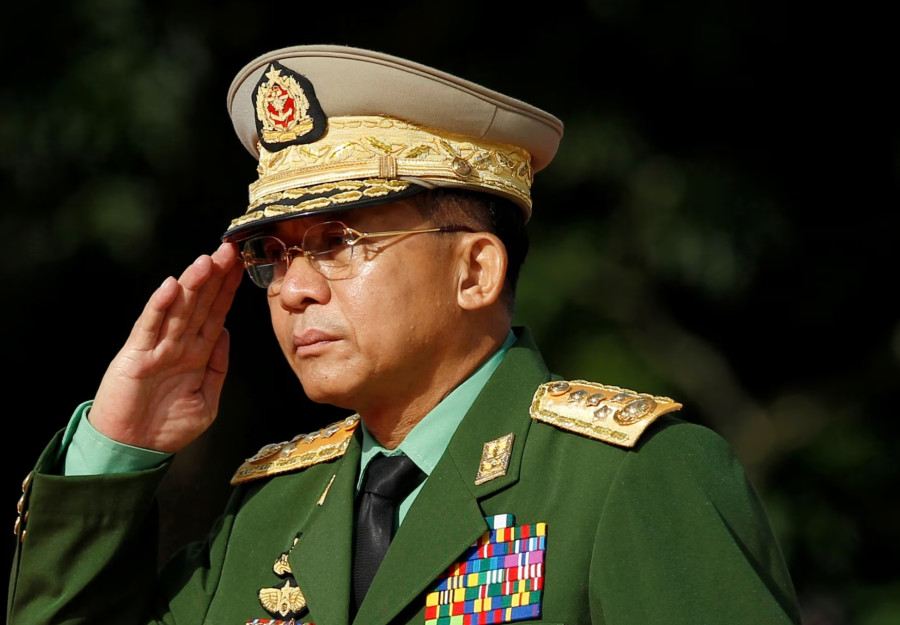
On April 3, Min Aung Hlaing, the former Commander-in-Chief of Myanmar who had removed Aung San Suu Kyi in the February 2021 coup, was elected by the Myanmar Parliament as its 11th President after relinquishing his post as Commander-in-Chief, as required by the 2008 Myanmar constitution. The two runner-ups for the presidency, former Prime Minister Nyunt Su and Union Solidarity and Development Party (USDP) Chair for Karen State Nang Ni Ni Aye, were appointed as vice presidents.
The country held its first election after the coup in three phases in December and January. In this election, the pro-military USDP won 339 seats, while Suu Kyi’s party, the National League for Democracy (NLD), was dissolved and banned from participating. In 65 areas, elections could not be held, and 78 seats remain vacant. The election to the Parliament saw nine countries participating as observers, which was largely perceived as the junta’s bid to acquire legitimacy through an election. Both India and China supported this election.
Military’s dominance continues
Prior to his elevation as President of Myanmar, Gen Hlaing had reshuffled the armed forces by appointing his long-time aide and former Intelligence Bureau chief, Ye Win Oo, as Commander of the Armed Forces. The military retains substantial control in Parliament, with 25 percent of seats reserved for serving military officers in both the Houses of the national parliament and local administrative structures. The Supreme Commander of the Tatmadaw, as the Myanmar Armed Forces is known, is an extremely powerful position in Myanmar. The Commander appoints defence, interior and border affairs ministers from the Military, a move that further consolidates the army’s dominance in politics, giving it a major say in the peace process and ceasefire with Ethnic Armed Organisations that are fighting the junta for a federal structure with a federal army.
In February, a new five-member Union Consultative Council with a chairperson and a secretary was established. It enjoys a wide range of power to advise on security and foreign affairs, legislative issues and matters pertaining to the peace process. The President will appoint members of this Council and define their duties and power. It is speculated that this Council will empower the President to exercise control. Already, all of the state and regional chief minister posts have been filled with President Hlaing’s loyalists.
According to the 2008 Myanmar constitution, the Commander-in-Chief enjoys enormous power. With General Hlaing as President, it would be easier for him to exercise his authority through this Council to determine the direction of the country’s foreign affairs and how the country deals with the challenges posed by diverse ethnic groups, some of whom are fighting the Tatmadaw. He would perhaps be more powerful than the Commander-in-Chief in the current administrative structure, even though constitutionally the new Commander, General Oo, will enjoy autonomy from any control by Parliament or even the President.
Challenges for neighbours
The Ethnic Armed groups will likely pose a severe challenge to the military-backed regime in Myanmar as peace remains fragile. The mineral deposits in Myanmar are controlled by the ethnic armed groups, especially the Kachin Independence Army in the Kachin state. Recent arrests of six Ukrainians and an American in India also show that the armed groups are developing linkages and are being trained in drone technology to fight the Tatmadaw. The Government of Mizoram, an Indian state that borders Myanmar and shares ethno-cultural linkages, stated that 2,000 visitors from Western countries visited Mizoram between June and December 2024. Russia has been the main supplier of weapons to Myanmar.
Countries bordering Myanmar do not want the conflict to spill over across the border, sucking them into the internal troubles. Bangladesh is already saddled with a million refugees, and it is unlikely that the problem will be resolved soon, as the Arakan Army controls the Rakhine State. The Myanmar state does not want the Rohingyas to return as it considers them migrants, and the refugees living in Bangladesh do not want to return unless they are assured the safety of life and changes in provisions of the constitution that render them aliens in their own country.
Moreover, Thailand, which shares the longest border with Myanmar, is affected by the instability and flow of refugees. Yet it does not adopt an isolationist approach and engages with Myanmar. ASEAN five-point consensus formula has not helped in forcing the military regime to adhere to the envisioned road map. Each of Myanmar’s neighbours realises the strategic cost of domestic instability and has engaged the regime to protect their interests. In fact, China negotiated with ethnic groups to bring peace in the northern part of the country, even if it remains tenuous at its best.
Minister of State for External Affairs of India, Kirti Vardhan Singh, is visiting Myanmar on April 8 for two days and will hold talks with the new government on bilateral issues. He is also expected to attend the inauguration of the Presidency on April 10 in Nay Pyi Taw. When General Hlaing was the Commander of Myanmar’s military, he visited India thrice, and New Delhi has developed robust security ties that helped in dealing with the challenges posed by the North East insurgents. It is unlikely that India will take any position against the present regime that would undermine its vital security and economic interests. India, a votary of democracy in Myanmar, has taken a pragmatic position since 1990s and has pushed forward connectivity projects for greater port access for the North Eastern region through the Sittwe port.
The National Unity Government, which is the government in exile in Myanmar, remains fractured and does not have a clear road map for the return of democracy in Myanmar. The Ethnic Armed Organisation is busy in consolidating power in pockets dominated by respective ethnic groups. The people at large in Myanmar aspire for the return of multiparty democracy, which, for the time being, appears to be a distant dream. Only time will tell whether the Myanmarese political leaders living in exile will leverage their sentiment to pose any challenge to the current regime.




 14.77°C Kathmandu
.PNG&w=200&height=120)