As trite as it might sound, there is no festival more passionately followed in India as elections. With the Election Commission announcing poll dates in four states (Assam, West Bengal, Kerala and Tamil Nadu) and one Union Territory (Puducherry), it is time for yet another round of that grand event.
Earlier this week, the poll body announced that elections in the five states/Union Territories would begin on April 9, with the results set to be declared on May 9.
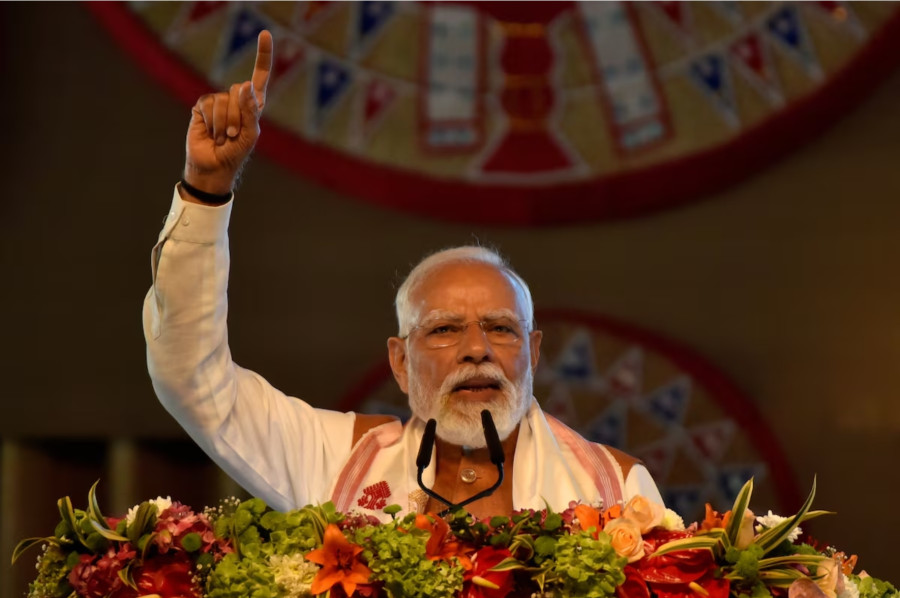
There is much at stake in all elections, but in this leg, the Opposition is the real story, being in power in three of the four states. The big question is to what extent it will be able to stop the ruling Bharatiya Janata Party (BJP) from expanding its national footprint, especially given that none of these four states are traditional BJP bastions. The BJP has built its national cult not just by reinforcing its presence in its established strongholds, but also by spreading its wings in earlier unchartered territories.
Thus, while these elections revolve more around the Opposition and its ability to convincingly hold on to its turf, it isn’t that there is no story from the BJP’s perspective. Here is what is at stake for the ruling party in each of these four poll-bound states.
Assam
This is a state where the politics for several decades revolved around ethnicity. The divide was on ethnic and linguistic lines, with the boundary clearly drawn between the indigenous Assamese and the ‘outsider’. In a way, the turf was never quite a natural BJP bastion, a party that has primarily been an upper-caste Hindu party with aggressive Hindutva ideology.
Despite the dissonance, however, the BJP managed not just to capture the state but also to decisively emerge as a near-displaceable force. The party, under Chief Minister Himanta Biswa Sarma, has diverted the state’s politics to represent an extremely brash and brazen form of communal rhetoric, replacing the ethnic concept of ‘outsider’ with a religious one.
While the party remains an extremely formidable force, and the Congress betrays disarray within its ranks, what is crucial for the BJP and especially for chief minister Sarma, is to ensure that its primary rival shows no sign of revival.
The ruling party put all its might in ensuring a poor Congress show in the state in the 2024 elections but was unable to prevent three of the party’s tallest leaders in the state from winning their seats, especially state party president Gaurav Gogoi, who stormed through a rather difficult constituency. Despite an otherwise poor show, this was a boost for the Congress and an embarrassment for the BJP.
Sarma and the party, therefore, would want to ensure the Congress is not only defeated but also decimated.
West Bengal
This is perhaps the most keenly watched battle, with the feisty Chief Minister Mamata Banerjee never afraid to take Prime Minister Narendra Modi’s BJP head on. Bengal is yet another state that wasn’t BJP’s traditional base, but the party under the Modi-Amit Shah combine has successfully managed to capture substantive ground and emerge as the principal opposition party. Ruled by the Left front for three decades, this shift towards the right-wing BJP is both marked and telling.
Despite these gains, victory, however, has remained elusive. Banerjee has successfully thwarted all attempts by the BJP to wrestle the state away from her and despite Modi-Shah’s best efforts to unseat her, has managed to keep an iron grip over her throne.
For a party and leadership that refuse to rest till they grab power, either through fair election wins or post-election Machiavellian tactics, the inability to unseat the hugely popular Banerjee has been a sore point. In its carefully curated bouquet of wins, West Bengal is perhaps the most conspicuous miss.
What makes it worse is that Banerjee has been in power now for three consecutive terms, and that is ample time for a rival to build momentum against the ruling dispensation.
The BJP, therefore, would by now be desperate to defeat Banerjee and capture a state it has eyed for so long, or in the very least, put up a fight formidable enough to rattle the chief minister.
Tamil Nadu and Kerala
The reason I club these states together for the purpose of this piece is that these are the only two southern states that have very decisively kept the BJP at bay. The others—Karnataka, Telangana and Andhra Pradesh have opened their doors to the party, which has scripted its national rise by expanding its base in these previously unexplored regions. However, Tamil Nadu and Kerala have been two prominent exceptions to these trends, and not for the lack of effort by Modi-Shah’s juggernaut.
Kerala has a largely bipolar polity, with the Left Democratic Front and the Congress-led United Democratic Front the traditional arch-rivals. Despite its best push, the BJP has failed to make any significant electoral gains in the state, with Congress leader Shashi Tharoor even dismissing the BJP as a “zero-seat party” in the state.
On its part, the BJP is vigorously trying to establish itself as a significant player in the state, placing technocrat leader Rajeev Chandrasekar as in-charge and playing to the gallery with decisions like renaming the state to Keralam.
The BJP story has been similar but not the same in Tamil Nadu. In the state, where politics has been dominated and driven by the Dravidian movement, the BJP is not a natural fit. The party has managed to extract something from the state by its alliance with the AIADMK, the other biggest party besides the ruling DMK. However, on its own, it has zero presence in the state, and neither the Modi factor nor the Shah electioneering brain has cut any ice with its electorate.
What makes these two states crucial for the BJP is not the improbable idea of winning anytime in the near future, but using these as grounds to expand presence so as to have some buffer when its traditional bases waver. Assam, Tripura and Telangana are among examples of some states with zero history of BJP politics but where the party has managed to make sizeable inroads, albeit in vastly different degrees, on its own merit. Therefore, creeping its way into untouched areas is not unheard of for this Modi-Shah-led regime, and in a way, these two southern states remain perhaps among the only states to have remained so much outside the BJP’s reach.
These state elections revolve significantly around non-BJP players, but for a party that treats each election as war, and puts power ahead of all else, there is no battle at the hustings where it doesn’t have more than enough at stake.




 19.89°C Kathmandu
.PNG&w=200&height=120)