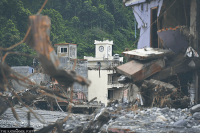
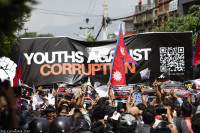
A few protestors of the TikTok generation first floated the name of Sushila Karki for prime minister while the Singha Durbar burned. Her supporters, coordinating on Discord, quickly rallied behind the proposal. As the state struggled to contain the devastating Fall Protests of 2025, the Nepal Army reportedly signalled that it would not oppose a non-partisan caretaker, and President Ramchandra Paudel moved with unusual speed: He appointed Karki as an interim prime minister charged with steering the country towards fresh elections.
The choice was extraordinary and extra-constitutional. Karki was not a member of the Pratinidhi Sabha, a basic requirement under the 2015 constitution for anyone seeking the premiership. More importantly, having served as Chief Justice, she fell under a constitutional prohibition intended to keep former judges out of political office. Yet the crisis had created a vacuum large enough for legality to blur into necessity.
It was, therefore, little surprise that one of her first acts after taking the oath of office was to recommend the dissolution of the lower house—a chamber that, had it remained intact, could have immediately challenged the legitimacy of her appointment. In a nation reeling from violence, upheaval, and the breakdown of governance, Karki’s sudden ascent captured both the desperation of the moment and the fragility of Nepal’s constitutional order. Since then, the government has continued to operate much as it was born—need-based, ad hoc, and at times almost arbitrarily.
In one of its earliest—and most perplexing—moves, the government ordered the recall of 11 ambassadors appointed by its predecessor. The Supreme Court quickly intervened, issuing an interim order to block the decision. The government pressed ahead anyway, choosing defiance over legality. A few of the recalled envoys have since resigned; others now sit in limbo, assigned a room inside the Foreign Ministry where they must sign in and wait for their taskless ordeal to end. What is even worse, the episode violated the basic tenet that continuity in foreign policy is a cornerstone of stable governance. It has come to epitomise a state machinery functioning in an improvised, arbitrary and increasingly law-averse manner.
As confusion reigns in both domestic and foreign policy, Nepal may soon face an international challenge of far greater consequence: Contestations over the reincarnation of Avalokiteshvara as the next Dalai Lama. It is possible that the Dalai Lama has quietly extended congratulations to previous Nepali prime ministers. If so, such gestures never reached the headlines—perhaps by design. Kathmandu may have preferred to avoid provoking Beijing, and Dharamsala may have judged public messages too delicate for Nepal’s political climate.
This time, however, there was no such caution. The Office of His Holiness the Dalai Lama wrote promptly to congratulate Premier Karki on her appointment. Nepali media carried the news as a banner headline. And then came what many found most striking: The silence of the usually vocal Embassy of the People’s Republic of China in Kathmandu—an absence that felt louder than any protest.
Himalayan dilemma
The Dalai Lama, Panchen Lama and Karmapa are among the most prominent figures in Tibetan Buddhism, though their influence varies across schools and historical periods. The Dalai Lama leads the Gelug school and has historically served as both the spiritual and temporal ruler of the Tibetan people, combining religious authority with the power of governance. The Panchen Lama, regarded as an emanation of Amitabha, holds high spiritual authority within the Gelug tradition, while the Karmapa heads the Karma Kagyu school, with succession largely managed within that lineage.
In 1959, the 14th Dalai Lama fled Tibet following a failed uprising against Chinese rule. He established the Tibetan government in exile at Dharamsala, India, along with tens of thousands of refugees. For decades, he sometimes suggested that he might be the last in his line, reflecting the uncertainty and risk under Chinese control. However, in 2025, he declared that his successor would be born outside China, in the ‘free world’, to ensure the continuation of his spiritual and political mission. This stance directly challenges the atheist regime in Beijing, which asserts that only a candidate born within Tibetan territories may be recognised as the Dalai Lama, and claims authority over the recognition process.
The Dalai Lama’s decision has transformed what was once a primarily religious succession into a significant geopolitical flashpoint. With Tibet under tight Chinese control, any effort to identify his reincarnation outside China carries implications for regional diplomacy, India’s security considerations, and the broader balance of influence in South and Central Asia. Countries such as Nepal, with historically close ties to both the Tibetan people and the Chinese government and currently facing fragile governance and uncertain foreign policy, may find themselves drawn into these disputes, potentially becoming arenas where spiritual authority, nationalist sentiment and great-power politics intersect.
The Tibetan Panchen Lama, recognised by the Dalai Lama, disappeared after being detained by Chinese authorities, while the Beijing-appointed Panchen Lama has failed to gain recognition from the Central Tibetan Administration. Similarly, there are two claimants to the Karmapa title—one once backed by Beijing but now in Dharamshala and another in New Delhi. In a similar vein, should the two Dalai Lamas, each supported by opposing religious and political authorities, emerge simultaneously, the resulting disputes are likely to be far more intense than the already contentious controversies surrounding the Panchen Lama or the Karmapa.
Geopolitical crossfire
In this delicate Himalayan theatre, Nepal finds itself both a spectator and a potential participant. The nation’s fragile governance and ad hoc policymaking—exemplified by the extra-constitutional appointment of Karki and the arbitrary handling of foreign envoys—leave it ill-prepared to navigate the coming storm.
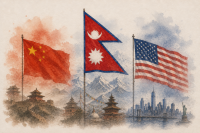
India, as host of the Dalai Lama’s government-in-exile, watches closely; any disruption on its northern border carries strategic consequences. Beijing, with its insistence on controlling the recognition of the next Dalai Lama, is equally alert, and its silence in Kathmandu is less a concession than a calculated pause. Washington, ever attentive to the balance of power in South Asia, perceives both opportunity and risk on this Himalayan chessboard.
For Nepal, the stakes are stark. Missteps could embroil it in confrontation with global and regional powers, undermine its diplomatic manoeuvrability, and invite intense scrutiny from both Beijing and New Delhi. What happens if the Central Tibetan Administration identifies the next Dalai Lama from Arunachal Pradesh, Bhutan, Sikkim, Ladakh, Nepal, or among exiled Tibetans anywhere in India, while Beijing appoints a candidate from the Tibet Autonomous Region? The succession is no longer merely a religious matter; it has become a geopolitical flashpoint.
The scheduled election for the new Pratinidhi Sabha is likely to acquire a geopolitical dimension. The closeness of ethnonationalist chieftain Khadga Prasad Sharma Oli to Beijing through his endorsement of Xi Jinping Thought is well-known. Will international supporters of the Tibetan government-in-exile also become active? In either scenario, Sharma Oli’s participation in Beijing’s victory day military parade has placed Nepal in an unenviable position, highlighting just how intertwined domestic politics and geopolitics have become in the Himalayan region.




 19.73°C Kathmandu