



 15.74°C Kathmandu
Mon, Oct 26, 2026
Columns
Paradox of Nepal’s democratic success
Nepalis have the freedom to choose, speak and migrate, but rarely the ability to prosper at home.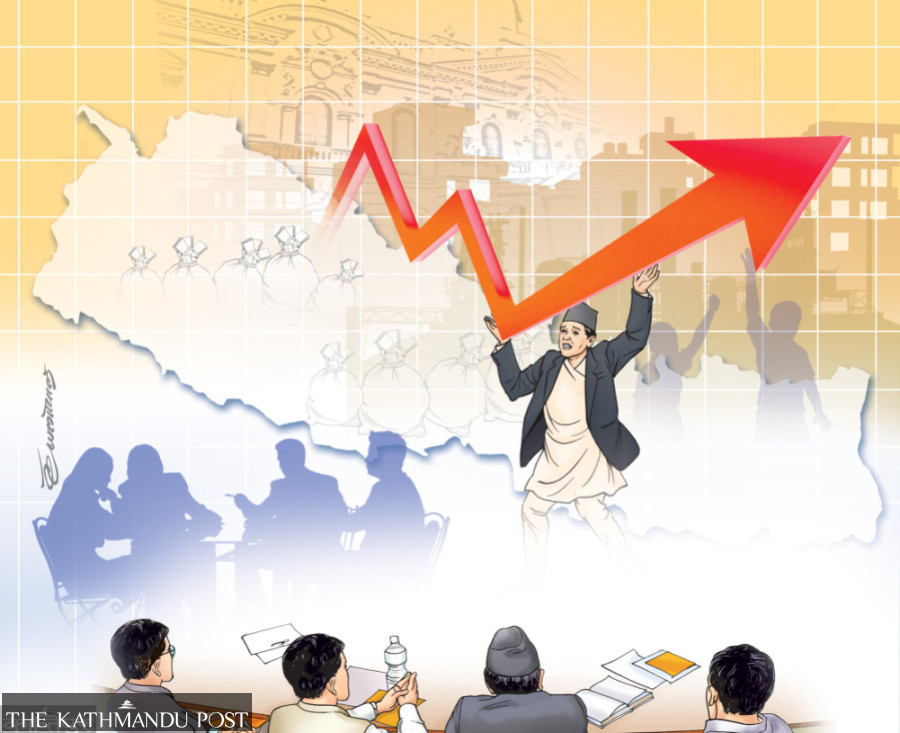
bookmark
Urja Singh Thapa
Published at : December 1, 2025
Updated at : December 1, 2025 07:22
Nepal is inadvertently democratic. According to the 2024 World Justice Project Rule of Law Index, Nepal ranks first out of six South Asian countries for rule of law, ahead of India, Sri Lanka, Bangladesh, Pakistan and Afghanistan. It ranks 48th globally in terms of constraints on government powers. Press freedom ranks 76th as of 2022, compared to 120th in 2014. Nepal has successfully transitioned from monarchy to federal democratic republic, held multiple rounds of free and fair elections under its 2015 constitution and maintained civilian rule. By these democratic metrics, it reflects a genuine transformation.
On the other hand, Nepal is conspicuously struggling economically. The country ranks 101st out of 197 economies in total GDP and 164th in GDP per capita at just $1,447 per person. On the Global Innovation Index, Nepal places 107th out of 139 economies. Here lies the paradox: How can a democratic country be so economically paralysed? Leading South Asia in rule of law and democratic institutions, yet lagging dramatically in economic performance? For a young Nepali, this implies a freedom to choose, speak and migrate but rarely to prosper at home.
Too many hands, too little pie
Consider economic growth a pie. Nepal’s politics has primarily focused on dividing the pie rather than making it bigger. Every political actor, from the federal to the local level, wants a share. This impulse to divide is not without merit. Nepal’s past is checkered by deep social, regional and caste-based exclusion, and democracy rightly sought to correct those imbalances. However, these challenges have evolved.
The central question is no longer simply who gets a slice, but how to bake a larger pie that everyone can share. From an economic standpoint, it is a graduation from a redistributive equilibrium where political competition revolves around how to divide limited resources to a growth theory where long-run prosperity depends on investments that enhance human capital, innovation and total factor productivity. The delicate balance lies in ensuring inclusion while simultaneously fostering economic growth.
How to bake the pie
Baking a pie in a kitchen with 10 different cooks, each with their own tastes, recipes and priorities, is not easy. Nepal’s federal system, while designed to be inclusive, often replicates this challenge: Multiple levels of government compete for authority and resources, while each political party, region and community has its own agenda. None is concerned about making a bigger pie. And it doesn’t help to be surrounded by economic ‘Michelin-star kitchens”. So what is the recipe?
Technocratic approach to growth
Nepal now needs a sober, technocratic approach: Put aside identity politics and focus squarely on economic welfare. Democracy gave citizens the freedom to speak, vote and organise, but freedom alone cannot feed a nation. The next challenge is to align incentives, streamline governance and invest in sectors where Nepal holds a real comparative advantage.
Bangladesh offers a lesson: In 1990, its GDP per capita was comparable to Nepal’s. Today it’s nearly double. The difference? Bangladesh bet on garments and stuck with it. For Nepal, the formula lies in identifying its comparative advantage.
Take hydropower. The conventional wisdom urges production and export to India. But what if India’s policy towards Nepal (like in the past blockade) deviates? The risk of concentrating solely on India creates a portentous market risk, a monopsony. India can dictate prices, cancel power purchase agreements, and Nepal remains a supplicant. The smarter play is utilising Nepal’s hydropower potential for domestic energy security first. Industrialise Nepal’s own economy with cheap, reliable electricity. Attract energy-intensive manufacturing, data centres and green bonds that create jobs at home. Export the surplus, not the strategy.
The second is tourism. Nepal’s whole package, including Mt Everest, Lumbini, Pokhara and many more, generated Rs66.54 billion in 2024-25. In the same year, Nepal received Rs 1.72 trillion in remittances. This means that Nepali workers abroad earn in 19 days what all the tourists spend in a year. But this doesn’t imply abandoning tourism. It means to strategise. Not all tourists are equal. A backpacker spending $30 a day contributes far less than a wellness tourist spending $300, or a medical tourist spending $3,000 on a procedure. Nepal should move up the value chain. The Himalayas offer spiritual authenticity. Bhutan charges $100 daily fee and still attracts visitors seeking yoga retreats and mindfulness escapes. Nepal, with deeper Buddhist and Hindu roots, could command similar premiums through quality eco-lodges, certified yoga instructors and curated spiritual experiences.
Equally vital is scaling medical tourism. For instance, Dr Sanduk Ruit has performed thousands of cataract surgeries and trained surgeons across Asia and Africa, proving Nepal has excellent medical talent. Yet medical tourism contributes minimally to its GDP. Nepal’s hospitals already serve patients from India, Bangladesh and Tibet, and an international certification and increased hospital standards would not only unlock a much bigger market but also create an economic incentive for doctors to remain in Nepal.
Nepal’s focus should also be on information technology. IT companies and freelancers combined accounted for 1.4 percent of Nepal’s GDP in 2022. But it only earned 5.5 percent of total forex earnings. Do we need to become the next Silicon Valley? Probably not. Nepal doesn’t need unicorn startups or venture capital frenzies. It needs steady, scalable work that keeps educated youth employed at home.
The pattern is clear. Nepal is democratic. With strategic interventions, it can also flourish economically. However, the arguments have to move beyond “where is my pie?” to “how do we bake a bigger pie?” With elections on the horizon, Nepali voters face a choice: Leaders who promise a bigger share of the same small pie, or leaders with a plan to make the pie bigger. Democracy gave Nepalis freedom of speech and choice. Economic transformation will give them freedom to prosper at home. The recipe is clear. It’s time to bake.
Urja Singh Thapa
Thapa has a master’s degree in Economics from Vanderbilt University, US.

Most Read from Columns



Editor's Picks

What to know about the US trial over Mamta Kafle’s disappearance
NPL returns with bigger ambitions and global recognition
What’s new in the Nepal Premier League’s third season?
After Nepal’s recent disaster, it wants to test whether COP31 can deliver climate justice

Why does an hour long flight to Dhangadhi cost more than a flight to New Delhi?
E-PAPER | October 26, 2026

×