



 17.84°C Kathmandu

Sun, Oct 25, 2026
Columns
Mamdani’s triumphant rise
His victory shifts politics away from big business, wealthy individuals and corporate media.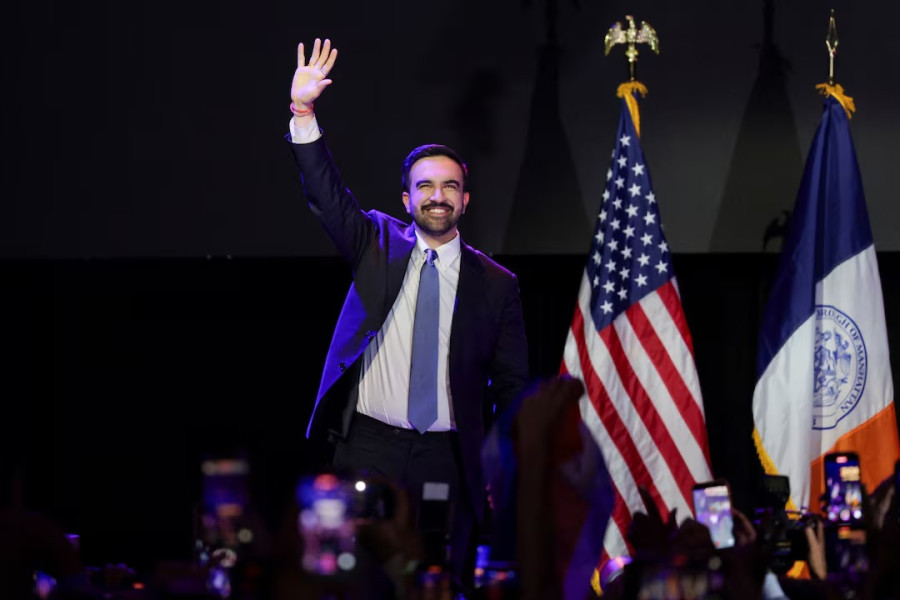
bookmark
Kashif Islam
Published at : November 11, 2025
Updated at : November 11, 2025 21:48
Zohran Mamdani’s victory as the mayor of New York City has elicited a variety of reactions worldwide, from disbelief and consternation to guarded optimism and elation. His win was remarkable considering the many challenges he faced. His programme of action centred on the concerns of working-class people—freezing rent, improving public transport and expanding social services—was dismissed as impractical and unrealistic. He received hostile media coverage and ran into wealthy individuals who ran campaigns with the sole aim of discrediting his candidacy.
Even within the Democratic Party, Mamdani faced significant opposition. None of the established democrat leaders endorsed him until late in the campaign. President Donald Trump frequently derided him as a ‘communist’ and threatened to withdraw federal funds for the city if he won.
The bane of centrism
For quite some time, politics in many countries has revolved around centrism. This has meant politicians, mainly on the left, toning down the social and welfare-oriented aspects of their programmes and aligning themselves with the interests of corporations, influential groups and individuals. Parties which used to represent the interests of the working class, such as the Labour Party in the UK, the Democrats in the US and the Socialists in France, no longer speak for the working class.
In the US, this has meant a minimum wage that has been kept low for years, the absence of universal healthcare and a refusal to raise taxes on wealthy individuals and corporations. In Europe, this has translated into governments not doing enough to create affordable housing and being unable to reduce inequalities. Any leftist candidate who strayed away from centrist positions with actions, such as promising universal healthcare or taxing the wealthy, found themselves shut out of politics. This happened with Bernie Sanders in the US and Jeremy Corbyn in the UK, highly popular leaders who made rising inequality the centre of their politics but found themselves shunted out. It was expected that Mamdani would also hit a similar roadblock, but he went on to first win the democratic primary and then the popular vote itself.
A grassroots movement
Contemporary politics is closely entwined with spending and media coverage. Whether in a developed country like the US or in a developing one like India, it is impossible to run for office without substantial financing, often involving wealthy individuals and corporations. The Mamdani campaign was unique because it built a grassroots movement from the bottom up, led by a large number of volunteers who believed in his vision. He raised funds through small individual donations and did not depend on wealthy families or corporations. Mamdani built his campaign on social media and face-to-face contact with people. A notable aspect of this was the effort to connect with ethnic minorities by making short videos in their languages. His grassroots activism was key to winning the mayor’s post despite the overwhelming odds against him.
Alleged anti-semitism
The other key difference with the Mamdani campaign was his pro-Palestine stance. In the US and in the Western world in general, it is very difficult for politicians running for office to take a pro-Palestine stance. The handful of US politicians critical of Israel face an uphill challenge from lobby groups and hostile media coverage. Taking a pro-Palestine stance is political suicide.
Long known for his activism on behalf of Palestinians, Mamdani did not play by this rule book. Most commentators maligned him as a threat to New York’s Jews, a significant presence in the City. President Trump declared on voting day that any Jewish person voting for Mamdani was ‘stupid’. Powerful Jewish individuals and groups, as well as Israel, ran ads and misinformation campaigns to smear him. His victory was taken with a very heavy heart in Israel, with Israeli politicians issuing calls for New York jews to emigrate to Israel, their ‘homeland’.
As it turned out, Mamdani was supported by a large number of Jews throughout his campaign. It is estimated that 33 percent of New York Jews voted for him. In those under 50, nearly one in two Jewish voters voted for him—a remarkable feat given that Mamdani was universally presented as a mortal threat to Jewish voters. Mamdani was also maligned for alleged Hinduphobia. His statements against the pogrom in Gujarat and the ruling BJP party in India were presented as evidence of his hatred for Hindus. The Hindu America Foundation, a right-wing American group closely aligned with the ruling party in India, brought out ads denouncing him. Clearly, the tactics didn’t work as Mamdani won more than half of the South Asian vote, including many Hindus.
A long battle
Mamdani carries a huge burden on his shoulders. Will he be able to expand affordable housing in a city with one of the most expensive property prices in the world? Will he be able to raise taxes on the rich in a city with the largest number of millionaires? Will he be able to run affordable grocery stores, improve suburban trains and buses? The real danger is not that Mamdani would try and fail but that he would succumb to centrism and political compromise. Mamdani’s campaign and win bring hope for leftist candidates all over the world. His victory takes politics away from big business, wealthy individuals and corporate media, and closer to the everyday concerns of ordinary people who are at the heart of democracy.
Kashif Islam
The writer works in the financial services industry based out of Gurgaon.





Most Read from Columns




Editor's Picks





E-PAPER | October 25, 2026

×