



 17.12°C Kathmandu

Sat, May 2, 2026
Entertainment
Arjun Khaling: The artist & activist
I first came across the work of the painter Arjun Khaling when my mother walked in with two canvases covered with butterflies of many hues.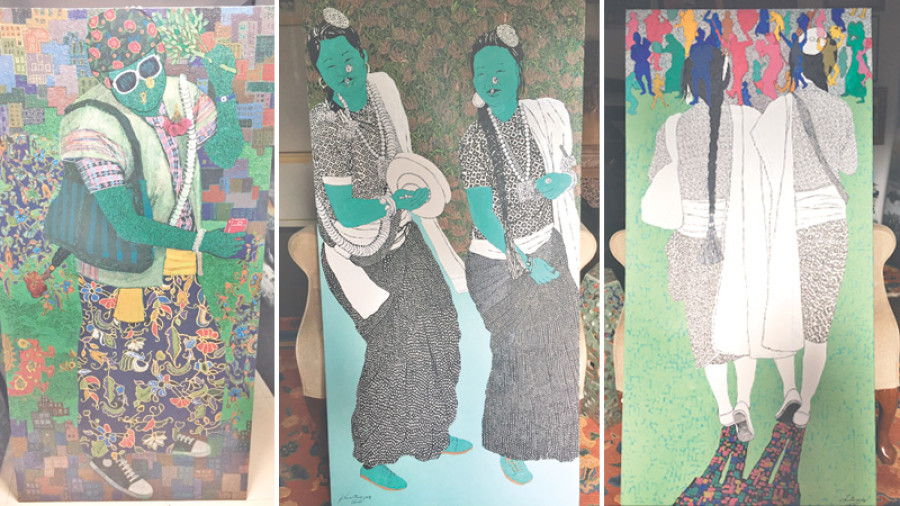
bookmark
Sophia L Pandé
Published at : December 25, 2016
Updated at : December 25, 2016 09:32
I first came across the work of the painter Arjun Khaling when my mother walked in with two canvases covered with butterflies of many hues. We were both enchanted. A few months later in July 2014, during a joint exhibition of twenty six Nepali artists titled Amalgam at the Siddhartha Art Gallery, Khaling’s paintings stood out with their distinctive colours and a boundary breaking juxtaposition of village life depictions that are figuratively conventional but brightly patterned, adorning the work with an edgy sensibility. Lush with colours and configurations that connote the essence of modernism, the works are a commentary on the struggles of the artist’s own community, the Kirat’s, an indigenous ethnic group that live in the eastern regions of the Himalayan foothills, who, along with all janajati groups in the country, are confronting an inexorably changing world.
Arjun Khaling, who was only forty-one years old, passed away recently. His death by suicide took his friends in the artistic community by surprise; they had been aware of his struggle with depression, but nobody expected such a drastic and final action.
In recent years, Khaling had stepped away from his art, moving more into activist politics, fueled by a strong sense of injustice at the way indigenous groups continue to be treated in Nepal. Today, with changing times, there is a measure of freedom in expressing dissatisfaction with the status quo. Arjun Khaling defined that liberty and worked towards it, using his paintings to bring Kirat culture to the public eye.
This talented painter made it clear that he wanted to address his political beliefs through his art. Striking portraits of conventional village life are augmented by encroaching signs of modernity, a traditionally garbed man wears converse sneakers, holds a cellphone in one had, a tree branch in another, he has sunglasses on, a wrist-watch, and while he is surrounded by foliage, the nod to subsistence farming that most rural communities are beholden too, the green gives way to the concrete jungle. The figure himself is covered by bright swirls of pattern and colour, something that should baffle the mind but instead creates riveting, vibrant movement for the eye, giving life to a flat canvas.
It is this quality of Khaling’s that made him such a great artist. Even while he was insistent on his politics melding with his art, he championed the quality of the art itself, and his high standards are reflected in the innovation and execution of his own work.
His portraits of village women, their poignant faces reflecting their ethnic background, cleave to his political inclinations, imbuing his work with the feeling that he has for his own people, embodying them in a timeless canvas, even as they feel the changes around them.
But it is in his almost abstract pieces that the real painter, the true artist who loves colour and form, is exposed. Khaling’s butterfly paintings of myriad multi-coloured winged creatures against colourful backgrounds could be interpreted, by those who insist on bestowing meaningful metaphors onto everything, as a celebration of diversity, or, they could simply be seen as what they are, a product of an artist who loved print-making and the beauty of the woodblock technique who is then experimented on canvas with acrylic paint and brush.
The chilis in their pots, red and purple, are a similar, playful examination of repetitive pattern against three-dimensional traditional perspective; all accomplished by a consummate draughtsman.
Painting analysis cannot always see into the heart of the painter, but it can give some clues to intent. Arjun Khaling’s work, however, is somewhat of a cipher in light of the circumstances of his tragic demise.
In his paintings his subjects are bound by the canvas, but they seem free, just as the butterflies seem to leap out of their frames. Whatever we may want to read into his work now, the most respectful thing is perhaps to simply step back and appreciate the distinctive, delightful work of a man who knew how to paint and could make his subjects come to life using the most unusual of techniques, patterns, colours and all.
Khaling had embedded himself in activism, a subject close to his heart, but it was his heartfelt belief that Nepal should continue investing in its arts education. He helped to found the Kirat Lalitkala Samaj to re-examine the roots and aesthetics of his own culture, and believed in pushing for regional focused education that would allow for learning to be spread equally across the country instead of being centred in Kathmandu. In addition to his fine work as an artist, a true tribute to the man as a whole would be to work together, irrespective of whom we are, towards creating a more aware, inclusive country that does not see just an indigenous village woman attired in her traditional jewelry, but a unique individual that could take wing, given the opportunity.
Sophia L Pandé
Pandé is a writer, art-historian and filmmaker advising on the economic and social potential of the Cultural and Creative Industries, Education Outreach, and Sustainable, Strategic Planning. She has consulted for IFC and UNESCO. She is Director of Development at the Kathmandu Valley Preservation Trust, and Founding Director of The Kalā Salon, a non-profit space for the arts. In the past, she has been a long-running columnist for The Kathmandu Post and the Nepali Times.




Editor's Picks
They built lives on land that was never theirs. Now they have nothing

“Let the ice wall melt”: No safe way up Everest yet
Cycling was once central to daily life. Now it’s done mostly for fun
No place to play for Kathmandu kids
These Karnali women once relied on family support. Now they own businesses
E-PAPER | May 02, 2026

×