A young photographer’s debut solo exhibition explores impermanence and human connection through frames from across Nepal. ‘Royal Sleep’ Photos: Courtesy of Robin Timalsina
‘What remains when a moment passes? When a place changes, when people move on, when time quietly reshapes everything we once knew?’
One is made to sit with these questions, sink into the impermanence of existence, time and memories while entering 22-year-old Robin Timalsina’s solo photo exhibition, ‘What Remains’, currently on display at Chitra Art Space, Lazimpat.
Timalsina is a visual storyteller whose work emerged from a life shaped by resilience, transformation, and a search for belonging. Raised in circumstances marked by uncertainty and emotional weight, he found visual language a refuge, a comfortable escape.
His works reflect sensitivity, stillness, observation, introspection, and visual depth. His interest in photography, sparked in school, was further deepened during his two-month visit to Dolpa as a Math and Science teacher a year ago, intensifying his passion for visual storytelling.
The exhibit presents photography as a form of emotional archaeology, digging for traces and remnants of life and memories. Timilsana’s visual voyage explores outer exploration and inner discovery. With his camera and sometimes his phone, he dissolves into the patterns of life across Nepal, particularly of Dolpa, Tokha, Kathmandu and Bhaktapur.
Eyes, be it at the centre or corners of the exhibition walls, narrate stories that overflow the density of the frames. Children of Dolpa, caught in the unguarded stillness, seem to hold the entire world within their gaze, and also the confusion of an anonymous silhouette of Timalsina’s camera standing in front of them. Regardless, stories are told. Confusion is captured. Transience is held within shutters.
‘Hope Behind the Bars’
‘What Remains’ begins with a depiction of ‘Soul reminder’, gradually progressing through the moments of life and ends with death.
‘You talking to me’ encompasses three children. With sharp expression, compositions and contrast, they deliver a nuanced experience as though a foreign object, toward which they are concerned, yet unbothered, is standing before them.
The boy on the left looks rather confused. With furrowed brows and a slumped posture, carrying a bag and a tiffin box in his hand conveyed concern, however, underlined by utter unbotheredness. The girl on the right appears slightly sceptical or perhaps defiant. She, too, carries a bag with her hair tied in two ponytails. A thin stroke of sunlight passes through her head and towards her hands that are resting on her lap. Both sit on the edge of a cement structure.
The seemingly older boy behind them carries a composed, almost guarded expression. His gaze into the frame evokes the question, ‘Who is talking to whom?’ The gentle shaft of light on his face contrasts with his firm guard. This falling of light highlights the texture in the frame, skin, dust and clothing. Their triangular composition creates a balance.
The rough stone wall behind them adds tactile texture, creating an almost harsh backdrop and a sense of lived reality. The sharp contrast between light and shadow also projects the emotional tension in their expressions.
The gaze of all three, looking into the frame, adds depth to the photograph, shifting the dynamics from observation to accountability. The image avoids pity. They are not portrayed as helpless, but as aware.
“This was the first picture I took of them,” explained Timalsina. “Initially, they were confused, but as I went to their school again and again, their expressions gradually seemed to embody familiarity.”
‘God’s Wish’
‘Samsara’ is presented as a meditative threshold of life and death. Shot in Pashupatinath’s cremation site, the frame includes funeral pyres, smoke, ritual structure and, in contrast, humans in motion. This coexistence makes the image powerful. Taken with a phone camera, the picture translates a complex spiritual concept into a visual experience using space, light and movement.
An arc stands abruptly in the picture, dominating the frame. It places the viewer in front of the linear stone path that lies beyond it. The eye is pulled inward through the passage and the receding figures.
The image’s background light casts silhouettes of the people walking through, perhaps depicting them as part of a larger human cycle rather than distinct subjects. The title ‘Samsara’ does not overpower the image, but rather directs its interpretation. “This is exactly how I wanted the picture to be,” says Timalsina. “With the people on the right end and the dead bodies on the left.”
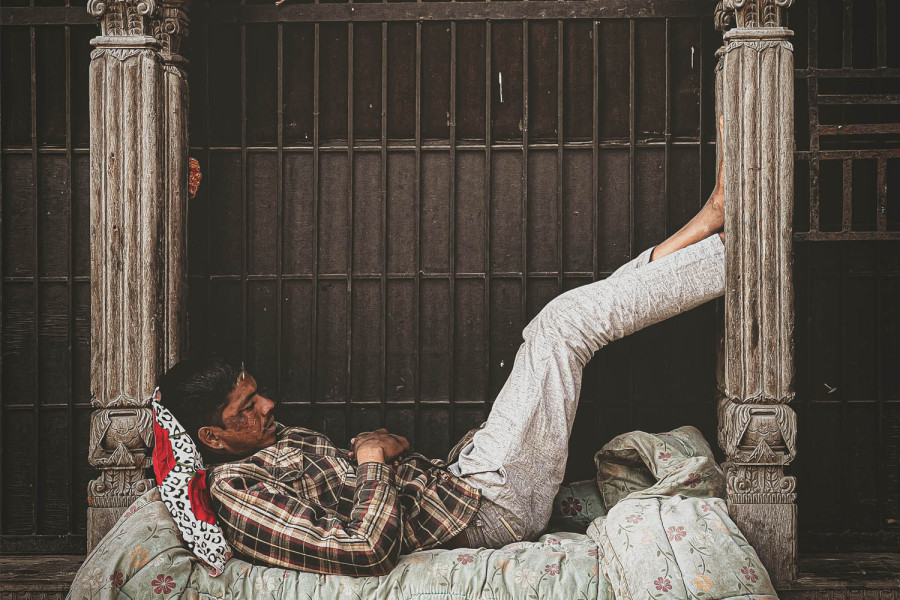
‘Royal sleep’ presents a man sleeping on the edge of a wooden structure. Taken in the suburbs of the Pashupatinath’s cremating site, the image depicts how sleep can be infinite for some and momentary for others. The man’s posture is relaxed and unguarded, with one leg propped up and arms resting on his torso. His sleep is not luxurious, yet the title ‘Royal sleep’ reframes it with a layer of irony, prompting questions about the meaning of royalty and comfort.
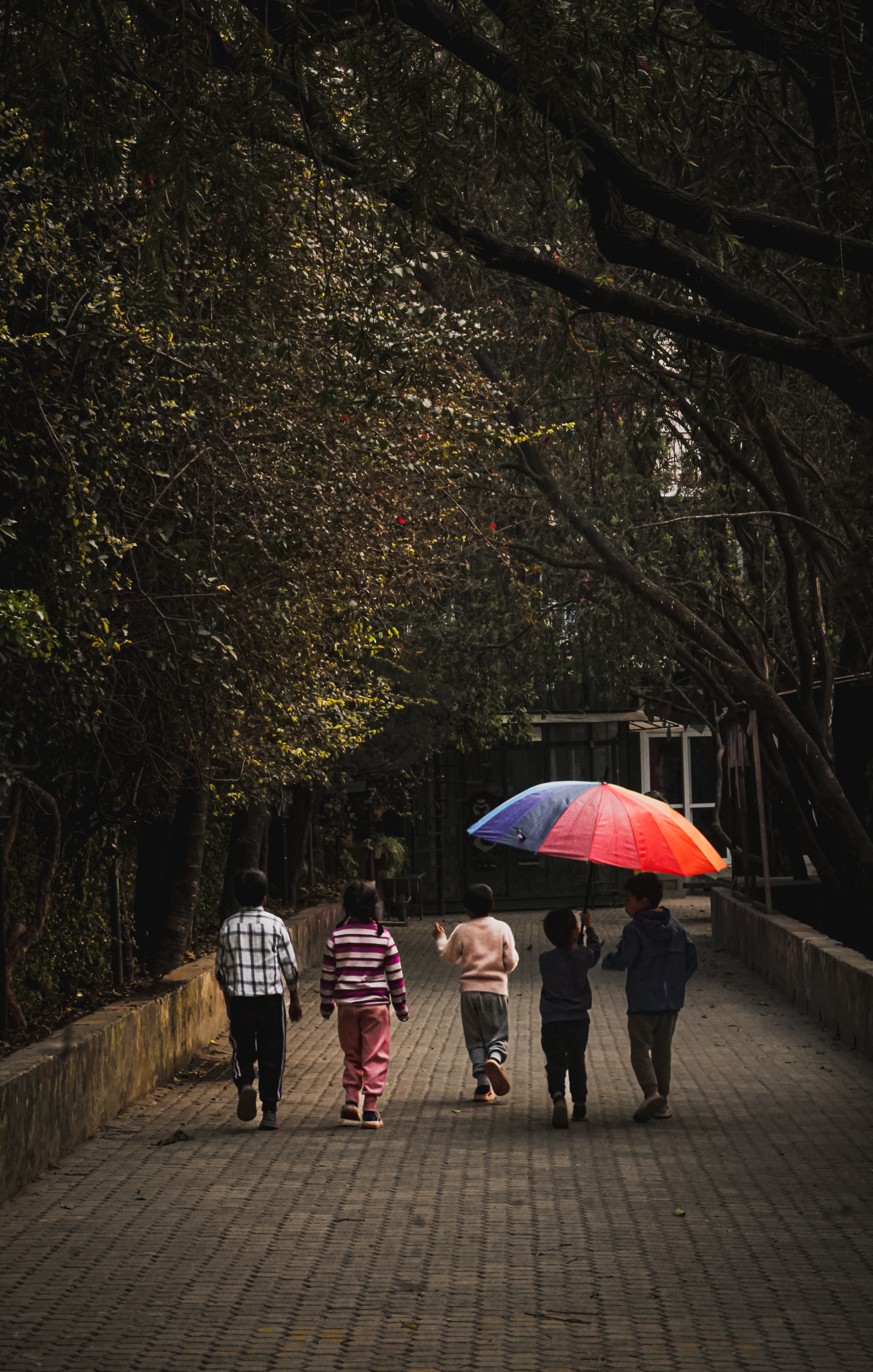
Umbrella emerges in Timalsina’s photography as a symbol of protection, shared warmth and memories. In some frames, children carry rainbow coloured umbrellas, which, according to Timalsina, is a form of advocacy for the LGBTQIA+ community.
The exhibition also showcases the vast landscapes of Dolpa, captured by Timalsina during a trek. “If only I find something interesting,” Timalsina says, “I capture it.”
‘God’s wish’ presents a portrait of an old man smoking from a pipe, while looking into the camera. Colour grading is the most striking aspect of the picture, which isolates the subject from the vast mountainous background, which does not appear green. The man fills the image, and everything else recedes. His hands, which seem weathered, partially obscure his face, perhaps drawing attention to the ritualistic nature of the gesture. The title makes the image philosophically relevant, signalling surrender, solitude, and fate.
Being in the journey of life, Timalasina describes how he, and perhaps each living being, has encountered uncertainties, displacement, longing and unpredictable reckonings. Everything, eventually, seems to disappear in the sands of time. What remains is hope, memories and photographs.
Timilsana’s shots neither demand extravagance nor seek leniency. They simply ask for our presence. To look at the children, looking back at us, to see the dreams that the man at the edge of Pashupati might have carried, to understand the visual poetry and at last, to turn inward and observe our own being gently.




 23.24°C Kathmandu

.jpeg)
.jpeg)
.jpeg)