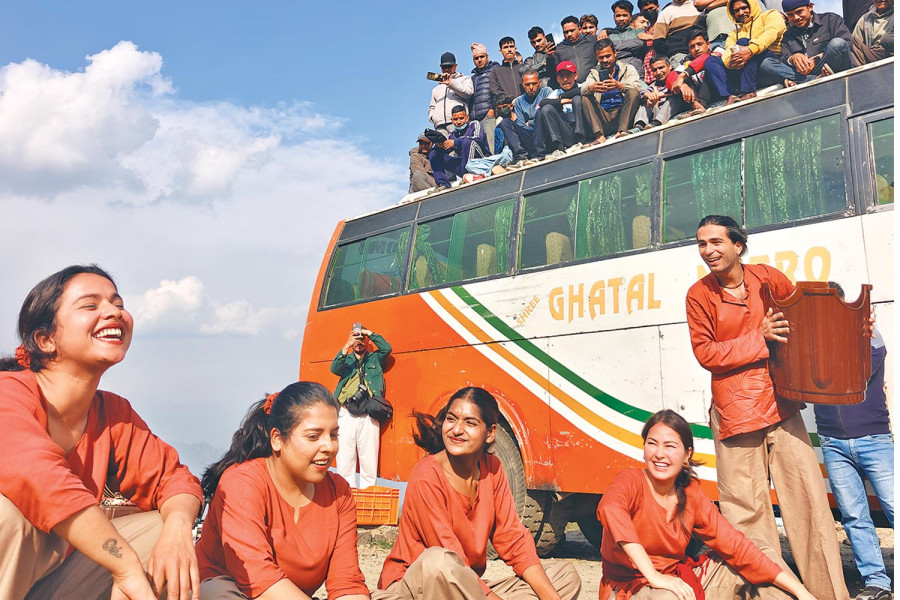
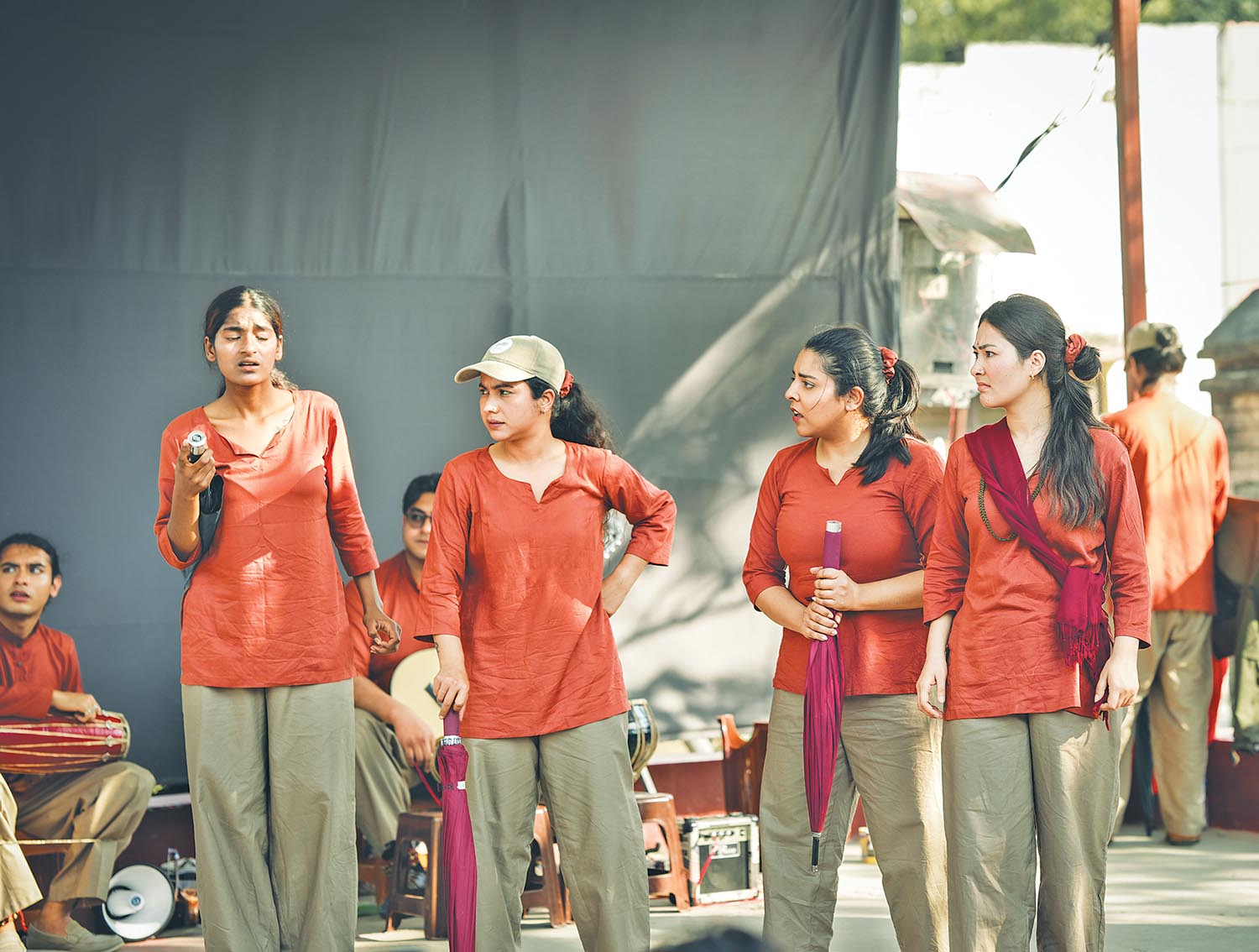
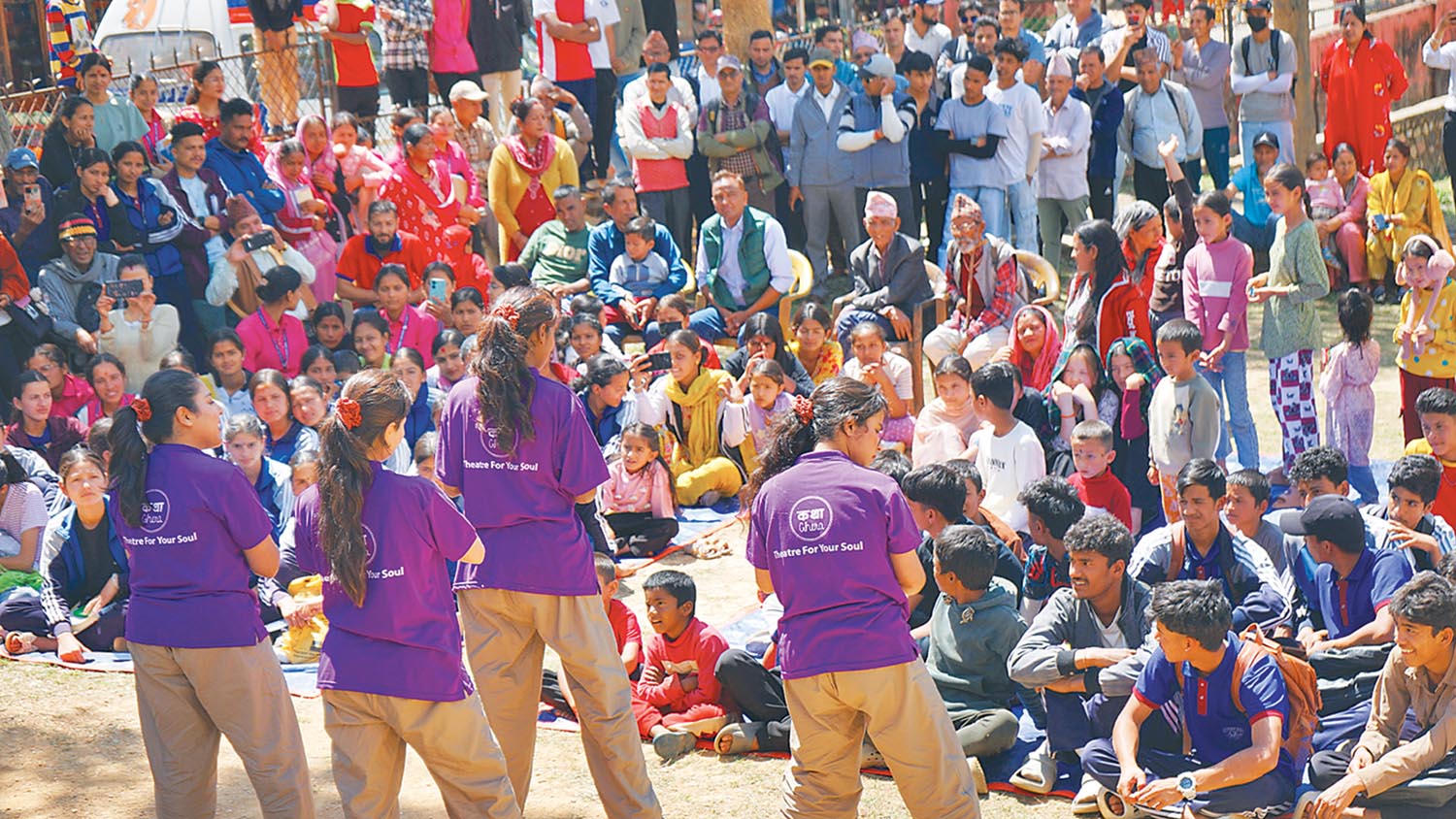
Performed without lights, microphones or a fixed stage, Katha Ghera turned public spaces into theatres, staging plays inspired by local stories. Without microphones, the actors had to project their voices in open spaces filled with traffic and ambient noise. Courtesy of Katha Ghera
The Kathmandu-based theatre group Katha Ghera has recently returned after nearly a month of street performances through the Karnali and Sudurpashchim provinces of Nepal.
The group travelled to Kailali (Dhangadi), Kanchanpur (Bhimdatta), Doti (Jorayal), Dadeldhura (Amargadhi), Achham (Mangalsen), Dailekh (Dullu and Narayana), Surkhet (Birendranagar and Bheriganga) and Salyan (Sallibazar), making an eleventh, unplanned stop in Baitadi because of popular demand.
The 11-member team included eight performers, a director, a project leader and a production manager.
While the team expected 100 to 200 people at each show, once clips from the production began spreading on TikTok, the momentum changed everything. “People from around the country started to notice,” said street play director Sudam CK. “Some people travelled long distances to come and watch.” Their performances drew over 500 people.
Without microphones, the actors had to project their voices in open spaces filled with traffic and ambient noise. “In an indoor theatre, you can work with lights, sound, and backstage,” CK said. “On the street, you have to make it work without all of that.”
Instead of elaborate wardrobe changes, the actors worked with neutral costumes, layering small pieces to signal character shifts. Even the performance space had to be reimagined. In a traditional theatre, the audience sits in front of the stage. On the street, the audience surrounds it.
“We tried to control that by placing a curtain behind us,” CK said. “But still, people are watching from at least 200 degrees.”
“In the theatre, everything is in your control,” Katha Ghera founder and team leader Akanccha Karki added. “On the ground, nothing is.”
The 50-minute show combined two stories into a single performance. In the first story, a woman starts a tea shop out of financial necessity while trying to balance household responsibilities, social pressure and restrictions linked to menstruation—an issue deeply felt in several of the municipalities visited. As the venture grows into a dairy business, the woman’s increasing financial contribution prompts her husband to take on more domestic work.
The 11-member team included eight performers, a director, a project leader and a production manager.
The second story is more satirical. A woman, frustrated with being known only in relation to her husband, decides she wants “a name of her own”. As she and other women begin experimenting with income-generating work—from making pickles to tailoring to farming—the play pokes at the men who resist women’s independence.
The production aimed to shift mindsets so that women’s work, whether at home or in the economy, is recognised and valued. “So people actually see women’s work as work,” said Venish Acharya, actress, songwriter and the production’s main researcher.
While there is one male actor who represents the husband, there are four female actresses playing the wife. “We’re not four wives, but we represent the voices inside her head as well,” said Acharya. “We are four women playing the nuances of one. And these women are very quirky, very determined and very scrappy.”
Research for the stories began in October 2025, followed by scriptwriting in December and January, and auditions and casting in February 2026. The team then spent around 25 days in rehearsal before leaving Kathmandu on March 22. For Acharya, the process was far from linear.
“It was a lot of constructing and deconstructing, then building it again and taking it apart again,” she said.
While the team began rehearsals with a script, much of the work evolved in the rehearsal room. Scenes were rewritten, shortened or cut entirely, and new moments emerged through improvisation.
“We’d write something, then realise it wasn’t working or felt too slow,” said Acharya. “In street theatre, you can’t force people to concentrate, so we had to move towards things that were quicker, funnier or more emotionally immediate.”
Research shaped the smallest details of the play, from the characters’ professions to the language and music used onstage. Characters worked in agriculture, threadwork and handicrafts, jobs common in the communities where they performed. “It made the stories more accessible,” said Acharya. “Anything too far removed from that wouldn’t feel real.”
The team drew inspiration from the experiences of real women, deciding which locations to visit based on where women were already starting small businesses. In Sudurpashchim, the story revolves around milk and ghee production, reflecting the region’s local economy. In Karnali, the character’s pickle-making and weaving businesses are based on real success stories. “Imagine going to a rural place, where women don’t even have access to basic education, and telling them, ‘Why don’t you become entrepreneurs?’” said Karki.
The team drew on local musical forms such as deuda and bhaka—common in Sudurpashchim and Karnali—to connect with audiences and ground the performance. While street theatre is not new to Nepal, Karki believes this show’s musicality helped it resonate more widely.
The group travelled to Kailali, Kanchanpur, Doti, Dadeldhura, Achham, Dailekh, Surkhet and Salyan, among others, with an additional stop in Baitadi.
“I think Nepali audiences connect deeply with music,” said Karki. “That’s a big reason why the performance went so well.”
The group travelled with their props, which included a sitar, a guitar, tablas, umbrellas and stools. Upon arriving in a province, the team would conduct a location ‘recce’, consulting locals about possible venues—near colleges, in central bazaars or in bus parks. A suitable location is needed to draw a crowd without disrupting traffic, with space for at least a few hundred people to sit. “On top of that, we also needed electricity for the guitar,” said Acharya.
Once they figured out the venue, the team would clean the space, often laying out plastic carpets for audience members to sit on. Then, they would make announcements through the town, telling residents that a play from Kathmandu would be staged the next day. They then approached local authorities, including the district administration or police office, to arrange support. The team would repeat this process at each location they performed at.
Though the travel was exhausting, the audience response kept the group going. One moment from the fourth show stands out for Acharya. After a performance in Amargadhi, a woman approached the group in tears.
“She told us, ‘This is my story,’” Acharya recalled. “She felt seen. She felt celebrated.”
Acharya gets emotional when she recalls the moment. “It shouldn’t be so difficult to tell women’s stories,” she said. “They hadn’t felt seen in a long time.”
Young audience members responded in ways the actors hadn’t expected. After the show, the team would sometimes ask children what they had understood. Some answers were strikingly direct: that they should help their mothers at home or try to better understand them.
Not every audience reaction was this straightforward. Because the play used satire, men sometimes clapped at lines spoken by deliberately problematic male characters. Later, as the story moved forward and those views were challenged or dismantled, the same audience members often fell silent.
“That was interesting to witness,” Acharya said, laughing. “It was like ‘oops, you just got caught.’” The play was designed to invite reflection rather than confrontation, telling stories that allowed audiences a moment to think.
Despite the overwhelmingly positive response, the show has also drawn online backlash, particularly for a song written by Acharya titled ‘Women Are People’. The song emphasises a simple idea: before women are wives, mothers or daughters, they are individuals in their own right. “I think that offended a lot of people,” Karki said. “We never thought something so basic would be controversial.”
“If even two out of the 10,000 people who watched our show live feel inspired to start something, that’s big,” Karki added. “And I’m sure that is already happening.”




 16.76°C Kathmandu