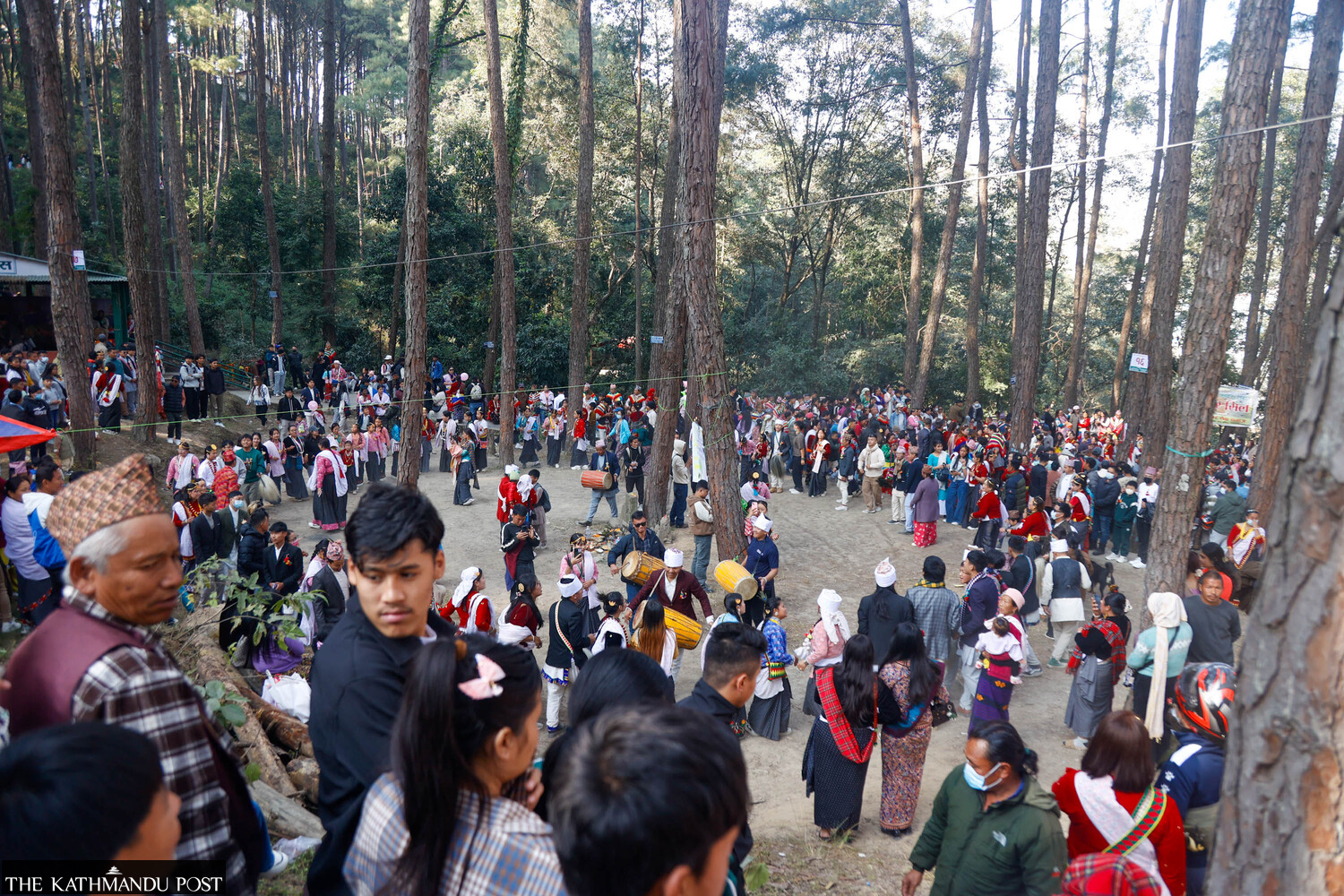
Young Nepalis’ involvement in organising, documenting and participating has helped the festival evolve while preserving its core connection to ancestry and nature. Udhauli was observed across Nepal on Thursday, and this year’s celebrations showed how the festival has steadily changed with time. Post Photos: Suryams Upreti
Udhauli was observed across Nepal on Thursday, and this year’s celebrations showed how the festival has steadily changed with time.
In the bygone days, the festival took place within village communities. Today, it unfolds across large urban grounds, supported by youth groups who handle much of the preparation.
Across many towns, young people coordinated the dances, decorated the spaces and managed logistics. Their presence gave the day a sense of structure and consistency. For Dhiren Sustocha Bahing, the chairman of the Federation of Indigenous Kirat Associations, this shift captures the festival’s evolution. “Without youths, Udhauli would not feel this lively,” he says. He has seen the celebration grow from a gathering limited to a few Kirat subgroups to a space where all Kirat communities and even people outside the community feel welcome.
Bahing recalls when Bhumi Puja guided the entire day, and the Sakela Naach was performed only by Bantawa and Chamling Kirats. Over time, other Kirat groups have joined the circle. Now the dance often includes neighbours, local officials and people from different castes who want to be part of the celebration.
“When neighbours or ward officials come and dance with us, it makes us feel supported,” he says. These moments show how Udhauli has shifted from a closed ritual to a community-wide event.
This change is visible in Kathmandu, Dharan, Sunsari, Dhankuta and other cities where youth volunteers arrived early to prepare the grounds. Shraddha Rai from Sunsari says, “Children took part in the circles, teenagers managed the sound system, and young adults helped elders lead the steps. The day felt shared across generations, each giving something of their own.”
Digital visibility has also influenced the festival’s evolution. Young people filmed the dances on their phones, and videos of the Sakela Naach travelled online throughout the day. Bahing believes this has transformed how the tradition is preserved.
“A decade ago, there was no trend of filming the dance, hence it didn’t reach many people. But now with the evolution of technology, people in different parts of the world get to see our culture through social media. It keeps our identity present even when we are far from home,” he says.
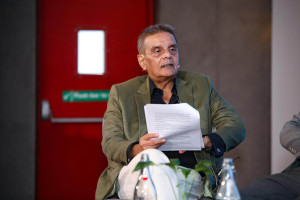
“Without youths, Udhauli would not feel this lively,” says Dhiren Sustocha Bahing, the chairman of the Federation of Indigenous Kirat Associations. Post Photos: Suryams Upreti
The reach of these celebrations has grown, especially for families abroad. “Many diaspora communities watched live streams from Nepal and organised their gatherings in parallel,” Bahing says. This has created a sense of connection across borders.
Bahing observed food stalls, clothing vendors and small businesses around the celebration in the Gokarna area. This festival provides them with a space to sell their products.
Moreover, tourists also came to observe the festival and joined the dance for a while. Their participation created an informal space of cultural exchange.
Even as the festival changes, its core meaning remains. Udhauli marks the seasonal shift when birds, animals and people move toward warmer plains and harvested grains are stored for winter. Families express gratitude to the earth, and many recall how the festival guided their ancestors’ relationship with nature. “We cannot survive without nature. Our ancestors taught us that,” Bahing says.
The dance movements carry these memories. Some steps mimic birds and animals. Others reflect farming practices or the rhythms of migration. Elders often explain the meaning behind these gestures, and young dancers listen carefully. This passing of knowledge keeps the festival rooted even as its surroundings transform.
Organising such a large event requires support, which was not always available. Bahing remembers how difficult it used to be to secure a ground for the festival in Kathmandu. The community spent years negotiating with local authorities. Bahing hopes more municipalities across Nepal will recognise the importance of accessible public spaces, especially since the community gathers for large dances only during Udhauli and Ubhauli.
The partnership between elders and youth has become crucial in this process. Elders offer guidance and continuity. Youths bring energy, communication skills and experience with digital platforms. Their cooperation has helped the festival move from private open spaces to wider public grounds in cities.
For many young participants, the festival carries emotional meaning. Rai says, “Our grandparents narrated about Udhauli and Ubhauli to us. When I dance in the circle, I feel connected to the stories I heard as a child. It helps me understand why festivals still matter.”
Many who grew up in urban settings see the festival as an anchor to identity. Bimal Rai, who lives in Kathmandu, expresses a similar feeling. “This day reminds us where we come from,” he says. For him, the celebration offers a pause from city life and a moment to reconnect with heritage.
Similarly, many urban families say that Udhauli has become a day to reflect on origin and belonging. The festival’s growing public presence has encouraged parents to bring their children to the celebration. This teaches young people about ancestral practices that might otherwise fade. “When we dance, we remember our forefathers. The festival remains alive because we continue to honour them,” Bahing says.
Sanskriti Pokharel, a former reporter and sub-editor at the Post, is a final-year student of Journalism, Mass Communication, and English Literature at St. Xavier's College, with experience in media, research, and communication.




 24.79°C Kathmandu