This Thursday, Nepal will hold its ninth parliamentary election in its democratic history. Originally scheduled for November/December 2027, the election has been brought forward by nearly two years, on the back of the Gen Z uprising of September 8-9 after the movement claimed the lives of 77 people and caused billions in damage to private and public property last year.
The youth revolt toppled the coalition government led by KP Sharma Oli, which was backed by the Nepali Congress and CPN-UML. On the very day a new citizens’ government was formed on September 12 under former Chief Justice Sushila Karki, a decision was made to hold House of Representatives elections on March 5.
In the silence period of the parliamentary vote, some voters say they are not too enthusiastic about casting their ballot.
Dr Rabindra Singh Thakuri, an ophthalmologist who is a voter in Chitwan-2, says he has no excitement about the upcoming election.
On a personal level, Dr Thakuri believes this election should create space for new faces to enter politics. However, he admits that the overall atmosphere surrounding the polls has dampened his excitement.
He says that wherever he goes, he hears a strong public sentiment that it is time to give newcomers a chance. Yet at the same time, he cannot help but wonder whether a Parliament filled entirely with first-time representatives would have the maturity and experience required to steer the country in a stable and effective direction.
In this mix of hope and uncertainty, he shares his feeling of half-hearted enthusiasm about the outcome.
“All of my friends support the traditional political parties. In their view, if Parliament ends up being dominated entirely by new faces, it will not provide the country with any meaningful way forward—that is not what the public truly wants,” Dr Thakuri says.
Aman Maharjan, a software engineer who is a voter in Kathmandu-10, also says he is not highly motivated to cast his ballot in this election.
He feels that this election does not appear significantly different from previous ones. He admits that he is especially unenthusiastic about turning out to vote.
As the election mood builds up, political scientist Krishna Pokharel’s take is different. Having spent many years in Kathmandu teaching political science and now residing in Biratnagar, the seat of the Koshi provincial government, Pokharel says he has noticed greater enthusiasm among young voters this time.
According to him, there has been a visible increase in the number of young people returning from abroad specifically to cast their votes. He also points out that political gatherings in villages have seen encouraging public participation. Taken together, these signs suggest to him that voters are approaching this election with a renewed sense of interest and engagement.
“Voters in some places may not be particularly enthusiastic about the election, but that doesn’t mean people everywhere are uninterested,” Pokharel says.
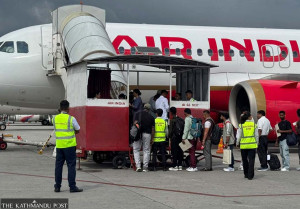
According to data from the Department of Immigration, the number of Nepalis returning home from abroad in the lead-up to the election has increased by 28.58 percent. The figures show that in February alone, 148,623 Nepali returned to the country by air. This marks a 28.58 percent rise compared to the same period last year, when 115,584 Nepali flew back home.
At the same time, the data also indicate that the number of Nepali leaving the country in February has increased compared to last year. In February of the previous year, 125,866 Nepalis travelled abroad, whereas this year the figure rose to 149,815—an increase of 1,272 over the same period.
Tikaram Dhakal, director at the Department of Immigration, says that in previous years the number of people leaving the country would usually exceed those returning. This year, though, the number of Nepali coming back and those travelling abroad appears to be almost equal.
He says it is possible that some Nepalis may have returned home due to the current election atmosphere. “The department has no official data linking the rise in arrivals directly to the election.”
While the department confirms no direct link between the number of Nepalis returning by air to the election, traffic police say there has been a noticeable increase in the number of passengers leaving Kathmandu for their home districts during the election period.
Supporting the traffic police’s observations, Saroj Sitaula, vice-president of the Transport Entrepreneurs’ Federation, says that nearly one million people are travelling to their home districts using public transport, possibly to participate in the election.
He adds that in the week’s time until Wednesday, around a million people will leave the Capital. “While some may be going out for personal reasons, the majority will participate in the election,” claims Sitaula.




 15.26°C Kathmandu