What begins as a family dispute grows into a powerful look at migration, emotional distance and the political chaos shaping modern Nepal. Both Bijaya Tamrakar and Eelum Dixit deliver compelling performances that feel spontaneous yet tightly connected. Photo: Courtesy of Katha Ghera/Facebook
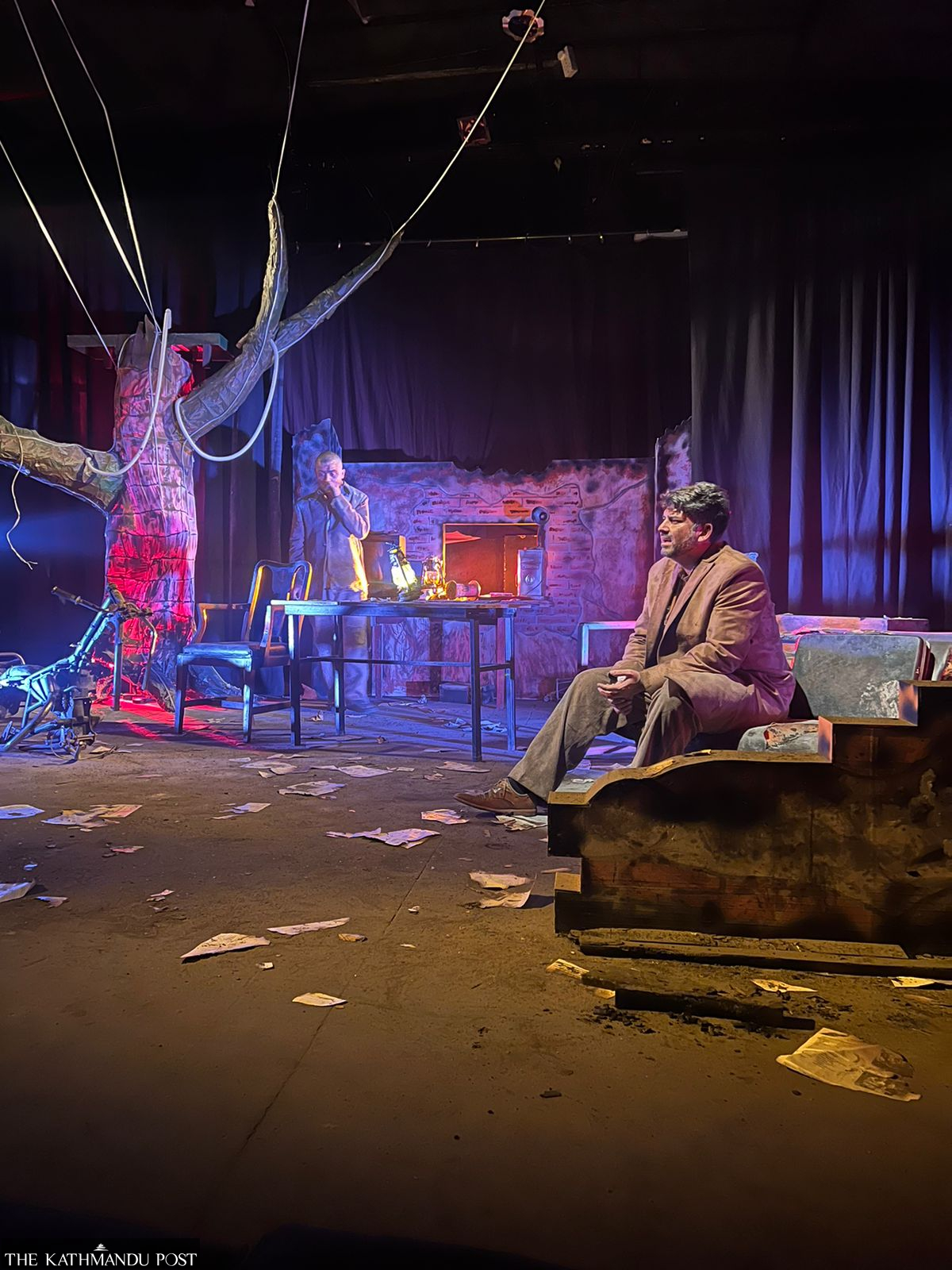
The first few minutes of ‘के? Us.’ at Kausi Theatre is deliberately disorienting—a prolonged, unsettling sound of heavy breathing layered with percussive drumming and electric guitar fills the hall. At the same time, the audience sits in a dim red glow. The stage is littered with paper, broken furniture, a run-down motorcycle frame, and shadowy structures that look charred. This atmosphere alone prepares us for a deeply introspective and chaotic performance that lingers long after the lights dim.
The play centres on two brothers, Ashim (Bijaya Tamrakar) and Aaryan (Eelum Dixit), whose lives have unfolded in opposite directions. Ashim has remained in Nepal, tending to their mother—portrayed not through a literal presence but through a striking visual symbol: a tree threaded with red LED lines that pulse faintly, suggesting a body suspended between life and disappearance.
After fifteen years abroad, Aaryan returns from the US carrying very little—only a lantern, a briefcase, and a history that has slowly collapsed: marriage, children, divorce, and financial instability. He jokes about climbing “from minus 20 to zero,” but the line lands more like a quiet admission of defeat.
An essential aspect of ‘के? Us.’ is how it emerges from the playwrights’ own experiences and reflections. Unlike conventional scripts, the play was developed externally, shaped by the anxieties and challenges of the post-2025 protest period. The creators used their personal and collective experiences to confront complex and sensitive themes, transforming lived emotions into the narrative and the characters’ conflicts. This process gave the play its distinctive blend of improvisation and structure, where every performance is slightly different, yet anchored in the raw truths of human experience.
As the team notes, the goal was not merely to entertain, but to engage the audience in dialogue—prompting reflection on personal, familial, and societal chaos. Even in moments of discomfort or unresolved tension, the play draws viewers into its exploration of emotional and societal complexities.
The house becomes more than a backdrop; it reflects the fractures in their relationship and the unresolved grief both brothers have learned to live around. Post Photo: Reeva Khanal
What they call their “renovating” ancestral home appears less like a work in progress and more like a structure abandoned by time. Cracks, empty corners, and scattered tools create a space where memory feels unsettled. The house becomes more than a backdrop; it reflects the fractures in their relationship and the unresolved grief both brothers have learned to live around.
In many ways, the decaying home mirrors a nation struggling to heal deeper wounds, and the rooms the characters move through feel like extensions of their own internal disarray.
Both Tamrakar and Dixit deliver compelling performances that feel spontaneous yet tightly connected. Their chemistry is one of the production’s strongest elements. You can feel the tension in every argument, every prolonged silence, and even in the moments when the sound design—breathing, buzzing, heartbeats—interacts with their lines.
Tamrakar’s portrayal of the younger brother is especially striking; he holds a lantern at the beginning, almost as if he is carrying the last trace of hope. Dixit’s English dialogue, his accent, and his restlessness add authenticity to a migrant’s emotional exhaustion, heightened by a carefully crafted soundscape that echoes his inner chaos.
One of the most interesting exchanges between the brothers begins as a casual debate about food—Shandar Momo versus Burger King—and slowly unfolds into a sharp commentary on class, migration, and shifting economic realities. For Ashim, momo from a “big” brand feels expensive; for Aaryan, fast food abroad is the everyday middle-class meal. This seemingly humorous argument exposes how differently the world treats people based on where they live.
What is aspirational in Nepal becomes ordinary in the US, and the brothers’ friction subtly mirrors the frustrations of thousands of migrants whose dreams never quite align with their lived realities.
As the play progresses, society emerges as an invisible third character. This becomes explicit when Aaryan breaks the fourth wall, pointing at the audience and asking his brother, “What are you afraid of? Them?” In that moment, spectators abruptly become the judging community the characters fear. The discomfort is intentional—forcing the audience to confront their role as observers who scrutinise, speculate, and influence. This transformation of spectators into “society” is one of the play’s most brilliant devices, underscoring how deeply social pressure shapes personal choices.
Symbolism builds the emotional core of ‘के? Us.’. The mother—silent, glowing, breathing—becomes a metaphor with multiple layers: the muted Nepali Aama under patriarchy, the frail state struggling under political decay, and nostalgia that people cling to even when it is dying. The staircase, climbed repeatedly by Aaryan though it leads nowhere, mirrors Nepal’s political cycles: promises of progress that end in the same place, if not worse. Even the cake-cutting scene carries a tension straight out of classic tragedy—brothers sharing a fragile, temporary sweetness while the possibility of betrayal hangs in the air.
Aaryan tells Ashim that this is his house, his place, his right—handing over both the burden and the throne. Ashim sits on the chair, places a childhood crown once worn by Aaryan on his head, and declares: “I am chaos.” This ending is haunting not just because of the line, but because the audience has already lived inside the chaos for the past hour. The crown, the house, the burden—all pass on to the younger brother, signalling that chaos is not resolved but inherited.
_______
‘के? Us.’
Producer: Studio Aakar
Cast: Bijaya Tamrakar (Ashim), Eelum Dixit (Aaryan)
Duration: 1 hour 10 minutes
Venue: Kausi Theatre, Teku
Showtimes: Until December 7, 5:15 pm daily, except Tuesdays; additional show on Saturday at 1:00 pm.




 15.48°C Kathmandu