20.12°C Kathmandu
Thu, Apr 2, 2026
World
Rasuwagadhi border opens after six months, traders still barred
Only Rasuwa residents allowed to cross as traders from other districts remain barred, leaving hundreds of containers stranded on the Chinese side.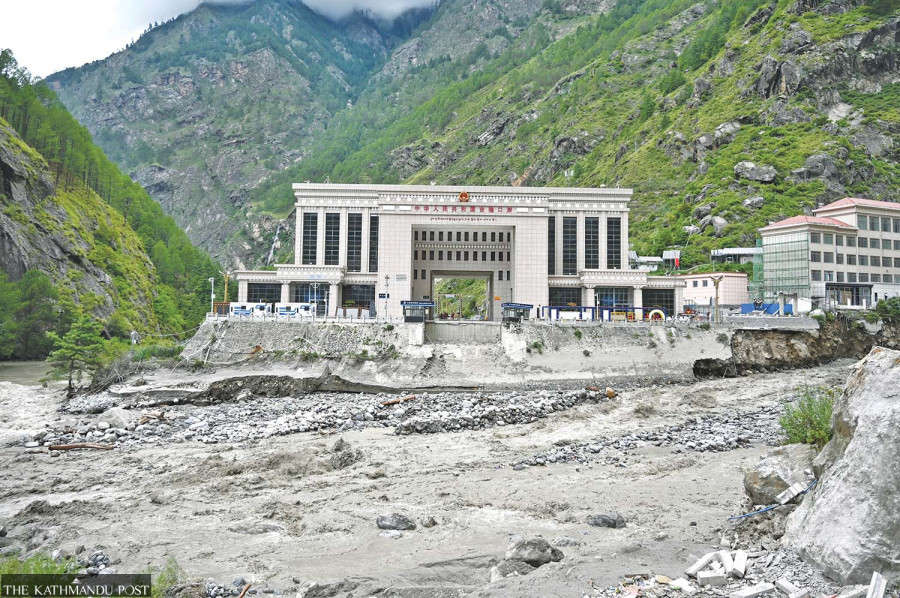
bookmark
Post Report
Published at : December 28, 2025
Updated at : December 29, 2025 06:54
Kathmandu
With the installation of a temporary Bailey bridge, the Rasuwagadhi border point has come into partial operation starting Sunday and ignited hope for its full resumption from the New Year.
However, restrictions on who can cross the border continue to make trade uncertain even though importers have waited nearly six months to bring in goods from China.
Officials said that, for now, only people from Rasuwa district are allowed to cross the border, a decision that leaves traders from other parts of the country frustrated.
Many traders, who have been waiting for months to retrieve their consignments, say the partial reopening of the border crossing devastated by the July floods offers little relief under the current rules.
Rajesh Panthi, chief district officer of Rasuwa, said that drivers and workers from Rasuwa district have been allowed to travel to Kerung from Sunday.
“As per the work procedure, only local residents and migrants living in Rasuwa are provided with border passes,” Panthi said. “We only have the information that the Kerung border point will resume from January 1. There is no detailed information regarding import and export or the movement of people.”
On July 8, a flash flood in the Lhende river swept away the Miteri bridge at Kerung, one of Nepal’s major trade gateways with China. It then took nearly six months for China to construct a temporary bridge. Nepal’s customs point at Rasuwagadhi lies about 24 kilometres south of Kerung.
Traders say that before the bridge was washed away, they were allowed to travel to Kerung to inspect goods. “There is no meaning in opening the border if traders are not allowed to cross,” said Ram Hari Karki, president of the Nepal Trans-Himalayan Border Commerce Association. “There are hardly any traders based in Rasuwa.”
Karki said the association plans to meet the director general of the Department of Immigration on Monday to seek clarity and urge authorities to ease restrictions.
According to traders, goods entering Nepal through Kerung originate from around 15 provinces in China. Previously, traders or their agents regularly visited Kerung to check the condition of consignments arriving from different regions, showing their identity cards.
Traders are still unsure if the border will resume operations fully as it did before the bridge was destroyed.
The association estimates that around 250 goods-carrying containers are currently stuck on the Chinese side. With news of the border reopening, traders have already placed new orders, potentially raising the number of containers waiting in Kerung to around 500.
Karki said the Nepali Consulate General in Lhasa has informed traders that an agreement was reached with Chinese authorities to allow people to travel to Kerung, but details on implementation remain unclear.
Despite the prolonged disruption at major northern trade points, imports from China increased by 24.63 percent in the first five months of the current fiscal year ended mid-December, compared to the same period last fiscal year. Exports to China, however, declined sharply by 73.26 percent during the review period.
According to the Department of Customs, Nepal imported goods worth Rs163.73 billion from China during the period, while exports stood at just Rs466.81 million.
Traders say shipments dispatched from Guangzhou to Nepal via the northern overland route usually arrive within three weeks, significantly reducing transportation time and costs.
Readymade garments, consumer electronics, footwear and electric vehicles are among the major imports through these points.
Since the Kerung bridge was destroyed, goods ordered ahead of the Teej festival in September have remained stuck at the Chinese border. Domestic electric vehicle dealers say sales declined during the festive season as they were unable to deliver vehicles in line with market demand.
To meet festive demand, traders turned to Korala, China’s third border point with Nepal. While Korala initially provided some relief, it has been closed for the past few weeks due to freezing weather conditions. Located at an altitude of 4,650 metres in Upper Mustang, Korala was opened for international trade in September.
With Korala now halted, fewer containers moving through Tatopani, and Kerung still not fully operational, traders say their difficulties mount.
Many traders, who financed imports through bank loans, say they are under growing financial strain as interest accumulates while goods can’t be delivered even in six months.




Most Read from World
Air Canada Express jet hits ground vehicle, closing New York’s LaGuardia airport
Colombia military plane crash kills 66, four still missing
Israel says it kills Iranian minister, will let military hit any senior official it can find
Giant oil tanker off Dubai hit by Iranian strike after Trump’s latest threats
Trump threatens Iran with power plant strikes over Hormuz oil blockade
Editor's Picks
Nepal risks losing up to 132,000 jobs, $1 billion after LDC exit

Raped and left to die, teenager’s family wants answers

Bengal tigers move to mid-hills. Sighted in Palpa, Arghakhanchi

Escaping poverty at home, Nepali women fall into the Gulf trap