Meet the street dancer duo reclaiming Kathmandu’s public spaces
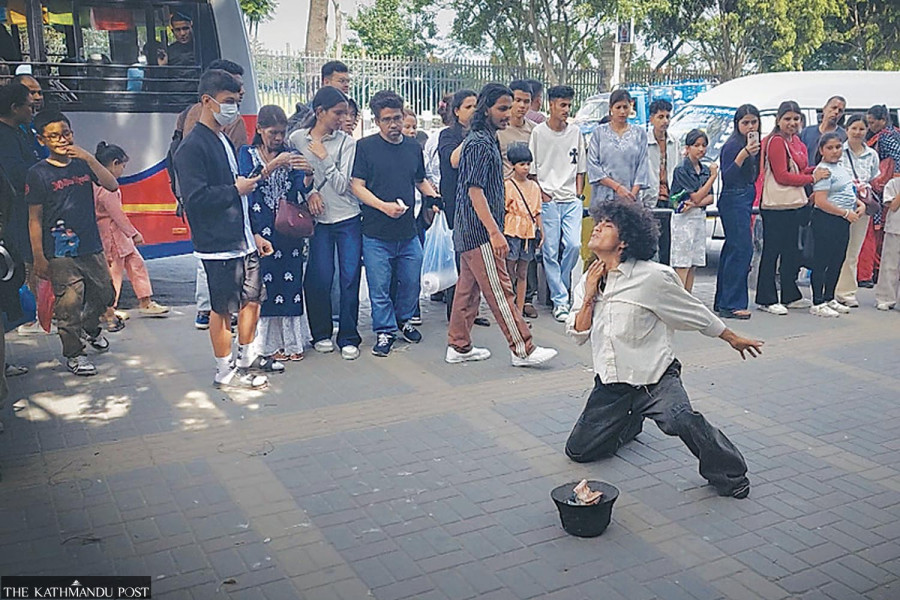
From spontaneous performances to viral fame, Siddhartha Chhetri and Jibriel Alam are turning city transit hubs into stages for their freestyle art. The duo has been performing together for around a year and a half. Post Photo
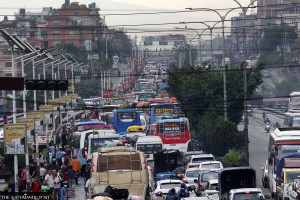
Ratnapark, a bustling transit hub in the heart of Kathmandu. Commuters hurry towards their destinations. Amid the rush, some people suddenly stop at the edge of the pavement. Some pull out their phones to record what they see. Others stand motionless, eyes fixed on the scene unfolding before them. A few reach into their pockets and drop money into a hat placed on the ground. Within minutes, a crowd gathers.
Treating all this attention as though it were routine, two young men move effortlessly to the rhythm of the music. Their feet repeat intricate steps. Their gestures seem to tell stories. Dancing in freestyle fashion like contestants in a competition, they glide across the pavement as if leaves were swaying in the wind.
Who are these two young men dancing by the roadside? Following them after one of their performances leads to a modest hotel room in Sundhara. It is here that they plan each day’s performances—deciding where to go and which songs to dance to. The room contains little more than a small speaker, a large hat, a few sets of clothes, and a collection of ambitions and dreams.
They are Siddhartha Chhetri from Gauradaha in Jhapa and Jibriel Alam from Champasari in Darjeeling, India.
The pair have been staying in Kathmandu for more than three weeks. Some days they perform at Ratnapark; on others, they head to Sundhara or nearby public spaces. They look for open spaces, place a speaker beside them, and begin dancing according to a plan they have discussed beforehand.
Their partnership began around a year and a half ago. Since then, they have become more than close friends. Each has become the other’s teacher.
The journey itself began by chance. Before meeting Siddhartha, Jibriel travelled alone as a street dancer, moving from town to town. He says his performances took him across Sikkim, Darjeeling and Kalimpong in India and Bhutan as well. Arriving in unfamiliar places, identifying busy public squares and performing for passers-by had become a way of life.
Jibriel had been travelling through Jhapa for about six months when fate intervened. At the time, Siddhartha was teaching dance at a local dance centre in Gauradaha. He had heard rumours about a young man wandering from town to town performing street dances alone. One day, Jibriel arrived in Damak. The two met and quickly discovered their shared passion for dance.
A fair was being held in Gauradaha at the time. They discussed the possibility of performing together and decided to give it a try. That joint performance forged a friendship that has endured ever since.
“Those early days were not easy,” Jibriel recalled. “Some people did not look at us, dancers performing in the street, positively. Others made fun of us. But we never gave up.”
Since their meeting in Damak, they have travelled together, shared dreams and faced hardships side by side. They rarely stay in one city for long. Like migratory birds, they move from place to place, transforming pavements and public spaces into dance floors.
Their journey has taken them through much of eastern Nepal before passing through Hetauda and Chitwan and eventually reaching Kathmandu about three weeks ago.
According to them, the national capital has been particularly encouraging.
People here, they believe, understand dance, thinking that audiences in Kathmandu appear more receptive to street performances than in many other places they have visited.
The crowds that gather around them often reward them voluntarily. Some offer applause. Others express appreciation with words of encouragement. Many contribute money to the hat placed on the ground.
The earnings help sustain their travelling lifestyle. On good days, one to two hours of dancing can generate between Rs5,000 and Rs7,000. However, income varies significantly and there is no guarantee of earnings.
For Siddhartha, the performances represent far more than a source of income.
The money he earns helps support the education of his three younger brothers, who are studying in their village in Jhapa. He also contributes to household expenses and occasionally assists people in need whenever he can. Jibriel likewise sends money home to support his parents and his family of six siblings in Darjeeling.
According to Siddhartha, their style is best described as freestyle dance. “Rather than following a fixed choreography, the body simply moves according to what the mind feels when the music starts,” he said. “The steps come naturally. That moment brings the greatest satisfaction.”
Although he once trained in hip-hop, Siddhartha says he has little formal knowledge of many other dance genres. “When I put on comfortable clothes and step out to dance, a different kind of energy comes automatically,” he said. “The emotion of the song emerges from within.”
Yet performing in public is not always straightforward. Sometimes local authorities object. At other times, rude remarks from passers-by create difficulties. “Occasionally people ask, ‘What are you doing here?’” said Jibriel.
But unpleasant experiences are often outweighed by moments of kindness.
Recently, while the pair were performing near Ratnapark, a woman in the audience noticed their worn-out socks. After watching their dance, she approached and handed them two new pairs.
“Some people praise us so openly that it makes us feel proud,” said Jibriel. Their performances have also gained attention online through social media accounts run under Siddhartha Chhetri and Street Dancer Thirteen. The videos regularly attract encouraging comments and allow them to reach audiences far beyond the streets where they perform.
Among those watching them in Kathmandu was Sameer Parajuli, who recognised them from TikTok. “I had seen their videos online,” he said. “Today I got to watch them face-to-face. The steps they perform are incredibly difficult.”
Another spectator, Khimlal Gautam, stood watching intently. “They dance exceptionally well,” he said. “I felt like I could keep watching.”
For now, the two dancers are focused on completing a journey across Nepal’s major towns and cities. Only after that, they say, will they consider travelling abroad again.
“We want to perform throughout Nepal first,” Jibriel said. “Then we will go to another country—but only somewhere street dancing is possible.”




 26.18°C Kathmandu