



 24.51°C Kathmandu

Mon, Oct 12, 2026
Culture & Lifestyle
Exhibit review: The language of Poubha
Rich in symbolism and meticulous craftsmanship, the exhibit ‘Traditional Poubha Paintings’ explores the narratives behind Nepal’s sacred painting tradition.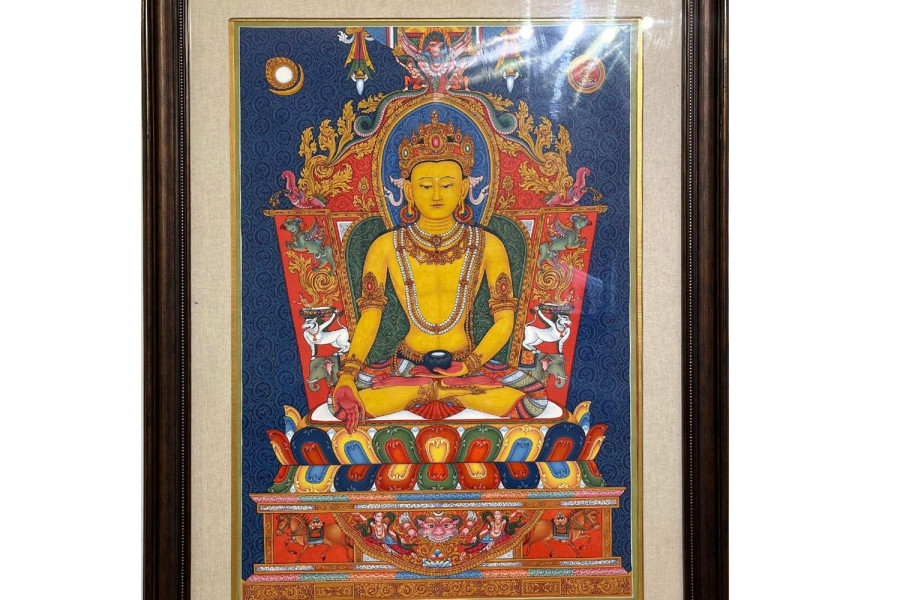
bookmark![]()
![]()
Rivash Rijal
Published at : July 31, 2026
Updated at : August 2, 2026 16:13
Kathmandu
The more you look, the more there is to see in Shankar Kumar Joshi's and Sankha Narayan Shrestha’s Poubha paintings – such is the intricacy and attention to detail that the art form requires and that these two artists are able to supply.
At first viewing, the paintings feature a cast of religious characters familiar to the run-of-the-mill Nepali viewer, as they were to me, images that are unmistakably of Buddha, Ganesh or Bhairav. But these depictions of the deities are most unlike the commonplace ones.
As both artists said many times in the detailed tour of the exhibition they enthusiastically gave, “There are endless myths and stories behind these forms; even we are always learning something or other" – a statement that is made all the more noteworthy given the many years of experience and practice the two have had.
Joshi has been learning to draw for as long as he can remember, and he has been making Poubha art professionally for some three decades. Twice now, he has won first place in the Lalit Kala Award, a prestigious award organised by the Nepal Academy of Fine Arts.
Similarly, Shrestha has also been drawing since childhood. His training began with Thangka work and then eventually moved to Poubha painting. Shrestha too has won awards at exhibitions organised by the Nepal Academy of Fine Arts.
Sixteen of Shrestha’s works are being presented at the gallery. In discussing his artwork, he spent a lot of time talking about his Pancha Buddha or ‘Five Buddhas’. “They are in five colours because they represent five differing forms. One for each direction, the four cardinal ones and one facing the heavens. They also represent the five elements: earth, wind, fire, water and space,” he said.
The artists also get to have their say in certain matters. With the Buddhas, Shrestha shared that he had initially planned to paint them on one canvas. But the attention to detail required made it impossible to put them all together. Similarly, the background designs are his choice. “The background art behind the Buddhas is considered a traditional one; you will see it in other paintings by other people also. But I could have put something else there if I wanted to. Not every detail is dictated; we can have our say.”
Each of the five Buddhas is surrounded by different icons, animals and mythical figures. The Buddha painted yellow is a representation of wind, or vayu. As such, the form is supported by two horses, known for their speed, quick as the wind. Similarly, the Buddha in blue represents earth energy and so is supported by two elephants on either side, able to bear the heavy burden.
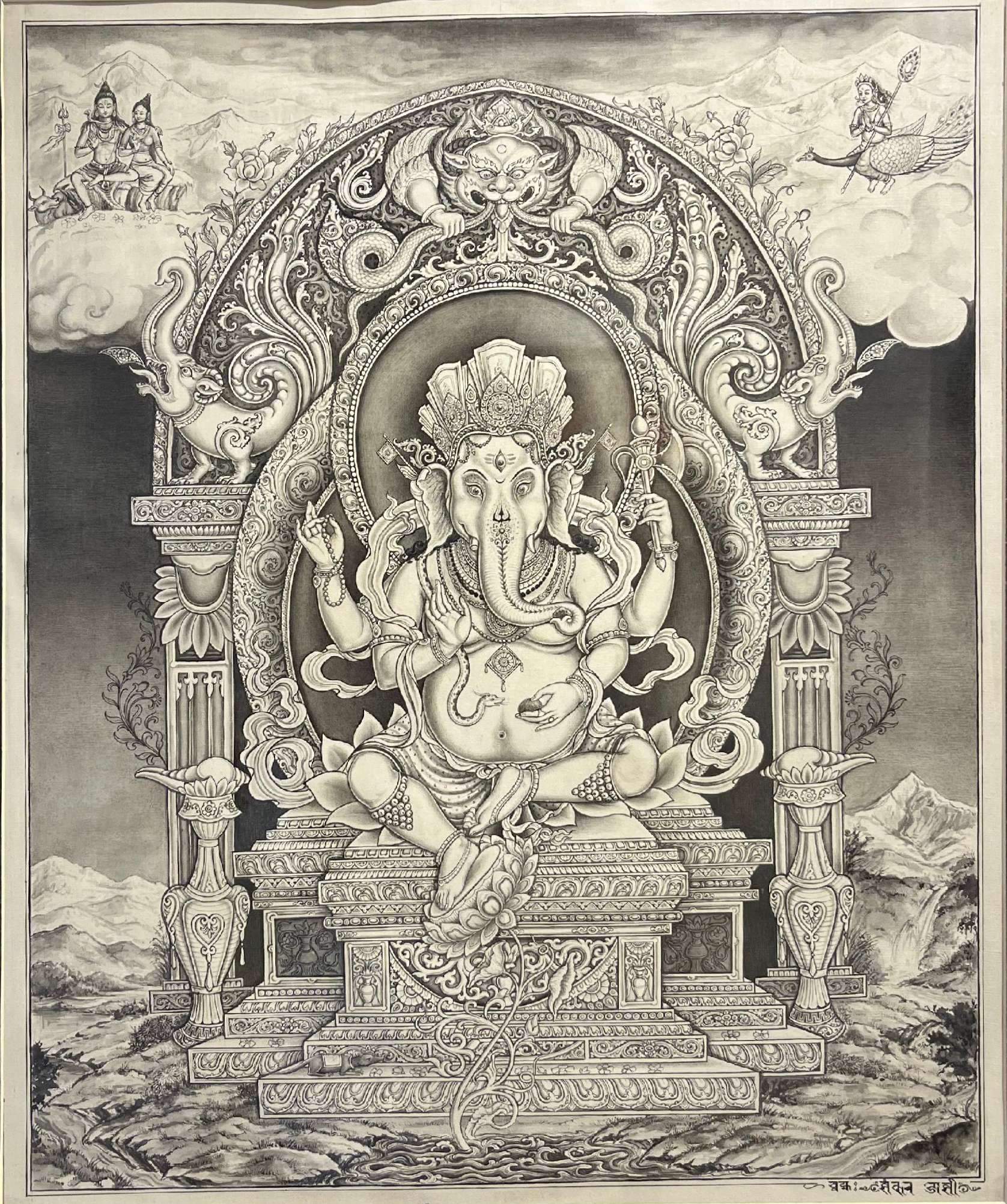
Twenty-one of Shrestha’s works are being presented at the gallery. He shared the story behind his rendering of Ganesh in one of them. “Ganesh has just managed to emerge victorious over his brother. The two are challenged to circumnavigate the universe three times over. Ganesh’s swift brother takes off on his peacock. Ganesh chooses to get on his mouse and take three laps around his seated parents. He wins and receives a boon. This is his victorious form," Shrestha shared.
Both artists stressed the importance of a good ‘guru’ in learning the art form. Gurus teach not only what and how but also the why – the reason a certain deity needs to be holding a certain item in one hand and not the other, the story behind the form a given deity has taken, etc.
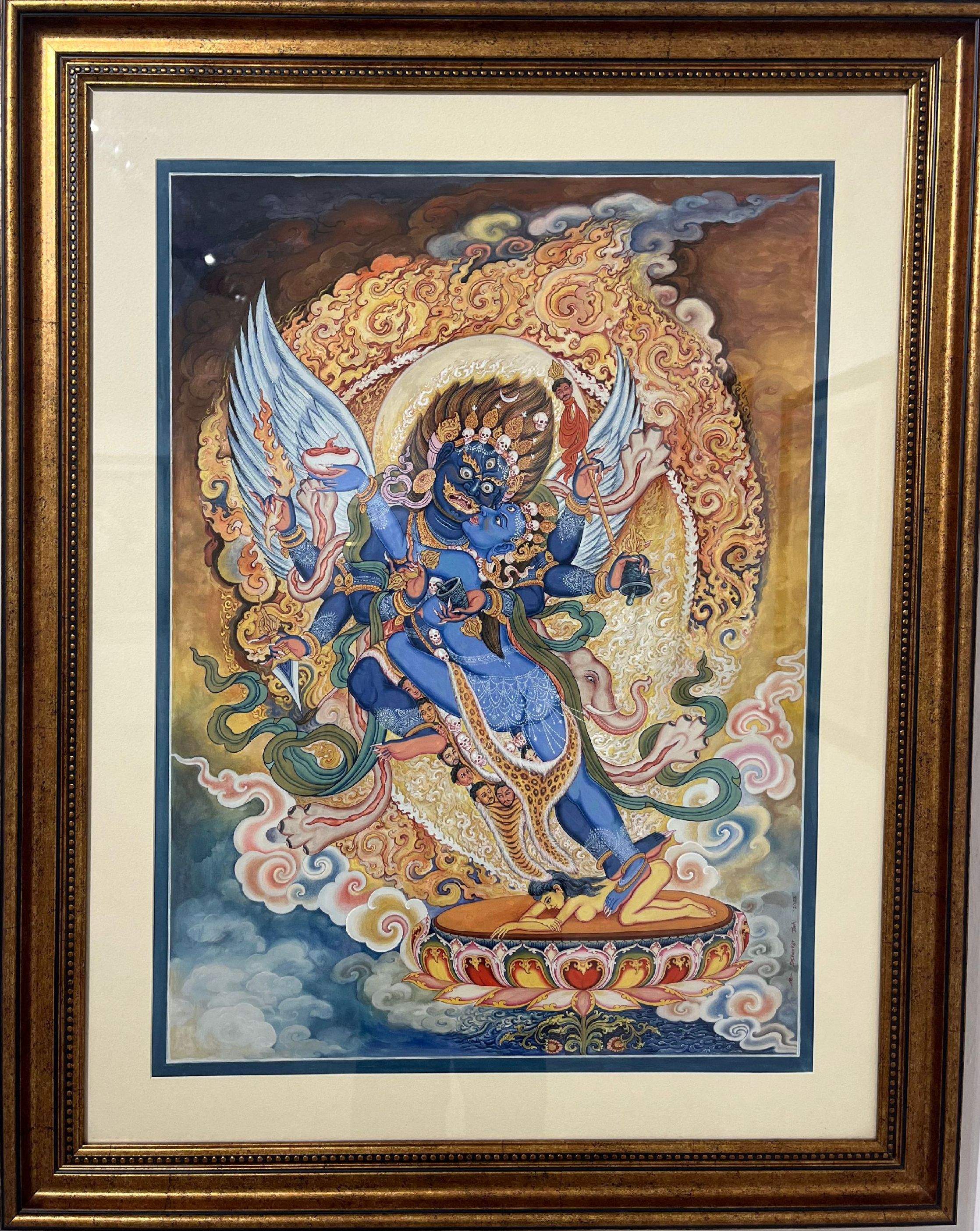
These details in the paintings are important because Poubha, as an art form, emerged out of Poubha, a religious practice. “These paintings go to temples. They are used for religious prayer,” Shrestha said. “They need to be accurate to the traditional stories; otherwise, they are not fit for religious use,” he added.
“In the past, not everyone was allowed to look at the deities in their fearsome forms. One needed to be initiated into the practice. Now it has become open for everybody to see and keep,” Joshi said. When asked about how they felt about this change, the artists expressed a sense of practicality. “If the art is kept in the temples to be viewed only by a certain few, it will begin to disappear. This sort of exhibition gives the art style publicity. That is a necessary thing if we want to keep the art form alive,” Joshi added.
The exhibition is most definitely worthwhile. The fearsome rendering of the deities with their legendary names makes the viewer feel small in the presence of the depictions, yes, but also in front of the tradition and history behind the art itself.
What are these stories and icons? What do they mean? Where do they come from? These are some of the many questions the viewer is confronted by. The viewing could be peaceful and meditative; the artists share that the focused work that goes into making the art certainly is, or it could lead down many a rabbit hole in search for more answers.
Traditional Poubha Paintings
When: July 15 - August 15,
Where: Siddhartha Art Gallery, Baber Mahal Revisited, Kathmandu
Time: 11:00 am to 5:00 pm
Entry: Free
Rivash Rijal
Rivash Rijal is a culture and lifestyle intern at the post. He is also a rising senior at St John's College in Santa Fe, NM. He will be graduating from the class of 2027 with a BA in Philosophy, Literature and Natural Sciences.

Most Read from Culture & Lifestyle

It’s a bird … it’s a plane … it’s the Indian ambassador’s farewell tweets

‘Tenzing’ puts the Sherpa at the centre of the Everest story
How should Nepal navigate a world in reorder? Rajib Upadhya on geopolitics and foreign policy

How Anup Poudel took Nepali cinema to Cannes
A Nepali photographer rediscovers Calcutta after decades
Editor's Picks

Constitutional Bench caught in seniority, ‘pick and choose’ dispute

A Dom boy’s long road to becoming a doctor

From blankets to handmade dolls, two foreign women bring comfort to flood survivors

News Analysis: When institutional defence exposes institutional fault lines
It’s a bird … it’s a plane … it’s the Indian ambassador’s farewell tweets
E-PAPER | October 12, 2026

×