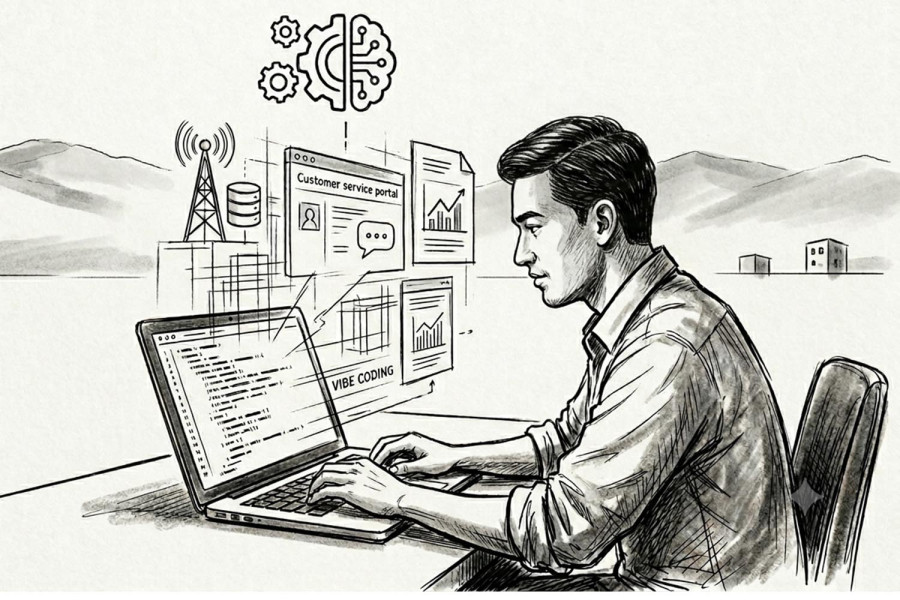
A fast-growing software approach known as vibe coding, where artificial intelligence is used to generate applications from simple instructions, is gaining traction in Nepal.
Nepal Telecom, the state-owned telecom operator, recently set up a software wing that has already developed around half a dozen digital portals and systems. The company said it has developed tools, including a demand management portal that centralises requests from local offices up to ministries, and a meeting management portal designed to ease pressure on limited office space.
These systems were developed by Nepal Telecom engineers using AI tools.
The company is also developing a unified ticketing system and a customer care portal, according to senior business officer Prakash Chandra Sigdel.
He said Nepal Telecom has automated the process of assigning IP addresses, which are the unique numerical identifiers used by devices on a network. This task previously required manual processing.
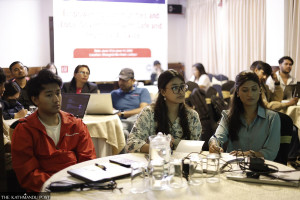
“In some areas, we also take support from external vendors, as we cannot compromise on quality and customer experience,” Sigdel said at a recent event in Kathmandu. “But we are moving towards building small and specific software in-house.”
He also said the company is studying a new billing system using similar technology. Nepal Telecom’s existing billing system is considered outdated and has been linked to recurring problems, including incorrect balance deductions.
Across Nepal, government offices and private companies are increasingly experimenting with AI-assisted software development. Known as vibe coding, this approach allows users to generate and refine software through user instructions (prompts) rather than relying solely on conventional programming.
In simple terms, it enables people with limited programming knowledge to create software by directing AI tools to write and refine code.
Sigdel said the approach works because companies understand their own needs best. “In-house coding has proven effective,” he said.
Private technology firms are also rapidly adopting similar methods. Nischal Shrestha, chief technology officer at Amnil Technologies, said the field is evolving into what is now being described as agentic engineering, where multiple AI agents handle the entire software development cycle.
“AI does not just write code. It runs and tests it as well,” Shrestha said. “These tools can help plan projects, design software, check for problems and even suggest features a company may need.”
He said this shift is enabling Nepali engineers to compete with counterparts in larger markets such as India. Tasks that once took weeks can now be completed in a few hours, Shrestha said.
However, he warned that the model also carries risks, particularly when it comes to security. Without a proper understanding of programming fundamentals, reliance on AI can introduce vulnerabilities. He said effective use requires strong prompting skills and the ability to guide AI step by step.
According to Rojesh Man Shikhrakar, director of AI education and talent development at US-based AI firm Fusemachines, the main concern is cybersecurity risks.
“People without basic programming knowledge relying entirely on AI can create serious security gaps,” he said.
Shikhrakar cited past incidents, such as municipal data leaks, as examples of how weak systems can be exposed when security practices are not properly followed.
He added that many companies now require engineers to use AI tools to improve efficiency and remain globally competitive. At the same time, concerns are rising that entry-level coding jobs could shrink as automation expands.
Some industry experts, however, argue that the bigger issue in Nepal is not job losses from AI, but a widening skills mismatch.
“Many graduates are entering the job market without the skills employers need,” said Gaurav Pandey, president of NAS-IT. “Students and their families spend between Rs1.4 million and Rs2 million on higher education, yet many struggle to meet even the basic requirements for entry-level technology jobs. The gap between university education and industry demand remains significant.”
Beyond software development, AI is also being used for research, documentation and analysis. According to Naveen Jaiswal, chief product officer at Codewing Solution, tasks that once took hours can now be completed in minutes.
He said AI tools can quickly analyse lengthy documents, such as the budget speech, and summarise key points. AI’s improving capability in the Nepali language, he added, is likely to further expand its use in Nepal.
Although vibe coding and AI-assisted software development are still in early stages in Nepal, interest is growing. Developers are increasingly relying on tools such as VS Code, GitHub Copilot, ChatGPT Codex, Claude, Gemini and Cursor as coding assistants.
Other platforms, like Lovable, are being used for website development, while Microsoft Power Apps and Copilot are used for enterprise applications. Free tools such as Ollama are also gaining popularity, alongside AI app builders like Base44, which allows non-coders to create applications, are also becoming popular.
Globally, major companies are also pushing deeper into AI-driven development. An AI startup founder, Ziwen Xu, is reportedly experimenting with building a version of the game Grand Theft Auto VI using a large AI model, Claude Max 20x, in an attempt to generate a complex game through prompts alone, without traditional coding.
Reports have also suggested that Elon Musk’s space company, SpaceX, had explored acquiring the vibe coding startup Cursor for about $60 billion. Cursor is a platform that allows developers to build complex software through natural language prompts.
These developments offer a glimpse of where software development may be heading. Microsoft and Google have both acknowledged that AI now assists in generating a significant share of their code, reflecting a broader shift towards AI-driven development.
“If the next generation cannot work with AI agents and manage complex systems, they will struggle in the market,” Shrestha said. “Engineers now need to move beyond automation and develop a deeper understanding of how these systems work.”




 21.89°C Kathmandu