Dhurbe, the rogue elephant that followed a family for 14 years
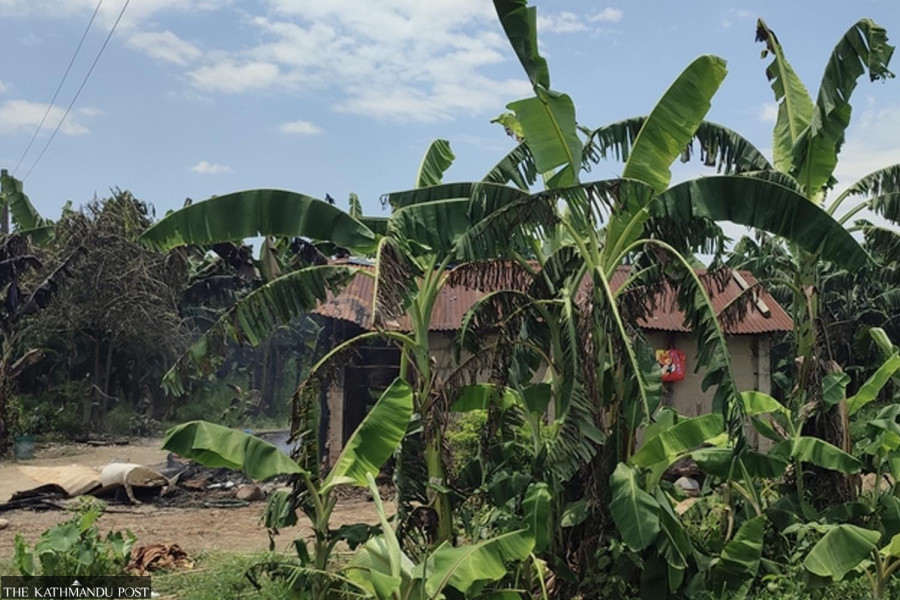
Shanichara Bote thought he had escaped the threat that killed his parents. Then, the notorious elephant returned to destroy his home again.The house of Ashika Bote pictured in Jagatpur on the fringes of the Chitwan National Park on Sunday. Bote was killed in a wild elephant’s attack, along with her four-year-old son, on Saturday, Ramesh Kumar Paudel/TKP
On December 16, 2012, Shanichara Bote sat motionless at the Baruwa bazaar in Madi, alongside the lifeless bodies of his father Budhiram and mother Jharali. They had just been trampled to death by Dhurbe, a notorious wild male elephant that had begun terrorising the fringes of Chitwan National Park.
In the wake of that tragedy, Shanichara uprooted his entire life to escape the persistent threat of wildlife encroachment. He crossed the Reu river, bypassed the core national park boundaries and moved across the Rapti river to settle down in Jagatpur. Yet, despite his desperate migration, the shadow of the rogue elephant followed him.
On Sunday afternoon, Shanichara was found sitting in a state of profound shock inside the District Police Office in Chitwan. Only hours earlier, during the quiet midnight of Saturday, the very same wild elephant broke into his new home, killing his daughter-in-law Ashika Bote, aged 25, and his four-year-old grandson Bharat Bote.
The structural failure of human-wildlife mitigation measures in the country’s premier conservation zones has left Shanichara’s family shattered, losing four members to a single animal over a span of 14 years.
“We originally lived at Dropatinagar in the Madi area, but the constant terror of wild elephants forced us to sell what we had and migrate to Jagatpur,” said Shanichara while waiting for the police to complete the post-mortem procedures.
“We believed that moving across the major rivers would keep us safe. But after all these years, the exact same elephant found us again, raided our home, and took my daughter-in-law and my little grandson. There is nowhere left for us to run.”
Dhurbe’s history of violence is well-documented within the records of Chitwan National Park, the country’s first protected area. Conservationists explain that when young male elephants mature, they are aggressively driven away from their maternal herds by dominant males, forcing them into a solitary, frequently hostile existence. Dhurbe followed this exact behavioural pattern, becoming a lone wanderer who increasingly viewed human settlements as foraging grounds.
According to official park dossiers, Dhurbe first began attacking human settlements and causing fatalities in 2010. Since then, the marauding jumbo has been directly responsible for the deaths of at least 25 individuals across the region.
“We have been utilising a satellite tracking collar to monitor the movements of this highly aggressive male elephant,” said Abinash Thapa Magar, information officer and conservation official at Chitwan National Park. “Our data logs show that his location coordinates were pinned directly around the perimeter of the incident site on Saturday night.”
He added, “Prior to this tragic incident, Dhurbe had officially claimed 23 human lives. With these two latest casualties in Jagatpur, the confirmed number of fatalities attributed to this single elephant has now risen to 25.”
Among his many victims, Dhurbe has also killed two separate military personnel deployed for counter-poaching and park security duties.
The historical trajectory of this rogue elephant highlights a long-standing regulatory dilemma. Following the deaths of Shanichara’s parents in 2012, a high-level emergency security meeting chaired by the Chief District Officer issued a formal executive order to track down and kill the elephant. What followed was an intensive two-week military and conservation manhunt inside the dense forests of Chitwan.
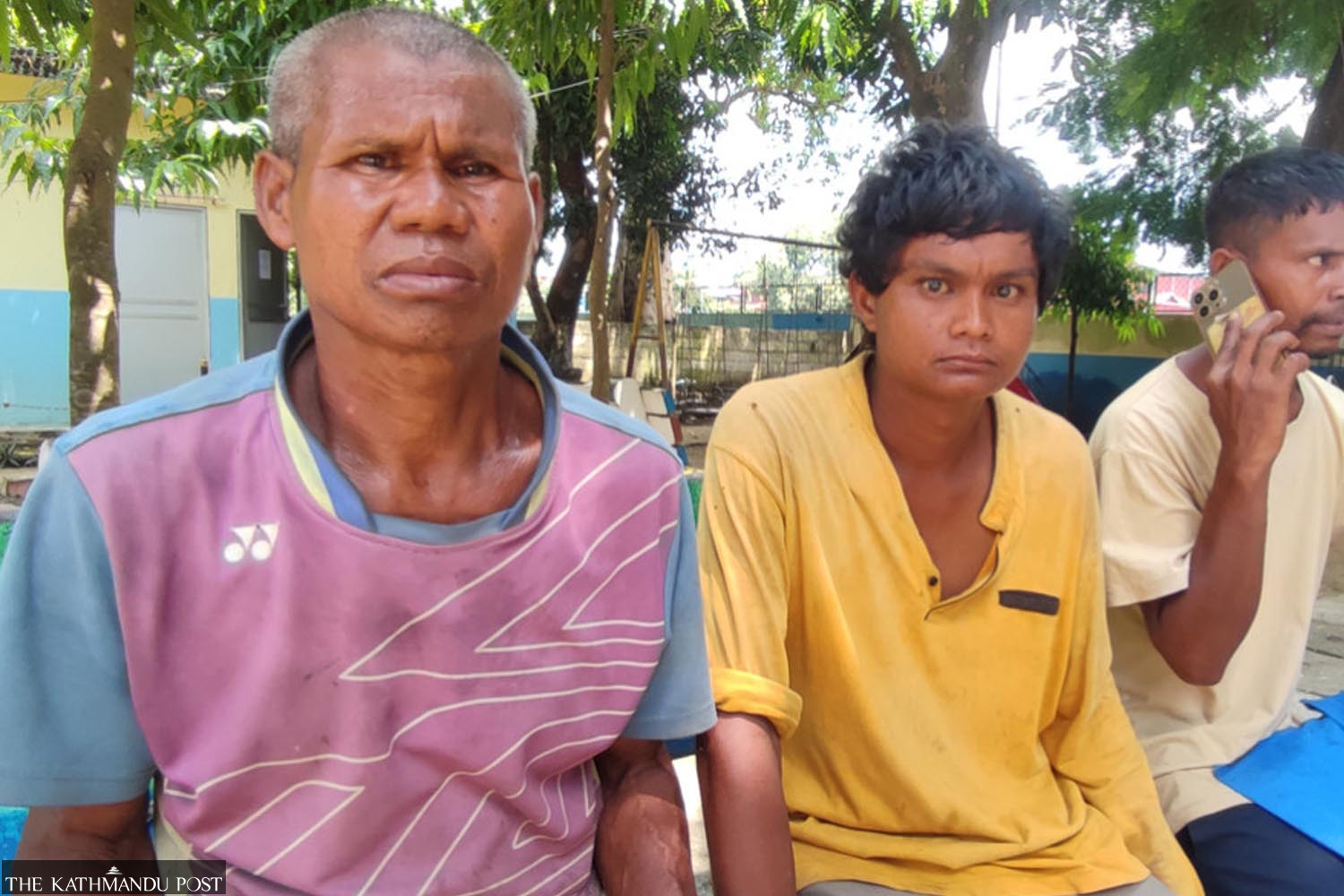
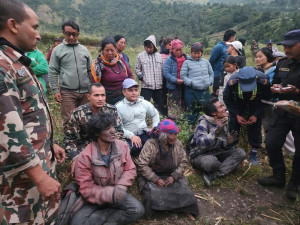
Shanichara Bote (left) with his son Purna (centre) and another son outside the District Police Office in Chitwan on Sunday as they wait for the post-mortem of Purna’s wife and four-year-old son, who were killed by the rogue elephant Dhurbe. Ramesh Kumar Paudel/TKP
Park authorities and army personnel fired upon the elephant on two separate occasions in late December 2012, severely wounding it. However, the resilient animal managed to escape deep into the jungle, costing the state treasury over Rs1.6 million in operational expenses. Believed to have succumbed to its bullet wounds, Dhurbe mysteriously re-emerged in the western sectors of Chitwan during the winter of 2016.
By 2019, however, Dhurbe expanded his territory, wandering into eastern Chitwan and Barandabhar forest corridor. This forced authorities to fit him with a second satellite collar in May 2020, as the initial radio collar attached in late 2012 had stopped transmitting signals.
“The satellite collars are designed to transmit precise data to our central monitoring computers, allowing us to anticipate when the animal is moving towards human settlements,” said information officer Thapa Magar. According to him, a satellite collar was fitted onto Dhurbe in 2023 for the third time. This tracking unit transmits location data at rigid one-hour intervals. Whenever the coordinates indicate a movement towards the villages, a joint team of national park rangers and Nepali Army soldiers is deployed to push the elephant back into the core forest area.
Despite these technological interventions, local communities argue that the current tracking system contains dangerous operational gaps. Lal Bahadur Dawadi, chairman of the Ghailaghari Buffer Zone Consumer Committee, said that Dhurbe had been actively hovering around the forest fringes and pushing into human settlements for the past nine to ten days.
“This animal follows a cyclical path and returns to the villages every single year, meaning his presence was entirely predictable to the park authorities,” said Dawadi.
Keshav Lamichhane, a 72-year-old resident of Jagatpur Belhattha in Bharatpur Metropolis-23, who has lived in the area since 1985, corroborated that Dhurbe’s raids peak during the autumn and winter harvest seasons. “When the paddy and corn crops ripen, Dhurbe arrives like clockwork,” said Lamichhane. “Just a couple of years ago, he raided a neighbouring village, slung sacks of harvested rice over his back, and walked right back into the jungle. However, this is the very first time he has committed such a brutal human killing within our immediate neighbourhood.”
Nine people live crammed together inside Shanichara’s tiny house, which is built on a narrow plot of land. Although the double-sloped roof is covered with corrugated zinc sheets, they are old and heavily rusted. The walls are not sturdy either. A total of nine family members—Shanichara’s wife, their three sons, his eldest daughter-in-law, a grandson, a granddaughter, and the daughter-in-law’s mother—share this cramped dwelling.
“During the night, it felt as though something was pounding against the wall. When I went outside to look, I saw the elephant,” recalled Sanischara. “The mud walls collapsed instantly. My daughter-in-law emerged holding my grandson, but the elephant intercepted them.”
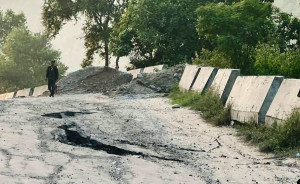
Shanichara’s wife Mangali managed to scare the elephant away by igniting dry thatch from their porch, which accidentally burned their home but saved the remaining family members. Following the attack, enraged local residents blocked the Rapti bridge to protest park negligence.
Park authorities have now pledged to permanently contain Dhurbe within the Sukhibhar forest sector, promising to upgrade their infrastructure to real-time satellite tracking collars to prevent future casualty.




 15°C Kathmandu
1.jpg)