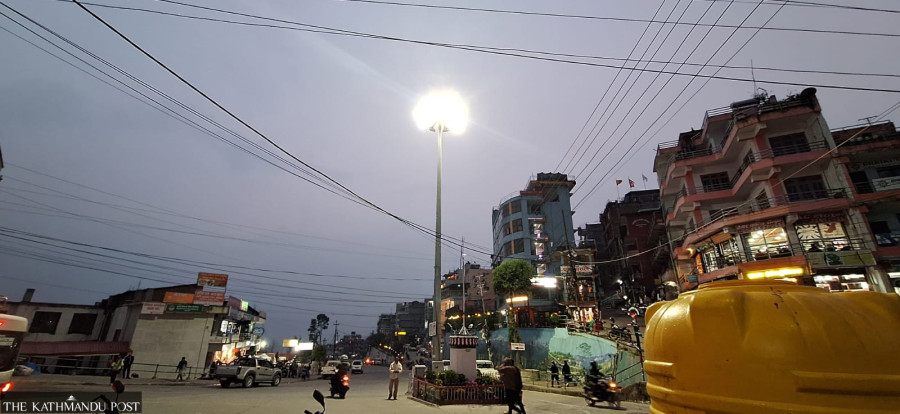
Streetlights installed under a smart city initiative in Charikot in Bhimeshwar Municipality have been switching on during daytime and remaining on longer than scheduled in the morning, exposing technical and operational weaknesses in the system.
Residents first noticed the irregularity during the month of Magh (January-February), when streetlights at the main Charikot junction were found glowing even under bright sunlight. The lights glowed early in the evening and switched off only around 7am, well after sunrise.
The issue persisted for nearly a month, prompting locals to question municipal officials about why streetlights were functioning in daylight hours. However, initial complaints did not immediately resolve the problem.
The streetlight system was installed about four years ago under a partnership between Bhimeshwar Municipality and the Nepal Electricity Authority as part of an initiative to modernise urban infrastructure and develop Charikot into a smart city. The installation work began in 2021 and was completed in 2022.
The system includes smart lighting infrastructure in key commercial areas such as Satdobato and Pashupati Chowk. All lights are designed to operate on a centralised automated schedule.
However, officials say the streetlight scheduling system runs on software hosted in India.
Arjun Tamang, a municipal official for managing the system, said the municipality repeatedly raised concerns after the lights began operating during daytime hours, but was told that schedule corrections could only be made through the India-based system.
“I informed the installing company after the lights started remaining on during the day. They responded that the timing had to be adjusted from India,” Tamang said. “Even after repeated follow-ups, we were told the software is controlled from there.”
He said the company had provided initial training and a mobile application to manage the lighting schedule locally. However, the application is no longer functioning, making adjustments locally impossible.
Tamang added that while the system was designed to allow centralised control, the municipality currently lacks direct access to the software that manages timing and brightness levels.
The municipality spends more than Rs1.5 million annually on electricity for the streetlights installed across the urban area. Officials say inefficient scheduling and the inability to control features locally are contributing to higher power consumption.
The system was originally designed with energy-saving features, including sensor-based dimming and automated brightness control depending on time and ambient light conditions. However, these features are not being fully utilised due to software access limitations.
Bhimeshwar Municipality Mayor Ishwar Narayan Manandhar said the system was initially dependent on the India-based control software, but claimed that responsibility had recently been handed over to the Dolakha Distribution Centre of the Nepal Electricity Authority.
“Earlier, we had to coordinate with the company for any adjustments to the lighting schedule,” he said. “Now, as far as I know, the system has been handed over to the Nepal Electricity Authority. We will see how effectively it is managed from here.”
However, the Chief of the Dolakha Distribution Centre, Roshan Kumar Singh, disputed the claim of a full handover. He said the streetlight system remains part of the broader Nepal Electricity Authority project framework and is not fully controlled at the local office level.
“This is managed under the streetlight project of the Nepal Electricity Authority. The technical system and control structure are handled centrally,” Singh said. “We were informed about the scheduling issue about a month ago and had been informed that it would be resolved through the central system.”
He added that if full control were available at the local office, such issues could be corrected more quickly.
Former head of the Nepal Electricity Authority’s streetlight project, Sagar Ghimire, acknowledged that technical issues in the software had earlier forced reliance on the India-based system for adjustments. However, he said the system has now been upgraded.
“There were problems in the earlier software, which required adjustments from India,” Ghimire said. “We have since upgraded both hardware and software components. The issue is minor and is expected to be resolved within a few days.”
He added that the long-term solution involves replacing servers and restructuring the system to ensure that full operational control remains within Nepal.




 13.86°C Kathmandu