Bhandari calls for long-term climate support for vulnerable countries
Nepal’s former president Bidya Devi Bhandari urges Himalayan nations to cooperate on glacier monitoring and disaster preparedness, while calling for long-term international support for climate-vulnerable countries.
Former President Bidya Devi Bhandari has called for reliable, long-term international support to help climate-vulnerable countries cope with global warming, highlighting the need for stronger cooperation among Nepal, China, India and other Himalayan nations.
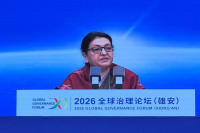
Addressing the Global Governance Forum 2026 in Xiong’an, Hebei Province, China, on Friday, Bhandari said international cooperation must better reflect the needs of vulnerable countries and deliver practical results for their people.
She urged the United Nations and international financial institutions to provide sustained support to help vulnerable nations reduce climate risks and adapt to their consequences.
Bhandari also called on Nepal, China, India and other Himalayan countries to strengthen cooperation on meteorological data exchange, glacier monitoring, early warning systems and disaster preparedness and response.
Describing the Himalayas as a shared natural heritage essential to regional water systems, biodiversity and environmental balance, she stressed the need for countries in the region to work together to address the effects of climate change.
Her remarks placed climate vulnerability among the broader questions of fairness and representation in global decision-making. Speaking at the conference organised by the Chinese People’s Institute of Foreign Affairs, Bhandari argued that smaller and vulnerable countries must have a greater say in shaping international policies that affect them.
“Global governance decisions should incorporate the voices of all nations,” she said, calling for greater consideration of least developed countries, landlocked developing countries, small states and countries vulnerable to climate change.
Bhandari outlined three priorities for global governance: equal participation and meaningful representation for all countries, dialogue and peaceful coexistence, and people-centred policies that deliver tangible results.
She said international relations should be governed by international law rather than the priorities of a limited number of powerful countries. She also called for the United Nations to be strengthened so that it better reflects the diversity and aspirations of the contemporary world.
Bhandari referred to Chinese President Xi Jinping’s concept of a “Community with a Shared Future for Mankind” and his four global initiatives on development, security, civilisation and governance. She particularly highlighted the Global Governance Initiative, proposed at the Shanghai Cooperation Organisation Plus meeting in Tianjin on September 1, 2025.
She said the initiative offered an opportunity to advance dialogue on governance reform and international cooperation, but its effectiveness would depend on meaningful participation by all countries, transparency, mutual respect and the fulfilment of international commitments.
Bhandari also urged countries to resolve disputes through dialogue and diplomacy, strengthen efforts to end armed conflicts, curb the proliferation of weapons of mass destruction and advance disarmament.
“Peace and development are complementary to each other,” she said, adding that ending poverty and hunger, improving human welfare and redirecting resources spent on the arms race towards development were shared responsibilities of the international community.
Describing Nepal, the birthplace of Gautam Buddha, as committed to peace, non-violence and coexistence, Bhandari said global governance should be measured by its impact on people’s lives. Poverty reduction, quality education and healthcare, employment, social justice and environmental protection should remain central to international cooperation, she said.
On Nepal-China relations, Bhandari said ties between the two countries had developed over centuries through cultural exchanges, Buddhist philosophy and close people-to-people connections. She described the relationship as grounded in the principles of Panchsheel, mutual respect, trust and cooperation.
She reaffirmed Nepal’s commitment to the one-China policy, saying respect for sovereign equality, independence and territorial integrity was essential to building lasting friendship and trust among nations.
Bhandari expressed confidence that the forum would contribute to building a fairer, more inclusive and effective global governance system and create opportunities for cooperation on international peace, sustainable development and shared prosperity.
Anil Giri is a Chief Sub Editor covering diplomacy, international relations and national politics for The Kathmandu Post. Giri has been working as a journalist for more than two decades, contributing to numerous national and international media outlets.




 21.76°C Kathmandu