Experts, leaders urge Congress to adopt a sharper foreign policy
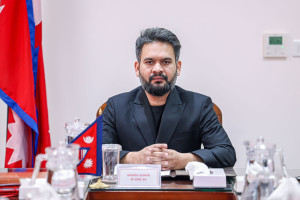
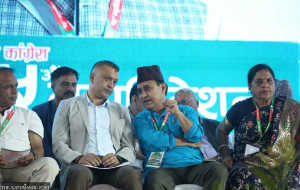
They call for a pragmatic approach to relations with India, China and other major powers, with greater focus on economic diplomacy and strategic autonomy. Nepali Congress spokesperson Devraj Chalise addresses participants ahead of the party’s 15th general convention, which starts on Sunday. Nepal Photo Library
As the Nepali Congress convenes its 15th General Convention in Kathmandu, senior leaders and foreign policy experts are urging the party to adopt a clear and specific foreign policy, rather than repeat broad references to non-alignment, sovereignty and national interest.
They say the party should define how it will manage relations with its immediate neighbours and other major powers, pursue economic diplomacy, and protect strategic autonomy while expanding international partnerships.
Congress has traditionally followed a foreign policy first drafted by its founding president, BP Koirala, and amended it over time.
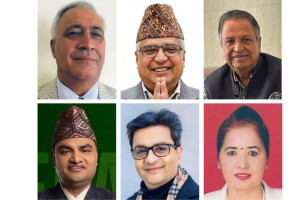
Dinesh Bhattarai, who was foreign policy adviser to former prime ministers Sher Bahadur Deuba and Sushil Koirala, said the new policy should be based on “continuity with change” and should not compromise on fundamental principles.
“The party’s foreign policy is clear and consistent as of now,” Bhattarai said. “Be it out of power and inside the power, its foreign policy remains unchanged. But in the changed domestic, regional and global contexts, it should be dynamic, forward looking, pragmatic.”
He said the neighbourhood-first priority the party declared in 2015 should remain, alongside constructive engagement with the wider world. Congress has long pursued strategic autonomy and non-alignment, stronger relations with India, China, the US and Western partners, economic, diaspora and multilateral diplomacy, regional cooperation, and the institutionalisation of the foreign ministry.
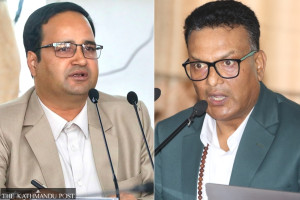
Senior Congress leader and former minister Minendra Rijal said foreign policy should not be used to appease domestic nationalist sentiment. Citing Canadian Prime Minister Mark Carney, he said Nepal must keep up dialogue and pursue its national interest even when it disagrees with neighbouring and powerful countries.
Such dialogue, Rijal said, has to be backed by substance. “Strategic autonomy” cannot be achieved through political slogans alone, he said, pointing to Nepal’s structural dependence on India, the limitations of its electricity market, and the controversy over the US-funded Millennium Challenge Corporation compact before its parliamentary ratification. Taken together, he said, these issues call for a clear and definitive policy.
Rijal also stressed that such a policy must be sensitive to the concerns of Nepal’s neighbours. Drawing on his own experience as a minister, he said even small diplomatic gestures carry significant meaning for China on matters such as Tibet and the Dalai Lama. Congress, he said, cannot ignore that geopolitical sensitivity.
But no policy will deliver on its own, he said. A country’s real strength in international relations comes from its domestic capacity, and Nepal can achieve strategic autonomy in practice only by strengthening its institutions, implementation capacity and economy.
That emphasis on the economy is shared by Gaurab Sumsher Thapa, secretary at the Nepal Council of World Affairs, who said Congress should orient its foreign policy toward economic development. He noted that Congress-led governments initiated economic liberalisation in the early 1990s and played a vital role in ending the Maoist conflict and ushering in the republic.
Thapa laid out what that would mean for each of Nepal’s key partners. On India, he said the party should put economic issues such as trade, foreign direct investment and connectivity first, and set aside long-standing political disputes. He added that Congress should emphasise cultural ties to nurture people-to-people relations.
Turning to China, Thapa said the party should support the one-China policy politically. “In economic terms, rather than setting lofty targets with regard to the Belt and Road Initiative, Nepali Congress should prioritise engagement in viable bilateral projects,” he said.
As for the US, ties should rest primarily on economic and developmental cooperation “rather than supporting its regional and global security ambitions,” Thapa said.
The Constitution of Nepal adopts non-alignment, Panchsheel, the UN Charter, international law and world peace. Within that framework, Congress should pursue a pragmatic foreign policy that protects and promotes the national interest, leaders say.
“The 15th General Convention gives the Nepali Congress an opportunity to take up this discussion in a substantive way,” Rijal said. “The leadership election will decide who leads the party, but the foreign policy adopted by the convention could shape the international role the party seeks for Nepal in the years ahead.”
Anil Giri is a Chief Sub Editor covering diplomacy, international relations and national politics for The Kathmandu Post. Giri has been working as a journalist for more than two decades, contributing to numerous national and international media outlets.




 20.58°C Kathmandu