Balendra Shah becomes 40th prime minister of Nepal
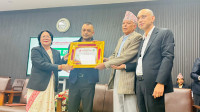
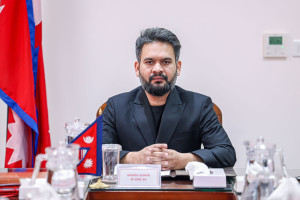
There are enormous expectations of the 35-year-old executive head who must now deliver on promises of anti-corruption, good governance, meritocracy, and justice for the families of the martyrs of Gen Z uprising. Prime Minister Balendra Shah (in black) takes his oath of office and secrecy from President Ramchandra Paudel with other top state officials in attendance at Sheetal Niwas, on Friday. Angad Dhakal/TKP
Three weeks after registering victory against former Prime Minister and CPN-UML chair KP Sharma Oli in the March 5 elections, Rastriya Swatantra Party senior leader Balendra Shah became the country’s executive head on Friday.
President Ramchandra Paudel administered the oath of office and secrecy to the 35-year-old prime minister amid a special function held at Sheetal Niwas.
The swearing-in ceremony included the performance of shankhanaad (blowing of conch shells). In addition, swastishanti recitation was performed by 108 Batuks, while Buddhist monks conducted ashtamangal chanting.
This marks the first time a leader from the Madheshi community has become prime minister.
A rapper and structural engineer, Shah shot to fame after he pulled off an upset in the 2022 local elections as an independent, defeating candidates from legacy parties by overwhelming margins to become the mayor of Kathmandu, the country’s most populous metropolis.
Shah served as mayor of Kathmandu Metropolitan City from May 2022 until his resignation in January 2026, and entered national politics by formally joining the RSP at the end of 2025.
Following Shah’s swearing-in, President Paudel also administered the oath to 14 other ministers. RSP vice-chair Swarnim Wagle has become the minister for Finance. He is an expert on economic affairs and was elected twice from Tanahun-1 to the House of Representatives, including the March 5 parliamentary elections.
Sudan Gurung, who rose to prominence during the Gen Z movement, has become the minister for home.
Shishir Khanal has been given the foreign ministry. He heads the RSP’s foreign affairs department.
Similarly, Khadak Raj (Ganesh) Paudel has been appointed the minister for Culture, Tourism and Civil Aviation. A writer, he was elected from Kaski-1. Dipak Sah from Mahottari has taken charge as minister for Labour and Employment.
Sasmit Pokharel, elected from Kathmandu-5, has been appointed as the minister for Education, Science and Technology, and Youth and Sports. Likewise, Bikram Timilsina has been appointed to the Ministry of Communication and Information Technology, while Pratibha Rawal serves as the minister for Federal Affairs and General Administration, and Land Management, Cooperatives and Poverty Alleviation. She has a background in journalism and was elected under the proportional representation system. Rawal is also the party’s co-spokesperson.
Biraj Bhakta Shrestha is the minister for Energy, Water Resources and Irrigation in the Shah Cabinet.
Gita Chaudhary is the Minister of Agriculture and Livestock Development, and Forest and Environment. She was elected under proportional representation and joined the RSP shortly before the elections. She also serves as an advocate.
Sobita Gautam has become the minister for Law, Justice and Parliamentary Affairs. A legal expert, she defeated former Bharatpur mayor Renu Dahal in Chitwan-3 in the March 5 parliamentary elections.
Sita Badi has taken charge of the Ministry for Women, Children and Senior Citizens, while Sunil Lamsal is the Minister for Physical Infrastructure and Transport and Urban Development. Nisha Mehata has become Minister for Health and Population, and Water Supply.
In line with the spirit of the Gen Z movement, the primary tasks of the new government are clear enough: ensure good governance, control corruption, improve public service delivery, accelerate economic growth, and create jobs.
Yet, as former prime minister and finance minister Baburam Bhattarai cautions, none of this can be achieved overnight. “Good governance and service delivery are not things that can be achieved by one person performing magic,” he said.
In a democracy, sustainable reform must be institutional, requiring gradual improvements across federal and provincial governments, constitutional bodies, the judiciary, and security agencies, he added. With a comfortable majority, the government has the opportunity—and responsibility—to pursue long-term reforms through laws, policies, and institutional strengthening.
Political scientist Karma Tamang echoes this view but emphasises urgency. Old laws, she argues, are inadequate for delivering good governance. “Legislative bottlenecks that once took months should now be resolved within weeks. Leveraging information technology to streamline public services could significantly improve efficiency and accessibility,” she said.
This urgency is rooted in Nepal’s recent political history. Since the promulgation of the constitution in 2015, governments have changed frequently, but structural reforms have lagged behind. Successive administrations spoke of federalism while in opposition, only to recentralize power once in office.
As a result, even a decade later, provincial governments remain weak, often functioning as administrative extensions of the centre. Critical laws—particularly those governing police and civil service—have not been enacted, leaving provinces dependent on Kathmandu even for routine administrative decisions.
The challenge of federalism
Balendra Shah’s remarks in Madhesh Province in January captured this frustration. He argued that provinces should not have to come to Kathmandu to seek their rights. This marked a shift in tone for the Rastriya Swatantra Party (RSP), which had previously expressed ambivalence towards federalism. During the 2022 elections, the party’s position had raised doubts, with some leaders even suggesting federalism could be scrapped.
Shah’s statement in the Janakpur campaign rally sought to dispel these concerns. By emphasising the need to empower provinces, he signalled a commitment—at least rhetorically—to making federalism work. “Provinces should be made so strong that one does not have to go to Kathmandu,” he said, adding that the capital should become a place people visit only for pilgrimage, not for administrative necessity.
Experts argue that this vision requires more than rhetoric. Federalism specialist Khim Lal Devkota notes that the constitutional framework already provides for decentralisation; the problem lies in implementation. Without key legislation—such as the Civil Service Act, Police Act, and Education Act—provinces cannot exercise their authority. More fundamentally, the mindset of governance remains centralised. “Changing this will be as difficult as passing laws,” Devkota says.
The RSP government thus faces a structural challenge: translating constitutional promise into administrative reality. Previous governments failed to create the legal and institutional environment necessary for federalism to function. Shah now inherits both the opportunity and the burden of correcting this.
Political coordination and constraints
Despite its strength in the federal parliament, the RSP’s reach across the broader state structure is limited. It does not lead any provincial government and has minimal presence at the municipal level. In a federal system, policy implementation relies heavily on provincial and local governments—the tiers closest to citizens.
This creates an immediate need for political coordination. In six of the seven provinces, power remains with alliances led by traditional parties such as the Nepali Congress and the CPN-UML. Municipal governments are similarly dominated by these parties. Without their cooperation, even well-designed policies from the centre may struggle to take effect.
Institutional constraints extend further. The RSP lacks representation in the National Assembly, making constitutional amendments difficult. Any major reform—particularly those related to federal restructuring—requires broad political consensus, including agreement from provinces. As Baburam Bhattarai points out, even a majority government cannot bypass this reality.
Legal experts also caution against overreach. Advocate Semanta Dahal suggests that constitutional amendments should initially focus on improving governance mechanisms—such as strengthening oversight bodies like the CIAA, the Office of the Auditor General, and the National Human Rights Commission. “This is the way to go rather than attempt sweeping structural changes that demand extensive political negotiation,” Dahal said.
Meanwhile, the legacy of previous governments continues to shape the state apparatus. Appointees to constitutional bodies, entrenched bureaucratic practices, and a centralised administrative culture all pose challenges to rapid reform. The risk is a mismatch between public expectations—raised by the Gen Z movement—and the pace at which institutions can realistically change.
Stability and internal dynamics
Another test lies in political stability. Nepal’s recent history offers little reassurance: no government since 1991 has completed a full five-year term. Internal party dynamics often prove as destabilising as external opposition.
For the RSP, questions have already emerged about the balance of power between the party leadership and the government leadership. The relationship between party chairman Rabi Lamichhane and Prime Minister Shah will be closely watched. Any perception of parallel power centres could undermine governance and erode public confidence.
The stakes are high. The RSP came to power on the promise of doing what traditional parties could not. Failure to manage internal cohesion and external expectations could quickly turn public optimism into disillusionment.
The path forward
Parliamentary strength alone will not guarantee success. The Shah government must navigate a complex landscape shaped by administrative inertia, constitutional constraints, political fragmentation, and economic pressures. Delivering on promises of good governance will require not just intent, but sustained institutional reform.
Economic realities add another layer of difficulty. Growth remains sluggish, state resources are limited, and revenue collection is under strain. At the same time, expectations for development are high. Bridging this gap will require both policy innovation and disciplined implementation.
Legal reform will be central. Streamlining administrative processes, clarifying accountability mechanisms, and closing loopholes that allow political actors to evade responsibility are essential steps. The long-standing practice of shielding political decisions under the guise of “policy decisions” must be addressed if anti-corruption efforts are to be credible.
Likewise, the question of international relations and maintaining balance also has a direct bearing on the government’s stability.
Former prime minister Baburam Bhattarai advises that Nepal must pay close attention to maintaining balanced relations with its two large neighbours. “We are situated between two major countries, India and China. But in recent times, Western powers—particularly the United States—have become increasingly active and assertive across various domains. In that context, there is a risk that a triangular contest among major power centres could intensify even in Nepal,” he said.
Finally, the government must manage the legacy of the Gen Z movement itself. Public anger over corruption and impunity was a driving force behind the political shift. The report of the Gauri Bahadur Karki commission, formed to investigate the suppression of the movement, remains a sensitive issue. Implementing its recommendations while maintaining broad public trust will be a delicate balancing act.




 23.63°C Kathmandu