Supreme Court puts controversial parliamentary rules on hold
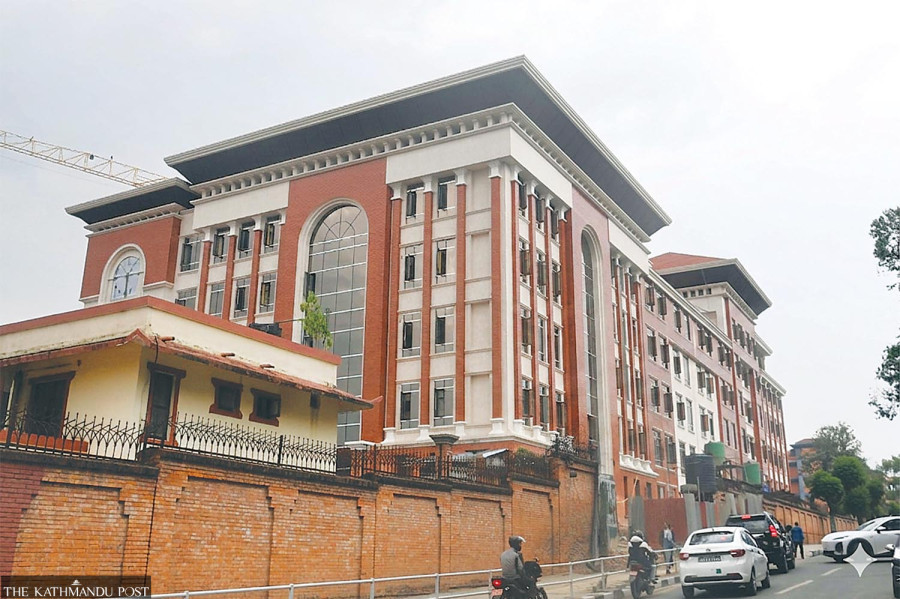
The court says two provisions in the House of Representatives rules may conflict with constitutional safeguards on amending the constitution and the authority of existing laws. The Supreme Court building. File Photo
The Supreme Court has temporarily blocked the implementation of two provisions in the newly adopted rules governing the House of Representatives, saying they appear, prima facie, to conflict with constitutional provisions.
A five-member Constitutional Bench led by Chief Justice Manoj Kumar Sharma on Wednesday ordered that Rule 140(11) and Rule 259 of the House of Representatives Rules, 2026, remain in abeyance until further orders.
The rules, adopted in May, have been contentious because of provisions concerning constitutional amendments and the legal status of parliamentary rules.
The court said Rule 140(11), which sets out a procedure for certifying a constitutional amendment bill, appeared to conflict with the constitutional requirement for each chamber of the federal parliament to approve constitutional amendments separately. It also said Rule 259 appeared to conflict with existing constitutional and legislative provisions.
Nepal’s Constitution requires a constitutional amendment bill to be passed by at least a two-thirds majority of the total members currently in each chamber of the Federal Parliament. Article 274 sets out the amendment procedure, while Article 104 allows each chamber to make rules governing its own functioning and proceedings.
The disputed Rule 140(11) provided a different mechanism. It stated that once an amendment bill passed by the House of Representatives was sent to the National Assembly, the speaker could certify it and send it to the president for authentication if the combined vote from both chambers reached at least two-thirds of their total membership.
That provision became the focus of a petition filed by Kamaladevi Pant, the parliamentary party leader of the Nepali Congress in the National Assembly, and others. The petitioners argued that the rule effectively allowed the votes of the two chambers to be combined, potentially enabling a constitutional amendment without the required two-thirds majority in each chamber.
The Supreme Court said the provision appeared inconsistent with the constitutional framework governing amendments and with Rule 129 of the National Assembly Rules, 2018, which sets out the procedure for constitutional amendment bills.
The court also put Rule 259 on hold. The provision states that, notwithstanding anything contained in existing laws, the House rules would apply as a federal law with the status of a special law. The petitioners argued that this could give the House rules precedence over laws enacted by Parliament and undermine constitutional procedures requiring the participation of the National Assembly and presidential authentication.
The petitioners also challenged the provision on the grounds that Article 104 gives each chamber authority to regulate its own proceedings, but does not empower the House to override existing laws or create immunity from criminal liability.
Constitutional expert Bipin Adhikari said the Supreme Court’s decision was appropriate.
“What Parliament can do is pass special laws, but such laws must remain subordinate to the Constitution. The normal legislative process must be followed,” he said. “The purpose of parliamentary rules is to regulate internal proceedings. Therefore, they must also operate within the legislative process prescribed by the Constitution.”
Adhikari said the court’s intervention appeared to have been prompted by an attempt to give the parliamentary rules the status of a special law.
“The rules were not passed by both chambers. They are internal rules of the House of Representatives,” he said. “If the court had not put the provision on hold, it could have encouraged a tendency to bypass the other chamber.”
The Constitutional Bench said there appeared to be a prima facie conflict between the disputed provisions and the Constitution. It also said implementing them could cause irreparable harm to constitutional provisions and that the balance of convenience favoured keeping them in abeyance.
The rules were passed by the House on May 31 amid strong opposition. Opposition lawmakers had surrounded the speaker’s chair and there were physical confrontations in the chamber as Speaker Dol Prasad Aryal put the rules to a vote. The ruling Rastriya Swatantra Party has a large majority in the House but has no representation in the National Assembly.
The dispute over the rules is closely tied to the balance of power between Nepal’s two parliamentary chambers. Because the RSP has no members in the National Assembly while holding nearly a two-thirds majority in the House, the disputed provision would have made it possible to make up a shortfall in one chamber by counting votes from the other.
The constitutional framework, however, treats the two chambers separately for constitutional amendments. The Supreme Court’s interim order therefore places the disputed procedure on hold while the challenge to the rules proceeds.




 15.34°C Kathmandu