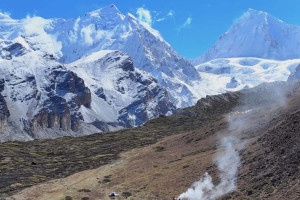
Mustang should be entering one of its busiest periods of the year. Pilgrims normally travel to Kagbeni during the annual ancestor rites, domestic tourists head north for the festival holidays, and foreign trekkers crossing the Thorong La pass descend into the district.
Instead, three days of heavy rain beginning on September 24 have severely disrupted the district’s main road link with the rest of the country, while landslides and river erosion have damaged electricity infrastructure and knocked out internet services. The disruption comes at a critical time for Mustang’s tourism, farming, and local economy.
The damage to the Kaligandaki Corridor has already begun to ripple through the local economy. Tourism has taken a hit just as the season gets underway, while apple growers are struggling to get their harvest to market. Supplies of food, cooking gas and fuel are also becoming harder to bring into the district.
“This is normally the time when Mustang is packed with tourists, but this year it is almost deserted,” said Ajita Sharma, Mustang’s chief district officer. “Tourism has taken a major hit.”
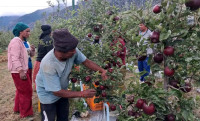
The damage extends beyond tourism. Farmers are struggling to get their apples to market at the peak of the harvest, while the lack of adequate cold storage means many are reluctant to pick them at all.
“There is nowhere to store them and nowhere to sell them,” said Sher Bahadur Raut, information officer at the Agriculture and Livestock Development Office in Mustang. “Farmers have decided it is better to leave the apples on the trees than pick them and watch them rot.”
Mustang produced 6,684 metric tonnes of apples last year, bringing Rs992.13 million into the district, according to Raut. Production is expected to be higher this year.
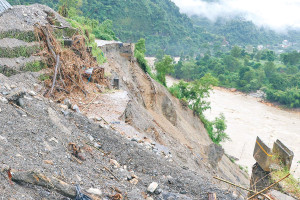
The main road through Myagdi and Mustang has been disrupted for nearly two weeks following the September 24-26 rains. According to the Kaligandaki Corridor Road Project, 41 locations between Maldhunga in Parbat and Korala on the Chinese border were damaged.
The Kaligandaki river eroded the road at eight locations and flooded it at two others, while landslides blocked the route at 26 sites and rockfalls at another five.
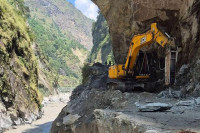
Most landslides have been cleared, and the Mustang section is now open to two-way traffic. But three major trouble spots in Myagdi remain, including Baiseri Kuineto, where about 300 metres of road has been washed away.
The disruption has left people travelling from northern Mustang and Myagdi with an arduous detour. Vehicles can reach Tatopani, after which travellers walk for nearly three hours through damaged sections to Baiseri, where they can find transport towards Beni and Pokhara.
“There is also a route through Raghuganga and Beg Gaun to reach Tatopani,” said Ganesh Gaire, chief district officer of Myagdi. “But because it is a longer route, people are choosing to walk despite the risks.”
Authorities are racing to restore the corridor before Dashain, when travel across the country increases sharply. More than 40 machines are working on the damaged sections, including 12 excavators, 10 loaders and 14 dump trucks deployed by the Kaligandaki Corridor Road Project.
Fuel deliveries to the machinery had also become difficult. Since Monday, drones have been used to deliver fuel to some work sites, Gaire said.
“We will open the road before Dashain, no matter what,” said Tejaswi Sharma, chief of the Kaligandaki Corridor Road Project. “Some sections may be single-lane, but we will make sure the road is passable for large vehicles.”
Authorities are also preparing an alternative route from Beni through Mouwaphant, Begkhola and Pokharebagar to bypass Baiseri Kuineto, where repairs are expected to take longer.
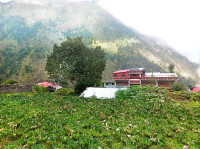
The road damage has compounded problems caused by the loss of electricity and internet services. Floods and landslides have knocked down or washed away power poles north of Beni. Electricity has been restored as far as Bhurung Tatopani, but areas further north remain without power.
The communications blackout is affecting government offices as well as businesses, while prolonged disruption could lead to shortages of fuel needed by ambulances, health workers and security agencies, Sharma said.
The impact is also being felt at the Korala border crossing, one of Nepal’s key trading points with China.
Around 150 containers that had travelled to China to collect goods before the September 24 rains remain there, according to Bidur Chudal, chief customs officer at the Mustang Customs Office. Some have returned as far as Tatopani after the Mustang section of the road reopened, but cannot proceed because of the damaged Myagdi section.
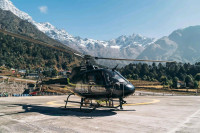
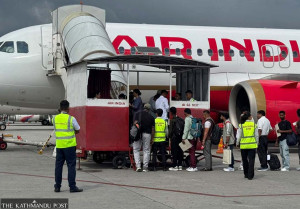
The road disruption has also complicated travel for foreign trekkers. Those who have crossed the Thorong La and reached Mustang are now flying from Jomsom to Pokhara, as road disruptions continue to hamper travel.
For Mustang, however, the bigger concern is what happens if the disruption continues. The district is entering the season when visitors fill its hotels and restaurants, farmers sell their apples, and traders move goods through Korala. This year, the roads that connect all three parts of that economy remain fragile.




 17.5°C Kathmandu
.jpg)