Gen Z uprising reshaped Nepal’s politics. A year on, questions linger over what it really achieved
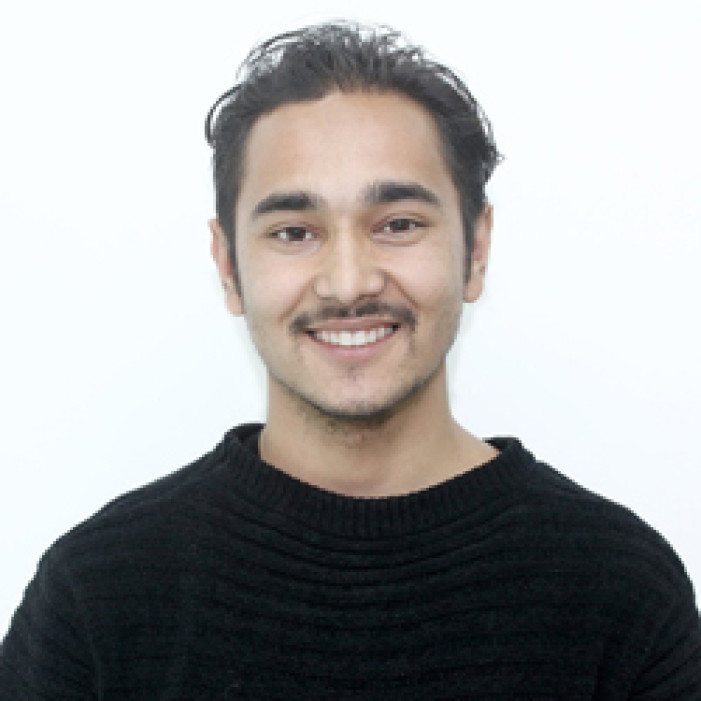
Injured protesters and families of those killed say the government has failed to deliver on promises of medical care, jobs and other support, leaving many questioning the movement’s legacy. Rakesh Mahato (in the wheelchair) is among the thousands injured during the youth-led uprising, which has come to be known as the Gen Z protests Dipesh Darshandhari/TKP
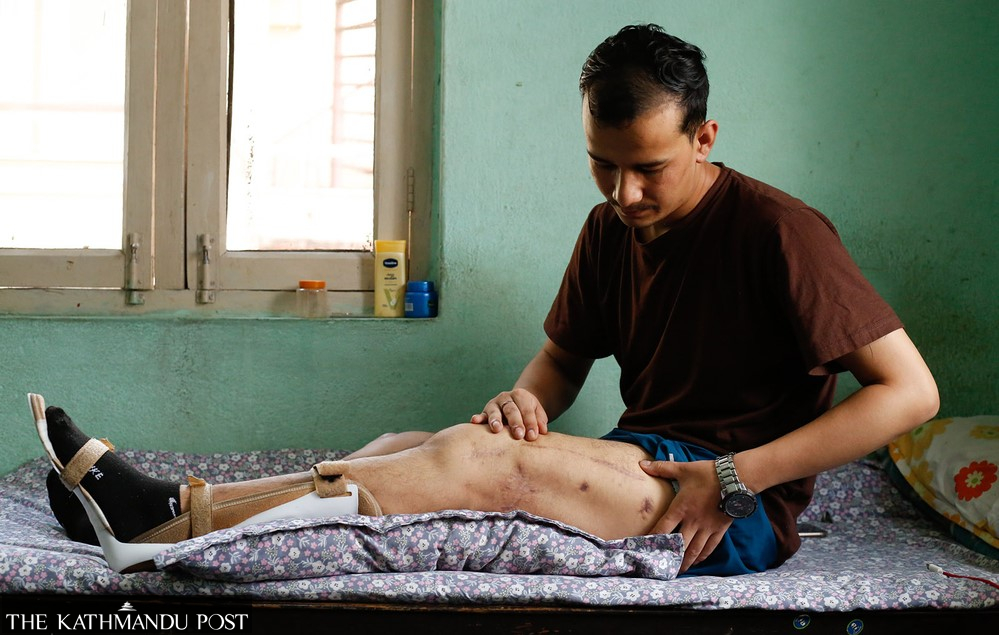
Rakesh Mahato lies in a hospital bed in Kathmandu with a simple wish—to get up, take a few steps and make it home.
The 25-year-old from Sarlahi district has spent the entirety of the past year in hospital after being shot by police while protesting against corruption on September 8, 2025.
Mahato is among the thousands injured during the youth-led uprising, which has come to be known as the Gen Z protests. Although the immediate trigger was the KP Sharma Oli government’s ban on social media, the youth were protesting systemic corruption and decades of power-sharing among a small group of ageing politicians.
The protests began as a peaceful demonstration but soon spiralled out of control, leading to massive casualties and the loss of private and public property. As many as 76 people were killed and 2,638 were injured during the demonstrations on September 8 and the violence that followed the next day. The spontaneous protests became a historic political event—triggering a major upheaval in the young democracy and turning the lives of thousands, including Mahato’s, upside down.
People, however, have yet to see the promises of the monumental movement translate into their daily lives, activists who took part in the protests say.
The faces in Singha Durbar, the country’s administrative centre, have changed. For the injured and families of those killed, however, life remains frozen on the two days of the uprising. Kantipur spoke to nearly a dozen people affected by the protests. Their demands were strikingly consistent—an end to corruption, better governance and a state that answers to its citizens. The movement transformed Nepal’s political leadership. Shah, once mayor of Kathmandu, became prime minister after the election. The party secured a near two-thirds majority. But for those who bled on the streets, little has changed, Mahato says.
Prakash Bohora, 29, from Dailekh, became a symbol of the Gen Z uprising after an image of his blood-stained white shoes went viral. Dipesh Darshandhari/TKP
Mahato was one of thousands of ambitious young men who travel to Kathmandu every year from across Nepal, seeking opportunities beyond their rural villages and small towns. He was studying for a bachelor’s degree at a commerce college and preparing for Loksewa, Nepal’s civil service examinations. He hoped to support his struggling family, get his younger brother a good education and make it big himself. Even in the capital city, jobs were scarce and the economy was in freefall. Like thousands of others, the Mahato brothers grew disillusioned by what they saw. Attributing these systemic issues to entrenched corruption, nepotism, and favouritism, they joined the protests together.
The demonstration was peaceful until shortly after noon, when gunfire suddenly erupted. One protester, Dipendra Basnet, was shot in the head in front of Parliament. Mahato and others rushed to help him. “That’s when police opened fire from behind,” Mahato recalled to Kantipur from his hospital bed. “I was shot in the belly and then I collapsed on the spot.”
The bullet entered through the right side of his abdomen and lodged on the left. Mahato regained consciousness three days later. By then, the protests had already set in motion a dramatic political transition. Gen Z representatives had proposed former chief justice Sushila Karki as interim prime minister during talks with army chief Ashok Raj Sigdel, while discussions were under way at the president’s office over forming a new government.
Mahato, meanwhile, was struggling to move his legs in the intensive care unit at the National Trauma Centre. He could not. A doctor eventually told him that he would never walk again and would probably depend on a wheelchair for the rest of his life. The nerves below his waist had been severed.
Mahato was devastated.
On September 12, four days after Oli resigned, an interim government was formed under Karki, following the violent uprising. Six months later, parliamentary elections brought the Rastriya Swatantra Party to a near two-thirds majority, and Balendra Shah, the rapper, structural engineer and former mayor of Kathmandu Metropolitan City, became the prime minister. That a 35-year-old political novice had become the prime minister was a tectonic shift for the country’s politics dominated by a handful of geriatric men.
Mahato watched from his hospital bed as Shah took office. He was hopeful.
A year later, that hope has receded. “They haven’t even investigated who shot us and why,” Mahato said. “No one has been punished. Sometimes it feels like this government is no different from the previous ones.”
An inquiry led by former chief justice Gauri Bahadur Karki concluded that police had used excessive and indiscriminate force during the protests. The panel said security forces fired continuously for about four hours before a curfew was imposed and that the police and the political leadership failed to intervene.
The report prompted police to arrest former prime minister Oli and former home minister Ramesh Lekhak on charges linked to the deaths during the crackdown. Shah’s first Cabinet meeting had decided to implement the inquiry’s recommendations. The two were later released after the Supreme Court considered a habeas corpus petition.
But police have yet to file a case against them. Home Minister Sudan Gurung told Kantipur recently that investigators were gathering enough evidence.
For the injured protesters, however, the legal process offers little comfort. Many say the government has failed to honour earlier commitments to provide full medical treatment, jobs for one family member of the injured and employment suited to injured protesters’ qualifications.
For some, life has become unbearable.
An agreement reached between the Gen Z representatives and Karki’s interim government on December 10 said the state would establish a permanent body to promote integrity and good governance, fight corruption and end impunity. It also promised an emergency task force to address the immediate and long-term needs of families of those killed and injured, including compensation, free medical care and psychological counselling, education, employment, social security and a permanent memorial.
Many now say the government has forgotten those promises.
Kamal Ghimire was discharged around mid-December last year. He now regrets taking part in the protest. Dipesh Darshandhari/TKP
Kamal Ghimire of Kavre still carries the scars of a gunshot wound to his chest. He has become accustomed to the physical pain. But the disappointment is harder to bear, he says. “Doctors had said I might not survive, and that’s perhaps why the wound no longer hurts as much,” he said. “But my heart hurts. I feel that this pain will stay with me for the rest of my life…They call this a Gen Z government. Then why have they forgotten the injured?”
Ghimire was discharged around mid-December last year. He now regrets taking part in the protest. “Those who went into government came out untouched,” he said. “Their lives carried on as normal. We’re the ones left with ruined bodies and no way to rebuild our lives. We can’t go abroad to seek work, and there’s little we can do here. So what do we gain from the movement if the government still can’t give us proper access to education, healthcare or jobs?”
The government had promised to cover Ghimire’s medical expenses. Yet he says he has been paying for follow-up treatment himself and previously had to buy medicines outside the hospital. His family has spent about Rs1.5 million on his treatment, he said.
Shree Krishna Shrestha, an additional secretary at the Ministry of Health, said the government could not reimburse bills for medicines or treatment bought independently outside the designated hospital system. Under government rules, hospitals treating injured protesters must submit claims themselves, he said.
According to Health Ministry figures, one Gen Z protester, Daulat Thapa, is still being treated at the Kathmandu Medical College in Sinamangal. “He is still in a coma and is receiving intensive care, but there has been no improvement,” Shrestha said. Mahato continues to receive regular physiotherapy.
For others, the financial burden is becoming overwhelming.
Bhandari lives in a rented room in Lokanthali and counts the days until his next hospital visit. Dipesh Darshandhari/TKP
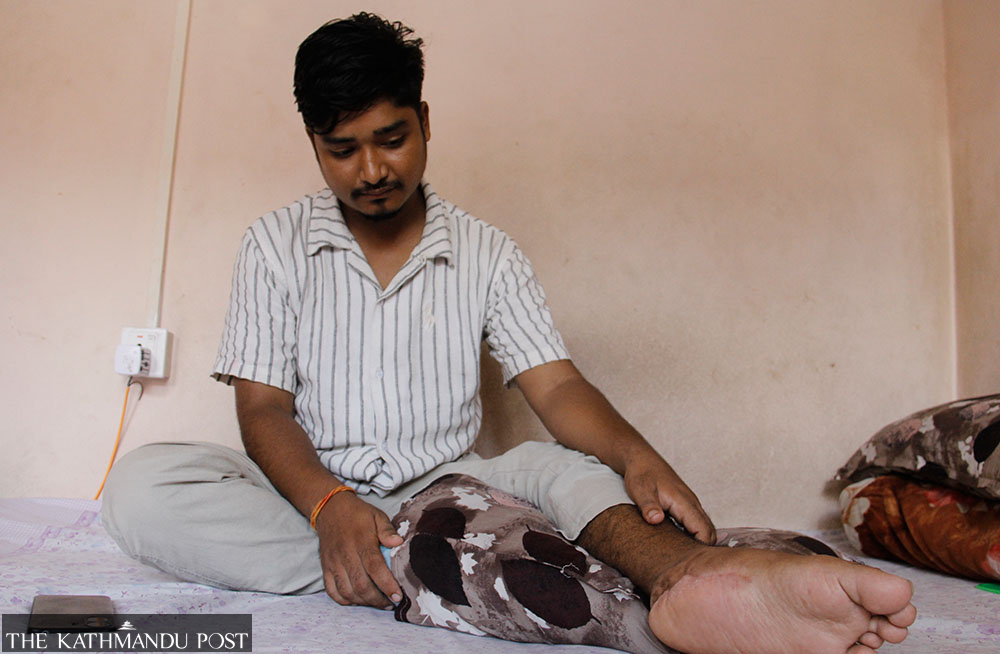
Rabi Bhandari, 29, from Sindhuli, survived a gunshot to the leg. But survival has not felt like a victory. At times, he says, he wonders whether it would have been easier to be among the 76 protesters who were killed.
Bhandari lives in a rented room in Lokanthali and counts the days until his next hospital visit. But every appointment brings the same question: how will he pay the bills? He was treated at B&B Hospital, where staff have told him he will now have to pay for treatment.
Additional Secretary Shrestha said the government prefers public hospitals because private treatment can be prohibitively expensive. But he acknowledged that officials were considering how to address cases involving protesters treated in private facilities.
Karki’s interim government had also introduced a system to classify injured protesters according to the severity of their disabilities. Those classified as very seriously injured receive a monthly allowance of Rs18,000, those in the serious category Rs9,000, and those classified as moderately or mildly injured Rs4,000.
Bhandari says the classification was poorly handled. “Many people were placed in the moderate or mild categories without properly examining their injuries and medical reports,” he said. “I was initially classified as moderate. I kept appealing, and only this year was I moved to the serious category.”
He now receives Rs9,000 a month. “But what can you do with Rs9,000?” he said. He has received only the monthly subsistence allowance and an additional Rs35,000 from the government so far. “The allowance does not even cover my rent,” he said.
Law Minister Sobita Gautam said the government was doing what it could within its authority. She said the government was also helping protesters who had travelled to India for treatment and was committed to providing free treatment within Nepal.
The frustrations extend beyond healthcare.
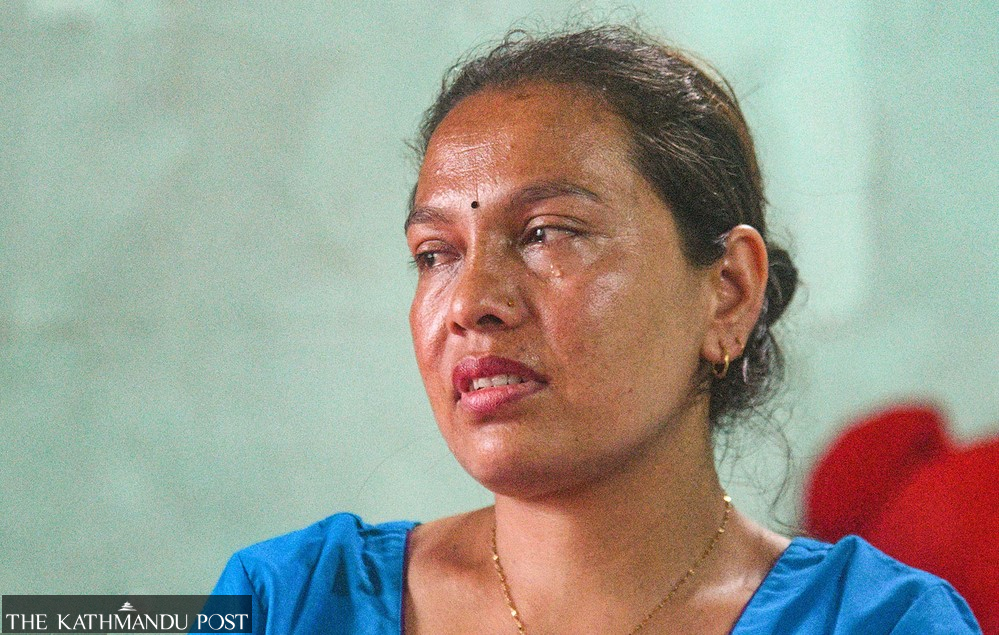
Ambika BK, from Udayapur, took a contract job in the administration section of the Nepal Electricity Authority’s Ratnapark office two months ago. But with limited pay and few benefits, the job has done little to ease the financial strain. “Most of what I earn, around Rs20,000 to Rs22,000, goes on rent and food,” she said. “There’s hardly anything left for my children’s education and healthcare.”
The job has brought another source of pain. She says people sometimes insult her in front of her colleagues, saying she got the job only because her husband died in the protest. “Sometimes I feel like quitting because of that,” she said.
BK’s husband, Santosh, was 28 and worked in a jewellery factory. On the morning of September 8, he returned home for lunch after work. He told his wife that the Oli government had shut down social media and that a peaceful protest was taking place.
“We have to go,” he told her. He left home at around 11.30am.
He never returned.
BK says the government that came to power on the back of the Gen Z movement has given families like hers little reason for hope. “Most of what was done happened under Sushila Karki’s government,” she said. “The government that followed has barely cared about the families of those killed.” She added she sent 14 or 15 demands through Home Minister Sudan Gurung but received no meaningful response.
She also holds Shah responsible. “Balen did not even visit the injured in hospital or pay tribute to the dead,” she said. “Promises about free education, healthcare and jobs for our children remain unfulfilled.”
Her children were eventually offered free education through grade 12 by Golden Peak Group.
For BK, that has not erased the loss. She often breaks down while looking at her husband’s photograph hanging on the wall.
The organisations representing the injured and bereaved families say the government’s record is equally disappointing. Gen Z leader Sarisma Thapa said several demands, including the creation of a Gen Z council, remain unresolved. “Even getting identity cards issued to injured protesters took sustained pressure,” she said. “Some people have been kept in limbo with token offers of jobs in government offices, on contracts or as administrative assistants.”
Despite the promise of free treatment, she said many injured protesters still have to buy medicines themselves beyond what public hospitals provide. She also said young protesters arrested in connection with the unrest remain in jail even though the government had agreed not to prosecute people simply for participating in the demonstrations.
For the families of those killed and the protesters who survived, September 8 remains an event that continues to shape daily life.
Ambika BK, from Udayapur, took a contract job in the administration section of the Nepal Electricity Authority’s Ratnapark office two months ago. Dipesh Darshandhari/TKP
Roshan Gautam, secretary of the Gen Z Martyrs’ Families Welfare Society, said the government had effectively abandoned them. “The prime minister has not even met the families of the dead and injured once,” he said. “Compensation is still a distant prospect.”
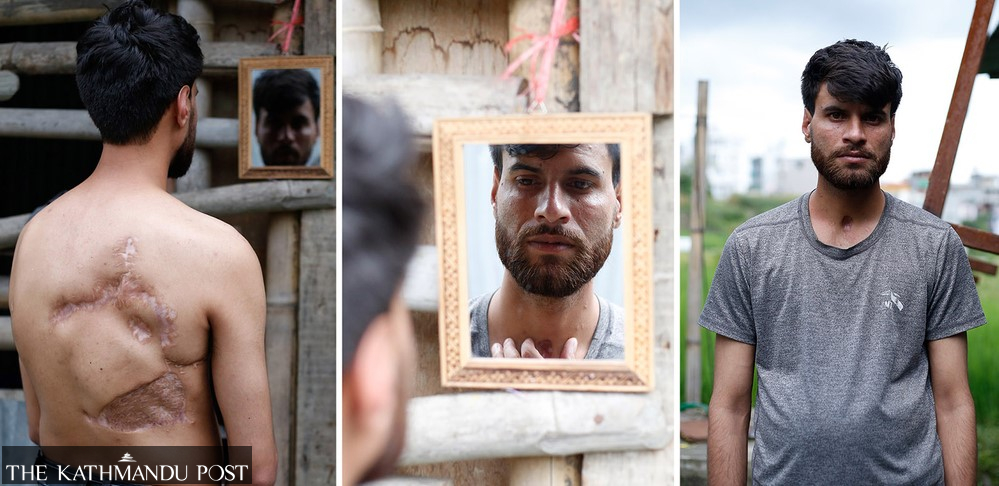
Some injured protesters also tried to turn their place in the movement into a role in Parliament, government or the ruling party. Prakash Bohora, 29, from Dailekh, was one of them. He became a symbol of the Gen Z uprising after an image of his blood-stained white shoes went viral. But he never secured a political role.
Bohora now relies on crutches to walk, and even passing through New Baneshwar can bring back painful memories. “Sometimes, when I pass the parliament building, it still hurts,” he said. “I find myself wishing I never had to go there.”
He is now staying at a hostel in Kathmandu while making regular follow-up visits to Bir Hospital. He still needs four more operations on his left leg, which was shot during the protests on September 8. He was discharged only five months later, on February 3.
Bohora contested the parliamentary election on a proportional-representation ticket for the Rastriya Swatantra Party but was not elected. He later ran for the party’s central committee at its general convention in Chitwan, but lost.
He is now frustrated by the absence of Gen Z victims in both government and Parliament. Their lack of representation, he says, has left their grievances easier to ignore. “But we will not stop asking questions until the demands and issues we raised are addressed,” he said. “And if the government forgets what citizens expected from this movement, we will continue to hold it to account.”
Even those who joined the protests and survived are wondering whether the movement will actually change their future.
Dhiraj Joshi, a Gen Z protester who took part in talks at the Nepali Army headquarters in the early hours of September 9, said protesters never took to the streets expecting to be injured, killed or rewarded. “No one joins a protest thinking they will be injured, killed or honoured,” he said. “But once people have been killed and injured, the government has a responsibility to honour the commitments it made.”
The movement was ultimately driven by demands for accountability, transparency and an end to corruption, Joshi said. Those in power must also recognise the sacrifices made by the injured and the families of those killed, he added. “A year on, it does not feel like the government is moving towards greater accountability,” Joshi told Kantipur. “The government appears to be falling short on accountability, responsibility and democratic values.”
Law Minister Sobita Gautam said the government was in regular contact with injured protesters and families of those killed and that the Gen Z Council would provide a more formal channel for that engagement.
“It’s not that we have stopped talking to them,” she said. “But it can sometimes be difficult to speak to everyone individually. That is why we want the Gen Z Council to serve as a channel through which their concerns can reach the government.”
She said the government was already in direct talks with the affected families and protesters and acknowledged their frustration over the delays. “Understandably, they feel things are taking too long,” she said. “But we needed time to work out how to implement the agreements and set up the necessary mechanisms. That work is under way, and it should not take much longer.”
Meanwhile, a year after rallying in Kathmandu for a corruption-free Nepal, injured protesters say they are left with little more than frustration and regret.
Mahato, who was shot in the belly and collapsed on the spot, says he is disappointed that the current government hasn’t investigated who shot them and why. He adds he keeps repeating the same question to himself: “When will I be able to stand and walk again?”
Bhandari, who sustained a gunshot in his leg, says he regrets his decision to join the protests. “Sometimes I ask myself why the bullet hit my leg,” he says. “Why didn’t it hit my chest?”




 15.34°C Kathmandu