Flood-displaced mothers struggle for privacy and care
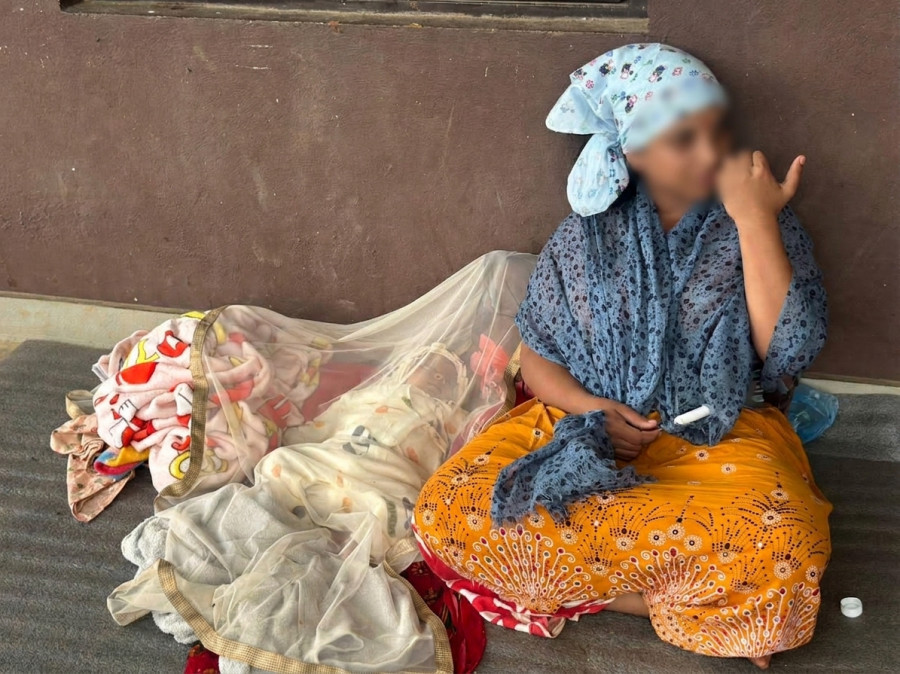
In crowded shelters, pregnant women and new mothers are struggling for privacy, adequate food and access to maternity care as damaged roads cut them off from hospitals. With roads and bridges damaged by landslides, pregnant women and new mothers are among those struggling hardest to get what they specifically need—a female-friendly space to breastfeed, food timed to their nursing schedule, and a way to reach emergency care. Photo: Courtesy of WOREC Nepal
Pariyar, who likes to be identified by only her last name, is a breastfeeding mother who is three months into caring for a newborn who does not stop crying.
On the morning of August 26, Pariyar fled her home in Trishuli when the floods came and is now staying with dozens of strangers under one roof, where men smoke cigarettes near where she nurses her baby and where sleep, food and privacy all arrive on somebody else’s schedule.
“We are all in the same place, so it is difficult,” she says. “There is cigarette smoke, the smell of alcohol, and the baby cannot sleep.” Pariyar says her breast milk supply has decreased since the floods, leading her to try formula. However, it seems to upset the baby’s stomach, causing her to cry even more after feeding.
“If there was a safe place, and the baby could get her vaccinations here, that would be better,” Pariyar says. “We are not getting food on time either. We are not getting enough to eat.”
Pariyar’s account is part of a much larger and unfinished crisis unfolding in the flood-hit districts along the Bhotekoshi-Trishuli corridor northwest of Kathmandu. With roads and bridges damaged by landslides, pregnant women and new mothers are among those struggling hardest to get what they specifically need—a female-friendly space to breastfeed, food timed to nursing schedule, and a way to reach emergency care if labour turns dangerous.
The United Nations Population Fund (UNFPA), estimates that around 4,430 pregnant women are living in the areas across the 15 municipalities in Rasuwa, Nuwakot and Dhading, the districts hardest hit by last week’s devastating floods.
The figure is a humanitarian planning estimate based on an affected population of about 310,000 people, rather than a headcount of individually identified pregnant women. Based on the estimate, around 492 births could be expected in the following month, with roughly 74 women potentially requiring emergency obstetric care.
Aid workers say the problem is not only the scale of it. It is that these women are being folded into a relief system built around a single, generic idea of what a displaced person needs which rarely is for a breastfeeding or postpartum mother, their privacy, or an infant’s need for anything softer than the staple dal bhat.
Pariyar’s experience is not unique. In another shelter along the same corridor, Sharmila Shrestha, 33, sleeps on a classroom floor with two children: her own 14-month-old daughter, carried back to her over a six-hour walk through the hills after the flood separated them for two or three days, and her sister-in-law’s 18-month-old son. Both the infants eat what the adults eat, because nobody has brought food that suits them.
“They aren’t giving any special food for babies,” Shrestha told the Post over phone. “We are forced to feed that same heavy adult food to the small child.” What would help most, Shrestha says, is simple: “If only we had a decent, proper place to stay. That would bring some peace of mind.”
The concern is not only how many women are pregnant, but whether they can access care when they need it.
At Trishuli Hospital, the district-level hospital serving the area, the maternity ward has become an improvised outpost of crisis medicine. Basanti Pancha, who runs the department, says the hospital has performed nine deliveries since the floods but was struggling to keep pace with everything else. Women have kept arriving for fever, reduced fetal movement and urinary tract infections in pregnancy.
“Because of the floods, our service delivery has become very difficult,” Pancha says.
Electricity is unreliable enough that staff run a generator for surgeries and now sterilise instruments in small batches by hand. Four maternity patients have been referred out in recent days—two by military helicopter, two by ambulance, including a woman with a severe wound infection after delivery.
“Previously, Kathmandu was just a two-hour road trip away,” Pancha says. “Now, by road, nobody knows how many hours it will take because of the landslides.” What used to be routine, she adds, has become “a lot of stress” for staff who have no advanced neonatal unit to fall back on if a case turns critical.
“Pregnancy itself brings a lot of natural anxiety, stress and doubt about what will happen,” Pancha says. “But the floods have added a layer of extra stress on these women.”
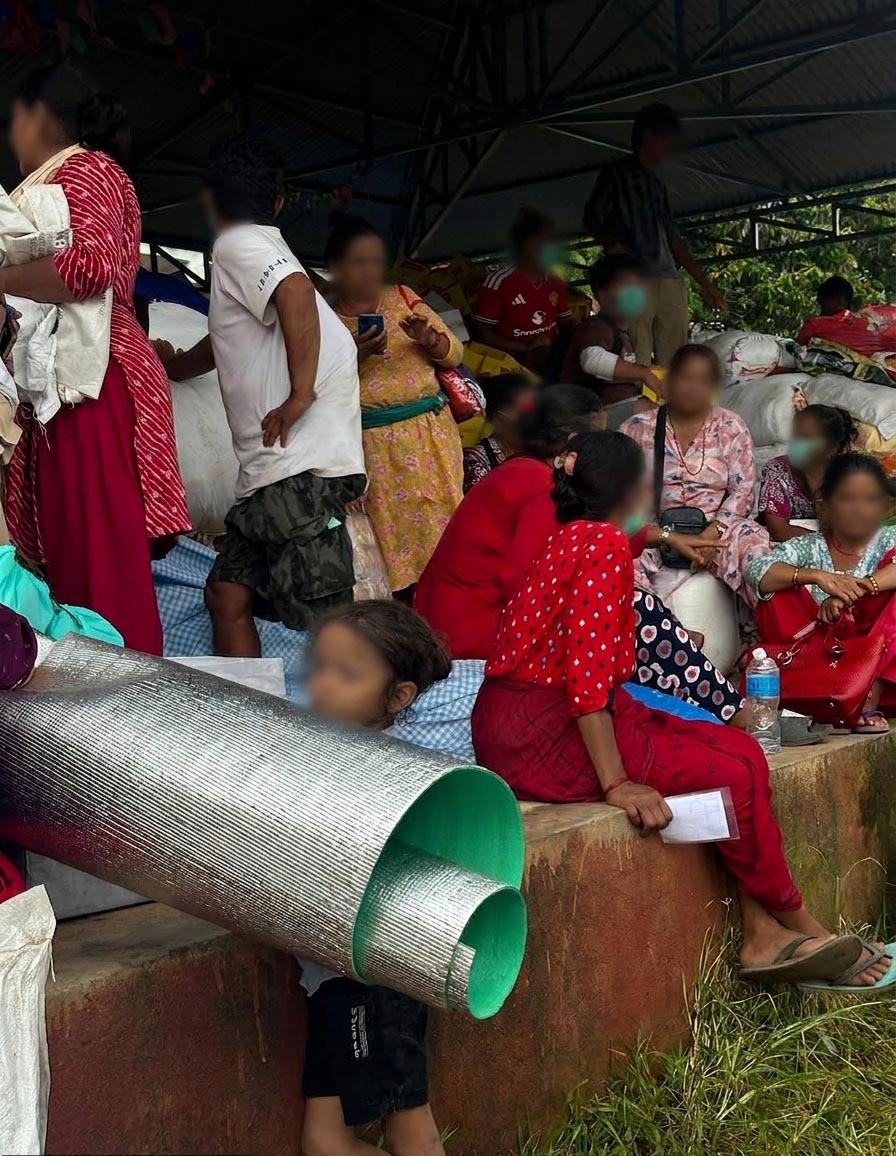
Sexual violence and trafficking have become quiet, urgent risks, worsened by the number of families now scattering toward Kathmandu in search of help that never arrived locally. Photo: Courtesy of WOREC Nepal
Rekha Shrestha, executive director of women’s rights organisation WOREC, says her team members are finding the same pattern across every holding centre they visit: women, men, children, the sick and healthy all are sharing one undivided space. The holding centre at Chandrajyoti Secondary School, for instance, houses more than 1,000 people, including over 500 women, among them pregnant women and new mothers.
“Everyone is in the same place,” Rekha says. Her organisation has begun setting up female friendly spaces in affected areas, where women and adolescents can talk privately and raise concerns they would not otherwise voice in a crowded hall.
Relief distribution, she says, has often assumed everyone in a shelter needs the same things.
Menstruating adolescents are not given sufficient sanitary pads. In one distribution, she says, women were handed a single pad and told it should last three or four days. Sexual violence and trafficking have become quiet, urgent risks, worsened by the number of families now scattering toward Kathmandu in search of help that never arrived locally.
“Pregnant women and postpartum mothers have special needs,” she says. “There is no private space to bathe, to dry clothes, to breastfeed. That privacy is not an extra service in a disaster response,” she adds. “It’s a necessity.”
Rekha says her organisation is pressing officials to separate vulnerable groups within shelters, disaggregate population data by gender and age, and ensure nutrition and medicine reach women who are otherwise kept into a single, undifferentiated relief effort. “It is extremely necessary to look at the diversity within the group,” she says.
UNFPA, too, describes its 4,430 figure as only an initial estimate, one it is refining with the Ministry of Health and Population and the Health Cluster. The number is modelled, not counted door to door, derived from a pre-flood population of roughly 310,000 across the affected municipalities. “We’ve used a standard demographic ratio for how many women in a given population are likely to be pregnant at any time,” says Sriram Haridass, UNFPA’s representative in Nepal. Teams are now working to identify and reach those women individually, a process he says will take weeks. For now, the priority is keeping maternity services running while the referral system is rebuilt.
“Babies do not wait for roads to reopen,” Haridass says. UNFPA is supporting mobile health teams offering antenatal and postnatal care and psychosocial support, and has dispatched 2,000 dignity kits, 800 Kishori kits and 300 shelter tarpaulins, with 32 reproductive health kits ready for deployment. But locating a woman, Haridass says, is only half the task. “She must know where to seek care and have a functioning referral pathway if she needs urgent assistance,” he says.
That gap, between being counted and being cared for, is what women like Pariyar and Sharmila Shrestha are still living inside. Neither of the nursing mothers is asking for much: a place that treats them as something other than one more body in a crowded hall. “This is very difficult for us,” Pariyar says. “We need a separate space.”
Aarya Chand is a reporter at The Kathmandu Post covering social issues. Before moving to the social beat, Chand was an intern covering culture and lifestyle for the Post.




 16.09°C Kathmandu