Authorities scramble for alternatives after Krishnabhir road cave-in
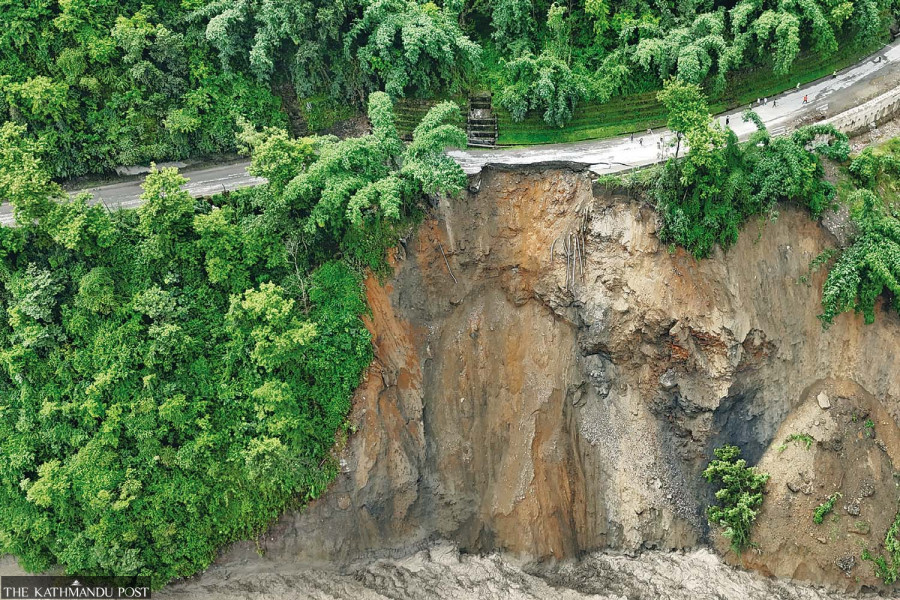
A 70-metre section has fallen into the Trishuli river, and another 120 metres is severely cracked. This picture taken on Sunday shows initial damage to the Prithvi Highway caused by landslide at Krishnabhir, Dhading. Post Photo
Authorities have launched a detailed study to find alternative routes after a section of the Prithvi Highway at Krishnabhir collapsed into the Trishuli river following heavy flooding.
The catastrophic damage to Kathmandu’s lifeline has completely severed the main artery to the national capital. The highway, which normally witnesses the daily passage of around 12,000 vehicles, has remained blocked since Sunday.
Officials from the Department of Roads stated that technical teams are currently assessing whether the damaged stretch at Krishnabhir can be restored or if long-term alternative routes must be developed. For the time being, vehicular traffic has been diverted onto alternative bypass roads connecting Hetauda to Naubise and Fisling to Benighat.
Sajana Adhikari, chief of the Malekhu-Mugling Road Project, inspected the Krishnabhir cave-in site to assess the extent of the destruction. She confirmed that a 70-metre segment of the road had entirely collapsed into the Trishuli river, while an adjacent section extending nearly 120 metres had developed severe structural cracks.
“We have conducted a preliminary technical inspection and study of the Krishnabhir area in Dhading,” said Adhikari. “It is not yet clear whether the existing road can be reopened. A technical team is currently conducting a detailed study.” She added that complete disruption of traffic along the Prithvi Highway occurred at the Krishnabhir stretch.
Reopening the highway along the traditional alignment has proven to be a complex challenge because the location had previously suffered repeated landslide damage, undergone repairs, and remained highly vulnerable.
Bijaya Jaishi, director general of the Department of Roads, confirmed that two primary options are currently under active discussion. “We are looking into whether we can operate the road by carving out space on the right or left side of Krishnabhir itself,” Jaishi told Kantipur. “Simultaneously, we are studying the feasible use of alternative tracks. We expect to reach a definitive conclusion within a couple of days.”
According to Jaishi, the department is coordinating closely with the Ministry of Infrastructure Development to decide on the future course of action. Technical experts have warned that repairing the road at Krishnabhir requires extensive engineering work starting right from the riverbank, which presents immense technical challenges during the peak monsoon season.
The road closure at Krishnabhir has not only stranded thousands of travelers but has also heightened the risk of severe shortages of daily essentials in Kathmandu. The capital relies heavily on this highway for supplies of food grains, fresh vegetables, milk, medicines, clothing, cooking gas, petrol, diesel, and other daily necessities.
Senior Superintendent of Police Ramesh Thapa, deployed to the Prithvi Highway sector from Nepal Police Headquarters following the floods, said the Naubise-Mugling stretch section has sustained major damage at three locations, including Krishnabhir.
“Krishnabhir is completely closed,” said Thapa. “Road erosion has also occurred around Parewatar and Shitalbazar in the Malekhu area. The risk of further soil erosion and landslide risks has not yet subsided in the affected areas.” He said passenger vehicles are currently using alternative feeder routes to travel to and from Kathmandu.
Department officials indicated that existing tracks on both sides of the Trishuli river could be upgraded for temporary use. Furthermore, an unpaved track opened by the provincial government above Krishnabhir requires just one additional kilometre of track construction to connect directly back into the Prithvi Highway.
Naresh Man Shakya, a former joint secretary at the Ministry of Infrastructure Development and an infrastructure expert, noted that the full scale of the structural damage at Krishnabhir remains to be calculated.
“A specialised team has been dispatched to survey the site. The precise level of damage and the exact repair methodology are yet to be finalised,” said Shakya. “The road collapse appears to have been caused by powerful floodwaters carrying heavy debris that violently struck the base of the Krishnabhir cliff.” He added that discussions are ongoing with the ministry to formulate a reconstruction plan once complete data is gathered.
With Krishnabhir rendered impassable, traffic pressure has escalated dramatically on short-distance alternative routes entering Kathmandu from Hetauda, notably the Tribhuvan Highway and the Kanti Lokpath. Heavy freight trucks and passenger buses carrying more than 14 passengers have been diverted to the Tribhuvan Highway. Smaller passenger vehicles and empty vehicles are being routed through the Kanti Lokpath.
As per the notice circulated by the District Administration Office in Makawanpur, light passenger vehicles with fewer than 14 seats traveling towards Kathmandu are required to take the Bhimphedi-Kulekhani-Sisneri-Dakshinkali route, while vehicles coming from Kathmandu to Hetauda must pass through Pharping-Phakhel-Kulekhani-Bhimphedi.
According to Basanta Adhikari, Chief District Officer of Makwanpur, heavy freight and large passenger vehicles must use the Tribhuvan Highway when heading to Kathmandu and the Kanti Lokpath when returning. However, because the 132-kilometre Tribhuvan Highway stretch from Hetauda to Thankot is narrow and winding, vehicles with more than 10 wheels have been prohibited.
“We have restricted vehicles with more than 10 wheels from using the Tribhuvan Highway,” said Madhav Prasad Kafle, deputy superintendent of police and spokesperson for the District Police Office in Makawanpur. “The highway has sharp bends and narrow stretches, so we only permit vehicles up to 10 wheels from Hetauda to Kathmandu.”
Meanwhile, trucks carrying vegetables and other agricultural goods produced in Thaha Municipality—a key vegetable production hub—are being routed via the Golmod in Simbhanjyang to Deurali in Bhimpedi to reach Hetauda, Pokhara, Bharatpur, and Birgunj. Traffic from Naubise towards Hetauda has been halted completely.
Chief District Officer Adhikari said only empty and medium-sized passenger buses are allowed to enter Hetauda via the Kanti Lokpath due to its narrow width. The Area Police Office in Thigan noted that while the Makawanpur side of the Kanti Lokpath is in fair condition, the Lalitpur section remains risky, and the Bagmati river bridge has limited load capacity, and is therefore unsafe for heavy cargo.
Prior to the disruption, traveling between Hetauda and Kathmandu via short-cut alternative routes took approximately three hours; owing to severe congestion, the journey now takes nearly five hours.
Meanwhile, the local administrative offices have designated the Galchhi-Sunaulabazar-Dhadhingbesi-Arughat-Gorkha Bazaar-Anbu Khaireni route as an alternative for traffic commuting from the Mugling side.
Krishnabhir, which lies in Dhading’s Benighat Rorang, first experienced a major landslide in 1999. Since then, it has suffered recurring monsoon slope failures. Local residents recall that a massive landslide blocked the highway for 11 days in August 2000.
To mitigate chronic risks from both above and below the road, bio-engineering interventions and retaining walls were installed in 2007. Last October, the Department of Roads observed fresh cave-in along the asphalt surface. The department had initiated micro-piling and horizontal anchoring works to counteract river erosion at the base, along with concrete surfacing to stop water seepage. However, despite these measures, Krishnabhir has suffered its worst structural collapse after 26 years.




 15.26°C Kathmandu