Bhotekoshi floods leave older survivors grappling with loss, uncertainty and trauma
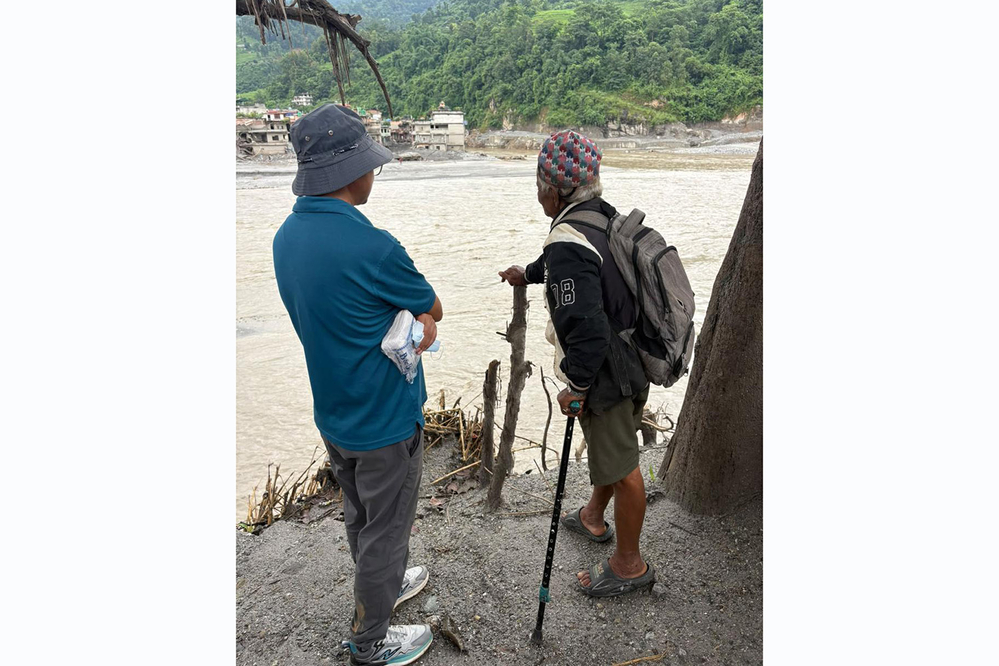
Two months on, many elderly survivors remain displaced, haunted by memories of the disaster and waiting for news of missing family members. Authorities are yet to establish how many older people were affected. Photo: Courtesy of Geriatric Society of Nepal
Two months after the Bhotekoshi floods of August 26, the trauma continues to haunt 60-year-old Yongjen Tamang, who is sheltering at the Kodobari Holding Centre in Pipalatar, Nuwakot. She is constantly gripped by the fear that another flood could strike. “The fear and anxiety keep me awake at night. Even when I manage to fall asleep, I dream that another flood is coming,” she said.
Tamang’s granddaughter and her younger brother’s youngest son went missing in the floods. “Something we never imagined happened. Two members of my family disappeared. I cannot sleep because I keep thinking about them,” she said.
After the floods, Tamang took shelter at a holding centre at White Gumba in Kathmandu before moving to another centre in Nuwakot. She said the family had hoped to return home but could not because the road was blocked.
“We spent some time in Kathmandu and then decided to go back. But with the road blocked, we couldn’t reach home. Now I don’t know where we will end up,” she said. “One of my daughters has a mental health condition, so travelling long distances with her is difficult. The uncertainty is taking a toll on me.”
Tamang was at home in Haku Besi, Rasuwa, when the flood hit. “We saw the flood coming and ran for our lives. We survived, but the images still haunt me. I am now too frightened to go anywhere,” she said. Although she is now physically safe, the fear of the disaster has yet to leave her.
No reliable count of older people affected by the floods
Tamang escaped after being warned of the approaching flood. Many older residents in the affected areas, however, were not so fortunate.
Two months after the disaster, authorities have yet to establish how many older people were affected, displaced or went missing. Surya Bahadur Shrestha, president of the National Senior Citizens Federation, said the authorities still lacked reliable figures. “We are coordinating with the relevant ministry, but we still do not have reliable data on how many older people were affected, how many were rescued and how many remain missing,” he said.
According to a list of people missing in the Bhotekoshi floods published by the District Administration Office in Rasuwa, 78 people aged over 70 remain unaccounted for in the district alone.
Sulakshya Rayamajhi, an NDRRMA official deployed to the Rasuwa District Administration Office to coordinate information management, said the absence of age-specific details in initial records had made it difficult to identify missing older people. Authorities are now collecting the data. “When missing people were first registered, their ages were often unknown. Some families provided estimates, while others did not give ages at all,” he said. “Local units are now verifying the details, which will then be sent to the National Disaster Risk Reduction and Management Authority.”
Rayamajhi said a reliable count of affected older people would be available only after the details had been collected and verified through the required procedures.
***
The Devighat Senior Citizen Protection and Study Foundation in Nuwakot housed 35 older people before the floods. Six went missing, and only one body has been recovered, said the centre’s chair, Bishnu Prasad Nepal. “Six senior citizens were lost in the floods,” he said. The army rescued six others. Some residents who could walk managed to reach safety after learning of the approaching flood. But evacuating those who were frail or needed assistance proved much harder, Nepal said. Gunamaya Bohora, 97, who was rescued from the centre, is still receiving treatment at Bir Hospital in Kathmandu, he added.
Youraj Roka, executive director of the Geriatric Society of Nepal, said older people in the flood-hit areas were facing a range of difficulties. “We visited the affected areas and spoke with older people and persons with disabilities. They needed safe surroundings, regular healthcare and psychosocial support,” he said. “The visits showed us that a disaster creates needs far beyond food, clothing and shelter.”
Older people staying at various holding centres have been struggling with grief and psychological distress after losing contact with their children and other family members, Roka said. “During our early visits to holding centres, we met many older people who had lost children or other family members. Many of those missing were the family’s breadwinners, working as drivers, helpers or in other jobs,” he said. “With no bodies recovered, their deaths remain unconfirmed and families cannot perform the final rites, adding to their distress.”
Older people still waiting for missing family members
For 71-year-old Kami Waiba, who is also staying at the Kodobari Holding Centre, life has been particularly difficult since the August 26 floods. A resident of ward 1 in Aamachhodingmo Rural Municipality in Rasuwa, Waiba lost his home and was displaced by the floods. His daughter and son-in-law also went missing. “I have heard nothing from my daughter and son-in-law since the floods. I still hope they might be somewhere,” he said. “I miss them terribly. I have barely slept since they went missing. At my age, I can no longer manage on my own, and even food no longer tastes the same.”
Doctors have been visiting the holding centre to provide medical care, he said.
The older people at the Kodobari Holding Centre frequently speak about family members they lost in the disaster, said Thegu Lama, coordinator of flood-displaced families at the centre. “Some have lost family members, while others are older people or women living alone. Everyone has their own struggles,” he said. “Some older people still cling to the hope that their missing children will return.”
***
Psychiatrists say the loss of family members and recurring memories of the devastation have taken a heavy psychological toll on many survivors.
Consultant Psychiatrist Nirajan Bhattarai said the impact of a disaster depended less on age than on an individual’s ability to cope with the experience. “Not everyone affected by a flood develops a mental health condition. Much depends on how they cope with the experience and the extent of their loss,” he said. “Regardless of age, those who lose loved ones or witness a disaster first-hand need support to deal with what they have been through.”
Some people may develop psychological problems in the aftermath of a disaster, Bhattarai said. “People who witness traumatic events may relive them repeatedly, struggle with sleep, remain preoccupied with distressing thoughts or live in constant fear. Even recalling what happened can trigger anxiety,” he said. “They may need counselling and, in some cases, medication prescribed by a psychiatrist.”
Ignoring these problems can lead to more serious complications, he warned. “Anyone experiencing such distress can develop mental health problems,” he said. “Some may experience grief or acute stress disorder, while others may develop more serious conditions such as post-traumatic stress disorder (PTSD), depression or anxiety.”
Pushpa Subedi, a woman development officer at the Ministry of Women, Children, Gender and Sexual Minorities, and Social Security, said the three tiers of government were working together to provide assistance and programmes for older people affected by the floods.
“Programmes are being conducted for them, including those focused on intergenerational knowledge and skills transfer, as well as care for older people,” she said, adding that the ministry was coordinating with other bodies.
Various organisations have been running psychosocial support programmes, but the ministry itself has not introduced a specific mental health programme for older people, Subedi said. “The ministry has not conducted a dedicated psychosocial health programme for older people. However, we coordinate with health agencies through the inter-agency coordination committee,” she said.
She said older people displaced by the floods were staying at holding centres in different locations. “We shared contact numbers and coordinated support for older people, persons with disabilities and others in need during the disaster,” she said. “There was also a shortage of buildings, but we have been told that this has since been addressed.”
The ministry is also working with other agencies to establish the number of older people affected by the disaster, she said.
Nepal said older people rescued from the Devighat centre were now being housed in a temporary camp. “We are sheltering 28 older people affected by the floods in a camp set up by the Red Cross,” he said. “Doctors are visiting to check their health, and various organisations are also providing support.”
Long-term effects on flood-hit villages
The floods have transformed village life in the affected areas, said Man Bahadur Tamang of ward 4 of Aamachhodingmo Rural Municipality.
“Some people have returned home from holding centres. But in some families, older people and children are still waiting for missing relatives and parents to return,” he said. “The floods swept away some younger family members, while others are working abroad. This has left only a few people to manage household chores and care for children and older family members.”
“Many older people say they watched their homes and entire families being swept away. Some have yet to find the bodies of their loved ones but continue to hope they will return,” Man Bahadur said.
Roka said the mental health needs of older people required greater attention.
“Many have lost family members, homes and livelihoods in the disaster. If their needs are neglected, the effects could linger for years,” he said. “The government and aid organisations must work together to address their mental health needs alongside other forms of support.”
How to support the mental health of older people
Bhattarai said families, communities and the government all had a role in supporting older people during disasters and helping them rebuild their lives afterwards. “The immediate priority during a disaster should be to meet older people’s basic needs, including food, shelter and essential services. Where possible, they should also be reunited with their families,” he said. “Beyond psychiatric care, they need rehabilitation and access to the support and services they require.”
Listening to older people and ensuring they receive the supplies they need are equally important, he added. Older people also face specific challenges during disasters that can make them more vulnerable than younger people. “Chronic illnesses, limited mobility, hearing and vision difficulties, the need for regular medication and dependence on others for daily assistance can make it harder for them to access rescue and relief services,” he said. “Disaster response plans must account for these needs.”




 20°C Kathmandu