‘I managed to survive, but my brother and sister couldn’t’
14-year-old Akash Tamang says he survived the floods, but his younger brother and sister are missing. 17,000 children have been directly affected by floods in Bhotekoshi and Trishuli corridors, says UNICEF. Flood survivors (from left) Akash Tamang, 14; Anju Tamang, 12; and Samir Tamang, 16; have lost siblings, parents and other loved ones in the August 26 floods. Angad Dhakal/TKP
By the time 16-year-old Samir Tamang reached his school in Khalte, Rasuwa, the Bhotekoshi river had already turned into a roaring torrent of debris. Samir, an eighth grader at Nilakantha Secondary School, scrambled up a nearby hill to save his life. But his two younger sisters—13-year-old Priya and seven-year-old Parbati—were at home. They have been missing ever since the torrent swept through their village on Wednesday.
“My youngest sister had an injury on her hand and could not attend school, so my older sister stayed back to take care of her,” said Samir, his voice breaking as he sat inside a crowded temporary holding centre at Shivalaya Basic School in Laharepauwa, Rasuwa. “I don’t know what to do anymore. My sisters were like my closest friends, and in a single moment, the flood took them away.”
The flood did not spare Samir’s home either. His father, Surya, managed to escape the deluge while his mother, Chhesang, is currently working in Kuwait.
Samir is one of hundreds of children now taking shelter in relief blocks in Rasuwa and Nuwakot following the catastrophic floods of August 26.
According to preliminary data released by the Education Ministry, 250 students and teachers remain missing across the affected districts. Out of 230 students, 213 are out of contact, while 17 have been confirmed swept away. Furthermore, 10 teachers out of 19 missing have been swept away. Severe structural damage has been reported across 23 educational institutions, including eight in Nuwakot, seven in Rasuwa, and remaining others in Dhading.
“This data was gathered through a WhatsApp group named ‘flood-affected education’, disaster management taskforce and direct updates from field officers,” said Bir Bahadur Dhami, information officer at the ministry. “Because search teams are still clearing mud and rubble, the casualty and missing figures are being updated continuously as people slowly re-establish contact.”
For 14-year-old Akash Tamang, also from Khalte, the memory of the flood is a horrifying blur. Akash had arrived early at Uttargaya Public School when he heard a terrifying roar coming from the Trishuli river. Crowds began running in panic as water inundated the compound.
“We ran towards the forest as fast as we could. Otherwise, we wouldn’t have survived,” said Akash. “The flood swallowed my school in seconds. A bus bringing students to school was also caught in the flood.”
Akash had prepared a meal that morning for his younger siblings—eight-year-old Ashwin and 11-year-old Anisha—and sent them off to Ramchandra Basic School across the border in Nuwakot. Neither has been seen since the flood.
“I managed to survive, but my brother and sister couldn’t,” said Akash, wiping away tears. Anisha was in grade three and Ashwin in grade two. Their mother, Karsang, works in Dubai, and the father, Sanukanchha, works in Malaysia.
The children had been renting a small room near Betrawati to attend school. “We had been staying in the rented room in Betrawati with the money sent by our parents. I have no idea where the river carried my siblings.”
Although children have been brought to various shelters, there is still no news regarding the whereabouts of their relatives. Fifteen-year-old Nirajan Tamang is frantically searching for his 12-year-old brother Abiral, a fourth-grader at Nilakantha Secondary School who was caught in the torrent while walking to class.
“I had already reached school,” said Nirajan with a pale face. “My brother was walking to school when he got caught in the flood. I miss him so much,” he lamented. “I don’t think we will ever find him now.” His father, Lawang, and mother, Munchi, were at home in Thiru with his youngest brother, Sachin.
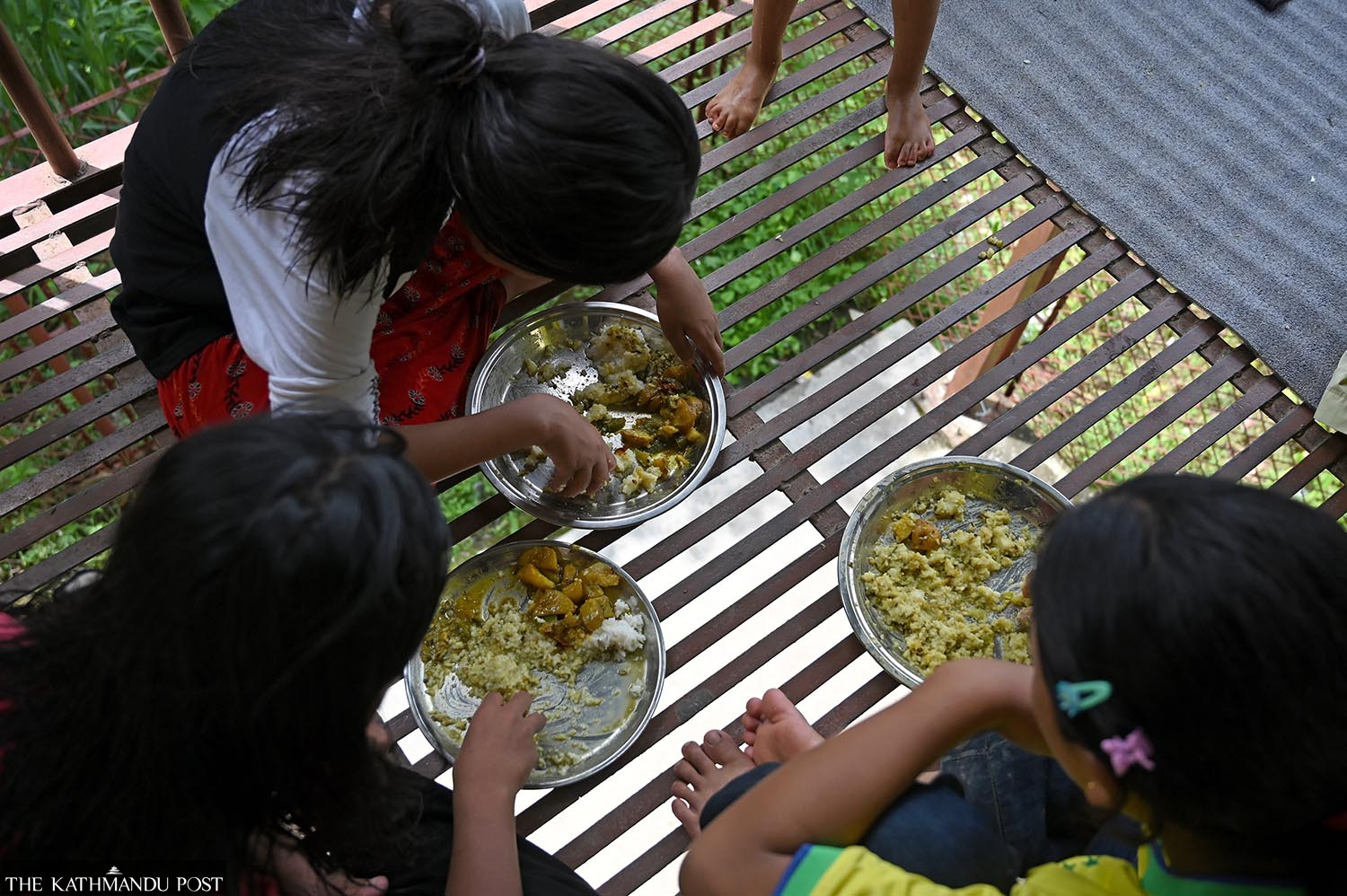
Flood-displaced children sheltering at the holding centre at Shivalaya Basic School in Laharepauwa, Rasuwa, pictured on Sunday. Angad Dhakal/TKP
In Kalikastan of Kalika Rural Municipality, 12-year-old Anju Tamang lost her mother, Subhamaya, along with her eldest brother, brother-in-law, aunt, uncle, and a one-year-old cousin when flash floods hit Shanti Bazar. Anju, who had lost her father five years ago, is now homeless and staying with relatives at Shivalaya Basic School.
In a statement issued on Thursday, UNICEF Representative to Nepal Alice Akunga confirmed that an estimated 17,000 children have been directly affected by the catastrophe across the Trishuli and Bhotekoshi river corridors.
UNICEF warned that the children who survived the disaster are now exposed to heightened risks of disease, malnutrition, exploitation, and trauma. The agency stressed the urgent need for temporary learning spaces, instructional materials, and immediate psychosocial counselling for both traumatised children and teachers.
The disaster has also raised grave child protection concerns. On Saturday, the Ministry of Women, Children and Senior Citizens issued an urgent alert warning against the illegal transport or unlawful custody of displaced minors.
Chakra Bahadur Budha, joint secretary and spokesperson for the ministry, urged local administration units in disaster-declared zones—including Rasuwa, Nuwakot, and Dhading—to strictly monitor child movement.
“No individual or organisation is permitted to transport or relocate children who have lost their parents or homes without explicit recommendation from the local Child Welfare Officer at the local level and prior authorisation from the National Child Rights Council,” said Budha in the official notice.
The warning comes as humanitarian organisations work against time to deliver targeted aid. While early relief distributions relied heavily on instant foods, aid agencies are shifting towards nutritional security and protection.
“The immediate need is proper nutrition,” said Sher Bahadur Karki, coordinator at the Emergency Operations Centre of the Nepal Red Cross Society. “Children in holding centres are being given junk food like instant noodles, which lack essential nutrients. They urgently require protein-rich, balanced meals to prevent outbreaks of illness.”
Karki added that the Nepal Red Cross Society has deployed field officers across three primary holding centres in Nuwakot, distributing mattresses, blankets, dry rations, and clothing in coordination with local government agencies.
Meanwhile, UNICEF has mobilised specialised mental health and psychosocial support teams to assist children coping with severe loss. Humanitarian workers are also conducting systematic profiling to track down missing children, register unaccompanied minors, and facilitate family reunifications.
For local community representatives, the sheer scale of destruction has proven overwhelming. Karna Ghale, an executive member of Uttargaya Rural Municipality who lost seven relatives in the disaster, said local authorities are struggling to manage the influx of displaced families.
“I can’t think straight because of the grief,” said Ghale at the Shivalaya shelter. “All I can do right now is beg the government and aid agencies to care for these children properly. They have lost their families, their clothes, and their schools.”
Thirteen-year-old Nirmal Ghale, who fled into the woods barefoot after watching his grandparents Mingmar and Lenjom get swept away by the river, remains too terrified to think about the future.
“I was walking to school when the flood hit,” said Nirmal. “The noise was deafening. I thought I was going to die right there. I pulled off my shoes and ran into the forest. So many of my classmates were swept away. Every time I hear the river now, I panic. I don’t want to go back to school. I don’t even have a change of clothes.”
As search and rescue operations continue along the riverbanks, officials at the National Child Rights Council acknowledged that establishing a final count remains challenging. Ram Bahadur Chand, information officer at the council, said that field teams are actively coordinating with local ward offices to verify figures, locate survivors, and ensure every displaced child receives immediate state protection.
Arjun Poudel is a health reporter for The Kathmandu Post. Before joining the Post, he worked for Sagarmatha Television, Naya Patrika, Republica and The Himalayan Times.




 18.54°C Kathmandu