Hundreds missing, billions in goods feared lost in Bhotekoshi flood
Traders, drivers and customs workers remain unaccounted for six days after the flood swept through the Rasuwa border area, while officials struggle to determine how many cargo containers and how much merchandise were lost.
Hundreds of traders, container drivers and customs-related workers remain unaccounted for six days after a devastating flood swept through Nepal’s northern trade hub in Rasuwa, while the scale of losses from the destruction of containers and goods worth billions of rupees remains unclear.
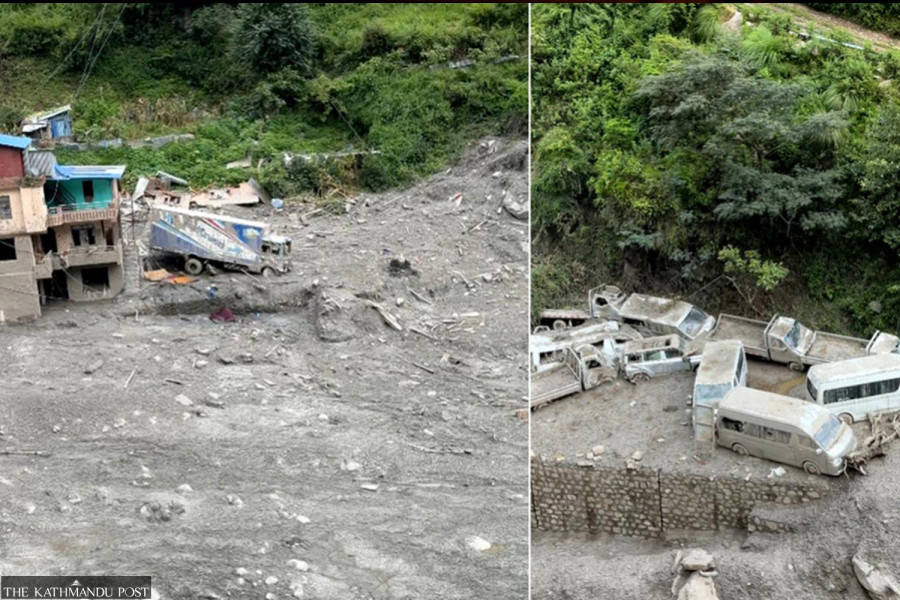
At least 15 customs employees are out of contact, while traders estimate that more than 300 container drivers and other workers may be missing. Hundreds of containers are believed to have been buried or swept away by the Bhotekoshi river flood, which destroyed the customs office and surrounding areas.
The uncertainty over the losses is compounded by the fact that many traders, workers and drivers had travelled to Rasuwa only after the Tatopani border crossing was fully closed on June 15. With the road through the Korala crossing longer and more difficult, traders had increasingly routed imports through Rasuwagadhi.
The Nepal Trans Himalaya Border Commerce Association, which represents traders operating through Nepal’s northern border crossings, said it was too early to determine how many containers were in the customs area or the quantity and value of goods they were carrying.
The Rasuwagadhi customs yard had already been left in disarray after being damaged by floods in 2025, forcing containers to be parked at scattered locations. Many were carrying goods worth millions of rupees, according to the association.
“We don’t yet know how many loaded containers were in the customs yard, or how many empty ones were waiting to return to China,” said Ram Chandra Parajuli, general secretary of the Nepal Trans Himalaya Border Commerce Association. “With traders, workers and drivers still unaccounted for, we are struggling to establish even the basic numbers.”
Parajuli said the losses could not be assessed until the whereabouts of missing traders and workers were established. He estimated that more than 300 people linked to the trade, excluding container workers, were initially believed to be missing.
A list released by the association contains the names of 234 people from Sindhupalchok involved in trade, trekking and container transport who remain unaccounted for. Most are traders, employees of trading firms and drivers who had travelled to Rasuwa after the Tatopani crossing was closed. As many as 73 workers and drivers from Bhotekoshi Rural Municipality alone are missing.
Preliminary figures compiled by association officials show that 70 to 75 containers loaded with goods had cleared customs and were preparing to travel to Kathmandu a day before the flood. The containers were carrying ready-made garments and other goods intended for the upcoming festive season. The association said all of them were swept away.
The Sindhupalchok Chamber of Commerce and Industry has formed a subcommittee to assess commercial losses and compile details, its president Buddha Raj Basnet said. The number of people from Sindhupalchok reported missing had reached 266, he said. Two bodies have so far been recovered, while the whereabouts of the others remain unknown.
Rajendra Prasad Dhungana, chief of the Rasuwa Customs Office, who survived the flood, estimated that more than 100 loaded containers had been in the customs yard.
“Hundreds of EVs and cargo containers appeared to be parked there,” Dhungana said. “The number of vehicles that entered the customs system after arriving from China is recorded on computers, so we should be able to establish the exact number in a few days.”
The customs office had collected Rs900 million in revenue over the nine days before the flood, Dhungana said.
Traders, however, said more than 200 loaded containers had been in the border area.
“The customs office and surrounding areas were all swept away, so the containers were either buried or carried away by the flood,” they said.
Nawaraj Timilsina, a trader and former general secretary of the Nepal Trans Himalaya Border Commerce Association, said traders had begun compiling details of the losses.
“We have started collecting the information, but it will be difficult to establish an accurate figure through normal means,” he said. “The immediate priority is finding the hundreds of traders who remain out of contact. We have asked the government to focus on their search.”
Timilsina said most traders working at the customs office and yard when the flood struck remained out of contact. Others who had been in and around the customs area were also missing.
“Those who managed to escape did so. Those who could not were either buried there or swept away,” customs chief Dhungana said. “Security personnel were flown by helicopter to search the rubble of houses where customs employees lived, but no one has been found.”
The physical and human toll remains too tough to establish, said Ram Hari Karki, chair of the association.
“The losses run into billions of rupees, but there is no way to determine the exact amount at this point,” he said. “We are currently compiling details of the human losses and missing people. Any figure at this stage is only an estimate. Hundreds of traders, workers and container drivers who were in the customs area along the border remain missing.”
170 containers stranded in Kerung
About 170 containers carrying goods destined for Nepal through the Rasuwa crossing are stranded in Kerung on the Chinese side of the border.
The containers will now have to be rerouted through either the Tatopani or Korala crossing, traders said. They called for an urgent decision, particularly for fruit shipments that could spoil if the containers remain stranded much longer.
Rajesh Bhandari, a fruit importer and member of the association, said about 30 of the containers stranded in Kerung were carrying fruit.
Fruit from containers that had already crossed into the customs area and became stranded in Rasuwa was distributed to residents, Bhandari said. Unable to move the containers to Kathmandu and facing the prospect of the fruit spoiling, traders decided to distribute it locally.
Imports of ready-made garments, shoes, slippers and bags had increased ahead of the festive season. But traders said the flood has left the Rasuwa crossing unusable for an extended period, adding to uncertainty over Nepal’s northern trade routes.




 18.95°C Kathmandu