



 14.71°C Kathmandu

Mon, Nov 9, 2026
Sudurpaschim Province
The two Nepali border villages that empty for six months every year
Residents of Chhangru and Tinkar in Darchula move to lower elevations each winter to escape heavy snowfall and extreme cold, returning in spring after preparing their homes, fields and livestock for the long absence.
bookmark![]()
Basant Pratap Singh
Published at : November 9, 2026
Updated at : November 9, 2026 08:56
Tinkar, Darchula
As Tihar, Nepal’s second-biggest festival, begins, families nationwide are preparing to reunite, exchange colourful tika, and celebrate with marigold and globe amaranth (makhamali) garlands. Even those who could not return to their villages for Dashain are making plans to go home.
But for Anjani Bohara of Chhangru, a village on Nepal’s northwestern edge, this is the time to leave home.
Before her family moves out, it must store its harvest and prepare for six months away from home. “There’s so much to do before we leave. We have to get everything in order, both at home and on the farm,” she said.
Her 13-member family is busy gathering firewood, cutting and drying fodder for livestock, and collecting dried leaves to use as bedding when they return next April.
For six months of an unusually long winter, Tinkar and Chhangru endure heavy snowfall and extreme cold. Snow remains on the ground for long periods, making it difficult to live in either village. To escape the harsh conditions, residents will leave in the coming weeks and move temporarily to Khalanga, the district headquarters of Darchula, and other lower-lying areas.
Because they will not return until April, families are rushing to get everything in order. The seasonal migration, known locally as kuncha sarne, is repeated every year, but leaving home still requires extensive preparation. Residents must store enough food, arrange for their livestock and prepare their fields so that farming can resume as soon as they return. Their homes will remain locked and the villages deserted throughout the winter.
With no one left in the villages during the cold months, residents are working around the clock to finish their tasks. In Chhangru and Tinkar, which lie along Nepal’s borders with China and India, few people can be found idle. Some are threshing buckwheat harvested in April and May. Others are tying napal, a Tibetan variety of wheat, into small bundles with their stalks intact before storing it. Some are setting aside potatoes, beans, flour, and other food for the winter, while others are making dried preserves from choto, a large variety of radish.
Every household must complete its farm work before leaving. “Most people have already brought in their crops. Now we will start carrying manure from the cattle sheds to the fields,” said Bhupendra Tinkari of Tinkar. “Once that is done, we will sow coriander and mustard greens. By the time we return, they will have sprouted and be ready to eat in April.”
Residents also sow garlic and peas before leaving. The seeds germinate in their absence and are ready for tending when families return. Manure piled in the fields now is spread over the soil after their return, before the next round of cultivation begins, Tinkari said.
Tinkar has 75 households and Chhangru 124, with a combined population of around 1,200. Both villages fall under ward 1 of Byas Rural Municipality in Darchula district. In about two weeks, towards mid-November, both will be completely deserted for the next six months.
“The village is completely deserted in winter. Everyone moves down to the lowlands,” Tinkari said.
The seasonal migration, known in the local language as kuncha sarne, has been practised for generations by the Sauka community, which inhabits the two villages. Before leaving, families must secure enough food to last the year and prepare their farmland for the next planting season. They spend six months in their high-altitude villages during the farming season and the remaining six months in the lowlands to escape the winter.
“We may leave because of the cold, but we have to come back in the monsoon. That is why we must make arrangements not just for now but also for when we return,” said Hitesh Budhathoki, a ward member of Byas Rural Municipality-1. “Getting everything ready before leaving makes things easier when we come back.”
Chhangru and Tinkar, both in the high Himalayas, have only one farming season a year. Livestock rearing is the main source of income for residents, and the animals also move with their owners during the seasonal migration. Once the farm work is complete, families pack food, bedding and household essentials and set out with their animals.
The journey to the lowlands takes about a week on foot, through Indian territory.
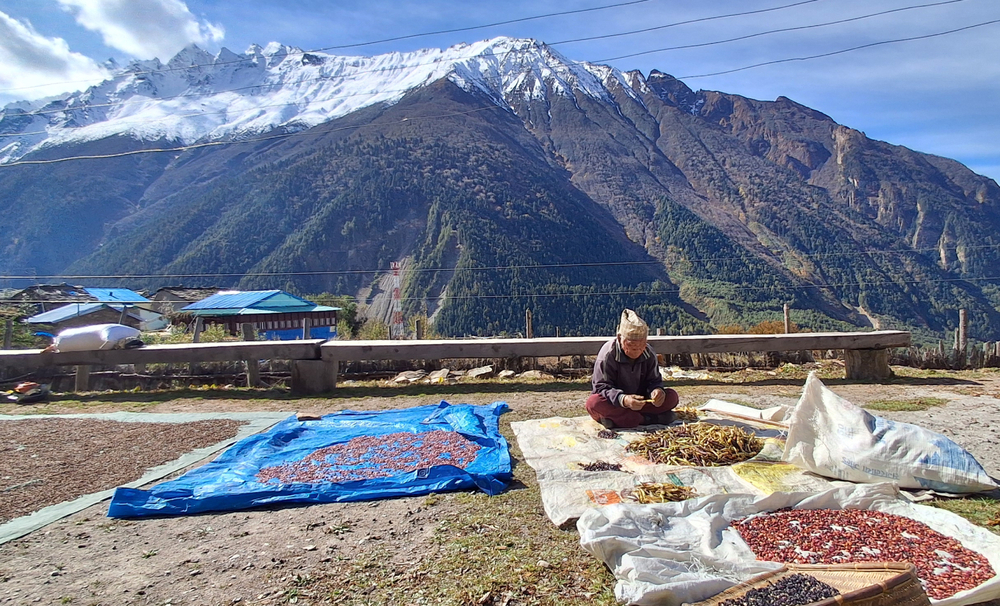
“We take the milking cows with us wherever we go,” said Droupati Aitwal of Chhangru. “We leave the other animals at places along the route where there is good grazing, under the care of herders. We bring them back with us when we return.”
Families hire herders collectively and share the cost according to the number of animals each household leaves behind, she said.
The journey is particularly difficult for children, new mothers, pregnant women, elderly people, people with disabilities and women travelling with livestock.
“It is difficult, but we have no option. This has been the practice since our great-grandparents’ time. We cannot stay in the villages because the snow and cold make it impossible,” Aitwal said.
Before the migration, each household performs rituals to worship its family deity. Families invite the wider community and host feasts. A collective worship ceremony is held at the end, and residents leave the villages on the same day.
“Before leaving home for the winter, we pray for the safety, well-being and prosperity of our families and community. Only after the worship is completed do we consider the preparations for departure formally finished,” said 80-year-old Devalal Budhathoki of Tinkar.
As the date approaches, families finish storing their harvest, preparing their fields, arranging care for their animals and performing the rituals. They then set off in a long procession.
Once residents of Chhangru and Tinkar descend on the district headquarters and other low-lying areas, life along this remote stretch of the border comes to a standstill. Doors are locked, daily activities cease, and the villages remain silent until spring.
When families return around April, they unlock their houses and resume their routines. Garlic, mustard greens, coriander and peas sown before their departure are sprouted in the fields and are ready for care. Farming, livestock rearing and village life gradually return to their usual rhythm. When winter comes again, the preparations to leave begin anew.
The cycle has continued in Chhangru and Tinkar for centuries.
A perennial struggle with the trail
As residents prepare to move to the lowlands for winter, they face another familiar worry: the route out of their villages.
Travelling through Nepal is far from easy. Landslides have damaged several stretches of the trail connecting Tinkar and Chhangru, while the mule track from Chhangru to Dumling is also in poor condition.
Residents say movement for both people and livestock is difficult because sections of the trail around Budi Khola, Mausyabhir, Ghatibagar, Dopkhe, Tambaku and Kaljul have been damaged.
“Everyone in the villages is preparing to move, but there is no reliable route through our own country,” said resident Dan Singh Tinkari. “We have to suffer every year because the trail is in such poor condition.”
Some sections of the route between Tinkar and Chhangru have been patched up with help from residents, the Armed Police Force and Nepal Police, but the trail remains far from fully repaired, he said.
The federal, provincial and local governments have spent money on repairing and rebuilding the mule track, but the problems persist. Four years ago, around Rs15.4 million was spent on the route, including Rs10.8 million through the Nepal Army, Rs3 million from the Sudurpaschim provincial government and Rs1.6 million from Byas Rural Municipality.
Yet the route remains difficult to use, forcing residents to continue travelling through India.
In previous years, residents were even held up in Khalanga when they tried to move their villages for the winter because of poor roads and problems at the border crossing. They staged a sit-in outside the District Administration Office, bringing their livestock with them.
For the Byansi community, the absence of a safe and reliable mule track has made the twice-yearly seasonal migration increasingly challenging.
The distance involved makes it difficult for the rural municipality to build a durable route using its own budget, said Dharam Raj Joshi, chief administrative officer of Byas Rural Municipality.
“We will discuss in the executive committee what can be done as an interim solution,” he said. “The municipality’s own resources are not enough to build a road that remains usable throughout the year, so we are seeking support from the federal and provincial governments.”
Basant Pratap Singh
Basant Pratap Singh is the Bajhang correspondent for Kantipur Publications.
Most Read from Sudurpaschim Province
Editor's Picks
The many lives of Patan, captured in photographs
Momo, mon amour: A Nepali bill of fare — and affair

Balendra Shah’s Facebook page used to hold power to account. Now it holds power.
Beyond sushi and sukiyaki, a taste of Japanese culture in Kathmandu
Everest Base Camp trek: From self-doubt to finding my feet in the Himalayas
E-PAPER | November 09, 2026

×