Bhotekoshi flood survivors face new battle against illness
Medicines are running short, health services remain disrupted, and crowded shelters are raising fears of disease outbreaks among displaced families. People who lost relatives in the flood are also beginning to show signs of psychological distress. Reuters
For survivors who escaped the Bhotekoshi flood with their lives, the crisis is far from over. Roads remain cut off, health services have been disrupted, and essential medicines are running short, leaving those who lost their homes facing a growing threat of illness.
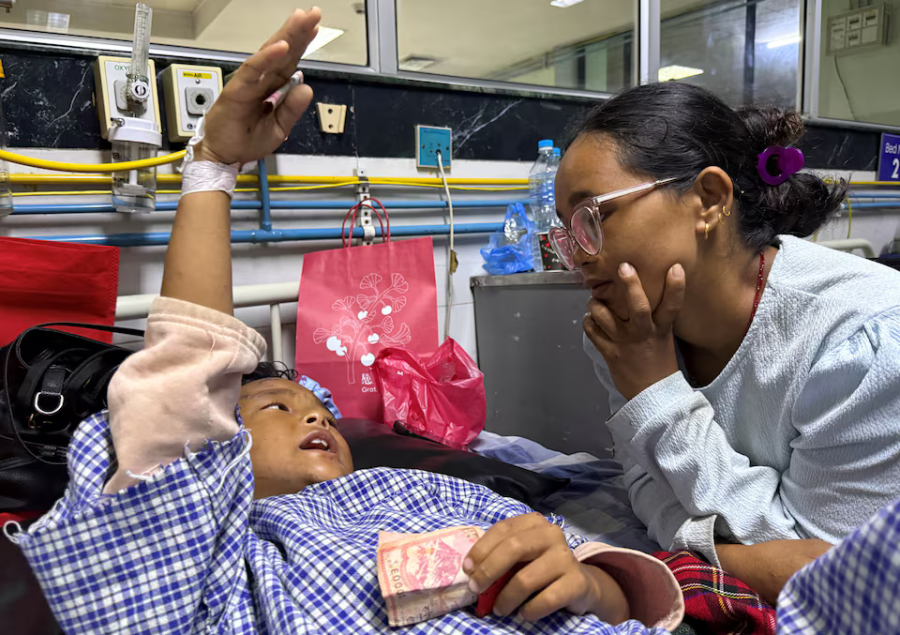
At a temporary shelter in Laharepauwa, Rasuwa, 26-year-old Ranjina Tamang is struggling to care for her four-month-old son, who has had a fever since Saturday.
Ranjina, who is four months postpartum, is among more than 150 people sheltering at Shivalaya Basic School in Uttargaya Rural Municipality. Health workers came to the camp on Sunday morning, examined her baby and wrote down the names of medicines she should buy.
But she has no money to buy them.
“I don't have even one rupee. How am I supposed to buy the medicine?” she said. “If I had money, I would have taken my baby for treatment yesterday. There is hardly any market left either. Where would I go to buy it? And there isn't even a road to get there.”
Her predicament is shared by many of those displaced by the flood, particularly pregnant women, new mothers, elderly people and patients with chronic illnesses.
Some have lost not only their medicines when the flood swept away their homes, but also the prescriptions needed to replace them.
“Many people don't even know which medicines they were taking,” said Ram Raja Bhandari, head of the health section at Bidur Municipality. “They know the name of their illness, but not the name of the medicine.”
The disruption has left many patients without medicines they need to take regularly. Bhandari said the shortage is particularly concerning for tuberculosis patients, as medicines that should not be interrupted have already run out at some health facilities.
The health risks are spreading beyond medicine shortages.
A viral fever has been reported in Pipaltar near Devighat and could spread to other areas, Bhandari said. People who lost relatives in the flood are also beginning to show signs of psychological distress.
Meanwhile, the temporary shelters where survivors have been forced to live are creating their own health concerns.
At Shivalaya Basic School, 30 people are packed into a single room. The school has only two toilets, forcing some people to relieve themselves outdoors when the toilets are overcrowded.
That raises the risk of contaminating water sources and spreading diarrhoeal diseases.
Ranjina sleeps on a mat on the school's floor with her baby. She has been given a bedsheet, while meals are provided in the morning and evening. Noodles, biscuits and fruit drinks are distributed during the day.
Her baby continues to cry, possibly because she is struggling to produce enough breast milk.
Her aunt, who is staying beside her, also has a fever. But there is little she can do to seek treatment.
The disruption is also evident at Trishuli Hospital. Before the flood, around 700 patients visited the hospital each day. Now, only five to 10 patients are arriving daily.
The sharp decline does not mean fewer people are falling ill. Rather, the flood has severed road links with the district headquarters, making it difficult for many patients to reach the hospital.
Some displaced people staying in a nearby camp have already developed diarrhoea. Their samples have been collected and sent to a laboratory for testing, said Dr Rikesh Rana, information officer at Trishuli Hospital.
“The risk has certainly increased, and there is also a problem with access to clean drinking water,” Rana said. “Many people with health problems are simply unable to reach the hospital.”
Disease risk grows in shelters
Keeping many people together may be unavoidable immediately after a disaster, but keeping them in such conditions for an extended period can increase the spread of infectious diseases, said Dr Sher Bahadur Pun, an infectious disease specialist at Sukraraj Tropical and Infectious Disease Hospital.
“If someone becomes sick, they need to be isolated immediately,” Pun said. “Otherwise, diseases such as respiratory infections and diarrhoea can spread quickly.”
Health authorities should also monitor influenza, he said, noting that swine flu infections are currently increasing.
Pun is speaking from personal loss. His parents-in-law are among those believed to have been swept away by the flood while travelling towards Gosainkunda on a bus carrying pilgrims.
He warned that another outbreak could quickly spread through the shelters.
“If someone develops cholera or even a respiratory infection in a shelter, it can spread rapidly to others,” he said.
The psychological toll also needs attention.
“After a disaster, people can become psychologically distressed,” Pun said. “That needs to be addressed as well.”
Hundreds of people remain missing after the Bhotekoshi flood, and authorities have yet to establish a definitive number of deaths and missing people.
Survivors have lost husbands, wives, children, parents, relatives, friends and neighbours. Many watched people being swept away while fleeing for their own lives.
“People experience psychological distress in situations like this and need counselling,” Pun said. “Diseases such as measles can also spread, so the relevant agencies need to be alert.”
Doctors also warn that disasters can disrupt treatment for chronic illnesses long after the immediate emergency has passed.
Pun recalled being sent to Sri Lanka after the Indian Ocean tsunami while he was studying in Japan. Despite Sri Lanka’s stronger health system, he said the disaster was followed by an increase in cases involving diabetes, high blood pressure and mental health.
“Nepal also needs to pay attention to people with chronic illnesses who have stopped taking their regular medicines and may need counselling,” he said.
In the flood-hit areas, getting those medicines to patients has become a logistical challenge.
Bhandari said officials were preparing to use drones to deliver medicines to a health centre in Khadgabhanjyang because the road has been cut off.
For survivors staying at temporary shelters, even necessities remain uncertain.
The heat is making conditions difficult at the Shivalaya school, particularly for pregnant women, new mothers and elderly people, said Biswas Nepali, a resident of Kalika Rural Municipality-3 and a social activist involved in relief efforts.
“People with chronic illnesses don't have the medicines they take regularly,” Nepali said.
He said villagers had been calling to say that local shops had run out of essentials such as rice, salt and cooking oil.
“They are calling to say everything in the shops has run out, but there is no road to transport supplies,” he said. “The government needs to pay attention to this.”
Arjun Poudel is a health reporter for The Kathmandu Post. Before joining the Post, he worked for Sagarmatha Television, Naya Patrika, Republica and The Himalayan Times.




 24.85°C Kathmandu