Helicopter rescues offer lifeline to teenage mothers in Nepal’s remote hills
Emergency airlifts are saving the lives of teenage mothers and newborns in remote districts, where difficult terrain and limited health facilities often turn childbirth into a life-threatening ordeal. Jyotee Katuwal/TKP
For 19-year-old Sushila Roka of ward 14 in Musikot Municipality, Rukum West, the morning of June 4 became the most difficult day of her life. Her family had been preparing to welcome her first child. But as her labour pains intensified, excitement quickly turned into fear. Sushila, who became pregnant at a young age, developed serious complications.
Her family rushed her to the district hospital, but doctors delivered devastating news.
“Forget about saving the baby. You did not bring her in on time, and we cannot save it,” Sushila’s sister-in-law, Nandakala Roka, recalled doctors telling them.
“The whole family was devastated after hearing that.”
Sushila was carrying twins. Although her family rushed her to the hospital, hoping both babies could be saved, doctors warned them of the risks. After a prolonged effort, doctors delivered one baby without surgery, but had to perform a caesarean section to deliver the second.
But the danger was not over.
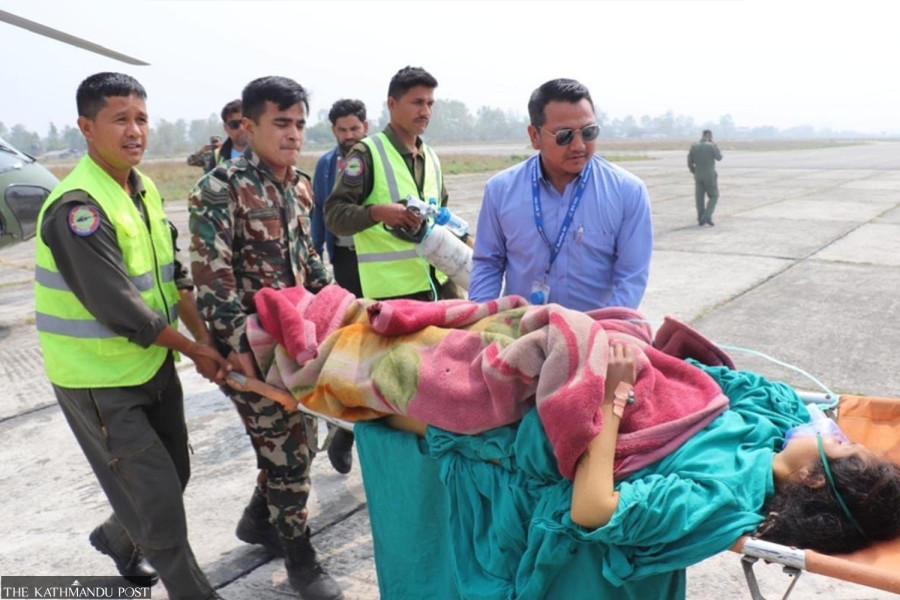
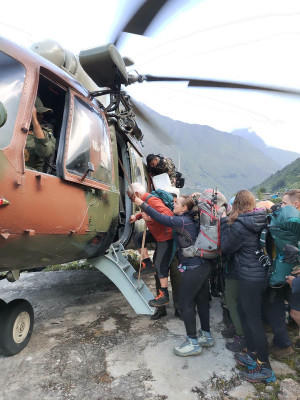
Sushila suffered severe bleeding after delivery. Doctors advised that she be transferred to the provincial hospital in Surkhet. She was airlifted by a Nepali Army helicopter after the District Administration Office, Rukum West, issued a recommendation for emergency evacuation.
Only then did the family regain hope.
A similar ordeal unfolded for 15-year-old Karuna Bista of ward 2 in Jagannath Rural Municipality, Bajura. She gave birth while unconscious on November 27 last year.
Karuna became pregnant during adolescence and lost consciousness after sudden labour pains before the baby was delivered. By the time she reached the district hospital, her condition had become critical.
The doctors suggested she needed treatment outside the district due to excessive bleeding and delivery complications.
“My daughter-in-law fainted while giving birth, perhaps because she was too young,” said Karuna’s mother-in-law, Amrita Bista. “My grandson was born while she was unconscious.”
Although the baby survived, Karuna didn’t regain consciousness for two days. She was later airlifted to the provincial hospital for further treatment.
Nilima Sherpa, 15, from ward 2 of Makalu Rural Municipality in Sankhuwasabha, faced a similar crisis.
She became pregnant at 15 and was flown by a Nepali Army helicopter to Paropakar Maternity and Women’s Hospital in Kathmandu on March 22 after suffering severe bleeding.
Nilima said she entered pregnancy with little knowledge of childbirth, potential complications or the preparations needed to deal with the risks, as she was still only 15 years old.
“I was not thinking about how I would deliver the baby. I was constantly afraid that I might not survive,” she said. “Becoming a mother for the first time was the most terrifying experience of my life.”
She said timely coordination among relatives, local authorities and concerned agencies, followed by helicopter evacuation, gave her a second chance at life.
“I never imagined a helicopter would come for the rescue and that all three lives would be saved,” Nandakala said. “The timely evacuation saved the mother and the babies.”
Because Sushila gave birth to twins at a young age, both babies have very low birth weights. Doctors say they need to remain in the hospital for at least another month.
Nandakala said Sushila’s health remains weak, and she cannot breastfeed directly. The milk has to be expressed and fed to the babies through a syringe.
Amrita in Bajura had a similar experience.
“My daughter-in-law regained consciousness only two days after reaching the hospital,” she said.
She said the free emergency evacuation service was the only reason Karuna reached the hospital in time.
Doctors say emergency referrals from remote districts remain necessary because many local hospitals lack specialised facilities.
Sijan Rawal, a doctor at Dolpa District Hospital, said even after a successful delivery, patients often have to be referred to better-equipped hospitals to save the newborns.
“We do not have paediatric specialists, essential equipment or enough medical staff,” he said. “Referring patients is sometimes the only option to save their lives.”
Nilima also credits the air rescue for saving her life.
“I received treatment on time because of everyone’s support, and both my baby and I are safe,” she said.
She said becoming a mother at such a young age had affected her both physically and mentally.
“My health has improved, but any sign of bleeding still frightens me. Although my body has recovered, I have not fully overcome the fear of going through it again,” she said.
In Nepal’s remote mountain communities, reaching health facilities remains a major challenge. Difficult terrain and hours-long travel often force women to give birth at home, increasing the risks, doctors say.
To address such emergencies, the government has been running the President Women Upliftment Programme since the fiscal year 2018-19. The programme provides emergency helicopter evacuation for pregnant women and new mothers facing life-threatening complications in remote areas.
The service is used for cases involving complicated pregnancies, severe bleeding or situations where delays in reaching healthcare facilities could put lives at risk.
Based on recommendations from chief district officers and local health institutions, the Ministry of Women, Children, Gender and Sexual Minorities, and Social Security mobilises the Nepali Army for rescue operations.
Helicopters stationed at the Central Air Base in Kathmandu and the Western Air Base Wing in Surkhet have been used to evacuate women from designated local levels across all seven provinces.
Brigadier General Raja Ram Basnet, spokesperson for the Army, said the emergency maternity evacuation programme has become a lifesaving service for mothers and newborns.
According to him, the free helicopter rescue service is available across all local levels in 19 districts: Taplejung, Sankhuwasabha, Bhojpur, Khotang, Solukhumbu, Okhaldhunga, Manang, Mustang, Rukum East, Rukum West, Jajarkot, Dolpa, Kalikot, Mugu, Humla, Bajhang, Bajura, Achham and Darchula.
The programme is partially available in remote areas of 25 other districts, where women facing life-threatening pregnancy or childbirth complications are evacuated to suitable hospitals.
So far, around 950 pregnant women and new mothers have been rescued by helicopter under the programme across the country. Data provided by the Nepali Army shows that 19 percent of those rescued were teenage mothers.
Dr Lalit Jung Shahi, an obstetrician and gynaecologist at Karnali Provincial Hospital, said young mothers often require surgical intervention due to pregnancy-related risks.
“Pregnant teenagers face a higher risk of high blood pressure. Because of that, it is often impossible to complete delivery without surgery,” he said.
“Teenage mothers brought in through helicopter rescue often face excessive bleeding after labour begins, low birth weight babies, severe haemorrhage and anaemia.”
Anju Dhungana, chief of the Women Empowerment Division at the Ministry of Women, Children, Gender and Sexual Minorities, and Social Security, said all three tiers of government must step up efforts to curb child marriage and prevent girls from becoming mothers too early.




 24.71°C Kathmandu