Under the guise of oversight, lawmakers face backlash over high-handed conduct
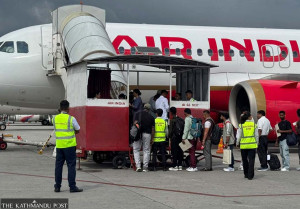
Chasing social media attention, lawmakers are crossing jurisdictional lines by confronting officials, seeking confidential files and issuing arbitrary ultimatums. A video clip showing federal lawmaker Jagdish Kharel aggressively questioning a corporate executive at TIA recently went viral, triggering widespread criticism. Screengrab Via YouTube
Nepali lawmakers have come under growing scrutiny for turning parliamentary oversight into public confrontations, with recent incidents ranging from confronting airport officials and demanding confidential investigation files to issuing abrupt deadlines to government agencies.
Critics say such actions blur the line between legislative monitoring and executive interference, fuelled increasingly by the pursuit of social media attention.
From MPs demanding confidential investigation files from the Commission for the Investigation of Abuse of Authority (CIAA) to Finance Committee members creating a scene at Tribhuvan International Airport (TIA), a series of recent incidents has raised questions about parliamentary conduct and the limits of legislative oversight.
Parliamentary affairs experts say the controversies reflect a lack of understanding about lawmakers’ roles and an increasing tendency among politicians to seek public attention through confrontational actions that perform well on social media.
A video clip showing a federal lawmaker aggressively questioning a corporate executive at TIA recently went viral, triggering widespread criticism.
The incident took place last Monday when Rastriya Swatantra Party (RSP) lawmakers Jagdish Kharel, elected from Dolakha, and Sagar Bhusal, elected from Parbat, arrived at the airport. Both are members of the Parliamentary Finance Committee.
The lawmakers said they were investigating public complaints about a Rs50 to Rs100 seating fee charged to visitors waiting inside the terminal. They confronted Charu Shrestha, chief executive officer of IMS Services, the company operating the terminal area.
In the video, Kharel can be heard questioning the company’s authority to impose the charge.
“Who allowed you to collect money from people just to sit here? This is an official inspection. We are members of the Finance Committee,” Kharel says.
The lawmakers had brought their own camera operator to record the interaction. When Shrestha requested that the recording be stopped, explaining that the company was operating under a formal agreement with the Civil Aviation Authority of Nepal (CAAN), the exchange became tense.
“We charge Rs50 and Rs100 to manage the crowd, but senior citizens, children below five years, and persons with disabilities are allowed to sit without paying,” Shrestha explained.
Bhusal then questioned the arrangement in a manner critics described as populist.
“Even under this new government, an elderly father waiting for his son returning from Japan has to pay just to sit down?” he said.
The lawmakers also warned that they would take the matter to the media. When Shrestha asked them to discuss the issue calmly, an irritated Kharel said he would raise it in Parliament before leaving the area.
The terminal area is managed by IMS Services under a 30-year Build-Operate-Transfer (BOT) agreement. IMS Group is one of Nepal’s major business houses and is the authorised distributor of Samsung smartphones and SsangYong Motors.
Shrestha later told Kantipur that the lawmakers appeared uninterested in understanding the operational realities of airport management.
“They were not interested in hearing about the agreement or the challenges involved in keeping the area organised. If we do not regulate access, the terminal quickly becomes overcrowded with unauthorised hotel agents, taxi operators and unnecessary crowds, making it difficult for passengers to move,” she said.
She also said the lawmakers did not present any formal letter from the Finance Committee authorising the inspection.
Finance Committee chairman Krishna Hari Budhathoki declined to comment on the issue. Committee secretary Laxman Aryal, however, defended the lawmakers, saying the video showed only a heated moment from what had otherwise been a “cordial discussion”.
He claimed the footage had been selectively circulated to create a negative impression. However, no official decision regarding the airport inspection has been uploaded on the committee’s website.
Demanding confidential files from the CIAA
The airport incident was not an isolated case.
A few weeks earlier, a four-member subcommittee of the State Affairs and Good Governance Committee became involved in a dispute with the CIAA’s regional office in Itahari after lawmakers demanded access to ongoing investigation files.
On July 1, lawmakers Yagya Mani Neupane and Gajala Shamim Mikrani of the RSP, Bishnumaya BK of the CPN-UML, and Yubaraj Dulal of the Nepali Communist Party visited the CIAA office and sought to examine active case files.
When Itahari CIAA chief Yagya Puri refused, citing legal provisions requiring investigations to remain confidential, Neupane objected strongly.
“If these files can be handled by everyone from office assistants to senior officials while maintaining confidentiality, why can’t elected representatives of the people review them?” Neupane asked. “How can we ensure the country is following the rule of law if we cannot examine such matters?”
Puri refused to provide the documents, saying the agency was bound by its legal obligations.
“Details of ongoing investigations, including information about informants and official correspondence, must remain confidential under our code of conduct,” he said. “We cannot provide access to active case files.”
Dulal argued that lawmakers needed to know whether influential cases were being deliberately delayed. The subcommittee warned that it would prepare an adverse report against the CIAA for failing to cooperate.
However, even 15 days after the dispute, the subcommittee has not submitted any report to the main committee.
Similar scenes have emerged during constituency visits.
In the fourth week of June, Prakash Gautam, a lawmaker elected from Makwanpur-1, visited Hetauda Hospital and publicly pressured officials to immediately bring a newly built Neonatal Intensive Care Unit (NICU) into operation.
“You have two weeks to make this functional. If it is not done, we will have to take action,” Gautam told hospital officials in front of cameras. “Building infrastructure and installing equipment alone is not enough.”
Bhim Sagar Guragain, registrar of the Madan Bhandari Academy of Health Sciences, said the lawmaker’s comments overlooked practical challenges.
“Visits from elected representatives can encourage institutions, but the equipment had arrived only two days earlier. Installation had been completed, but payment procedures were still pending, and specialised staff had not yet been recruited,” Guragain said.
He added that the hospital was now under pressure to conduct examinations on July 18 to hire staff nurses quickly, despite the administrative and logistical hurdles.
Experts and former civil servants say such incidents reflect a broader misunderstanding of the separation of powers between the legislature and the executive.
Rajendra Phuyal, former secretary of the National Assembly, says such controversies stem from lawmakers’ failure to understand, or their unwillingness to respect, the limits of their own authority and the mandate of parliamentary committees.
“They lack clarity about the scope of their role as MPs. They need to understand whether they are acting as legislators or as members of the executive. There is a fundamental difference between executive monitoring and oversight by an elected legislative body,” Phuyal said.
“An MP’s role is not to intimidate or pressure people. Their job is to examine the ground realities of projects, service delivery and the implementation of laws; identify the problems faced by citizens; find out what is causing those problems; and guide the government towards solutions,” he said. “When lawmakers fail to understand this distinction, they start believing that using their position to exert pressure is part of their responsibility.”
Prakash Chandra Pariyar, whip of the RSP, acknowledged that the party had repeatedly reminded its lawmakers to maintain parliamentary decorum.
“We have been telling our lawmakers to respect parliamentary dignity, remain logical and operate within their authority during inspections,” Pariyar said. “They need to understand the limits of their position, even when they are raising genuine concerns.”
Phuyal said social media had further encouraged such behaviour.
“What we are seeing is an attention-seeking sickness. Many politicians are more focused on creating viral moments on TikTok and Facebook than carrying out meaningful oversight,” he said.




 14.78°C Kathmandu