Government pushes ten percent scholarship rule across universities
Prime Minister Balendra Shah directs newly appointed vice-chancellors to enforce free scholarships for disadvantaged and meritorious students while curbing political activities on campuses.
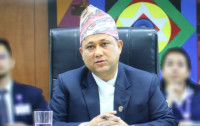
Prime Minister and Chancellor of universities Balendra Shah has instructed newly appointed vice-chancellors to enforce a mandatory ten percent scholarship provision across universities and their campuses.
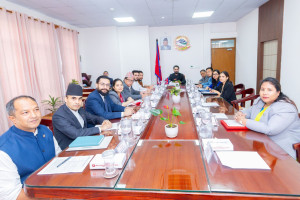
Shah held a joint meeting with vice-chancellors of seven universities, including Tribhuvan University, at the Prime Minister’s Office in Singha Durbar on Tuesday. During the meeting, he directed them to strictly implement the provision requiring universities and their campuses to provide free scholarships to ten percent of students.
According to vice-chancellors who attended the meeting, Shah also urged universities to remove party-affiliated student organisations from campuses, conduct examinations and publish results on time, investigate and protect encroached university land, end political appointments and create an environment conducive to learning and academic work.
“We briefed the prime minister about the condition of our universities. He shared his views after listening to us,” said one vice-chancellor who attended the meeting. “His main concerns were the implementation of the ten percent scholarship provision and ending political activities inside universities.”
Following the meeting, the Prime Minister’s Secretariat said the vice-chancellors had committed to keeping teachers, employees and students away from partisan politics and encouraging them to focus solely on constructive academic activities.
A press note issued by the secretariat said the vice-chancellors also pledged to implement academic calendars, improve administrative, financial and academic systems, strengthen good governance, maintain financial discipline, clear audit irregularities and enhance transparency.
Shah instructed the universities to ensure that at least ten percent of deserving students and those from targeted groups receive free scholarships to make access to higher education more equitable.
Earlier, Education Minister and university pro-chancellor Sasmit Pokharel had also instructed newly appointed vice-chancellors to implement the scholarship provision.
Following the directive, Tribhuvan University, Agriculture and Forestry University, Pokhara University, Purbanchal University, Mid-West University, Far-Western University and Rajarshi Janak University have issued circulars to their affiliated campuses to implement the scholarship scheme.
Although there is no uniform scholarship policy among universities, some university Acts have already included provisions for scholarships. Others have introduced scholarship rules through their senates and executive councils. Some universities have also included a condition in their affiliation requirements that ten percent of enrolled students must receive scholarships.
The provision has been implemented in some fields, including medical education and engineering, but has not been fully enforced across other disciplines.
Education Minister Pokharel said the scholarship system introduced by Kathmandu Metropolitan City would also be expanded to higher education.
“We are implementing scholarship provisions across educational institutions nationwide to ensure access to education, equal opportunities and social justice,” he said.
Meanwhile, Purbanchal University, Pokhara University, Agriculture and Forestry University, Far-Western University and Mid-West University issued separate notices on Monday and Tuesday directing their campuses to ensure scholarship opportunities.
The notices informed campuses about rules they must follow while admitting students under university-approved programmes for the academic year 2026-27. They require campuses to reserve ten percent of total admission seats for meritorious students, economically disadvantaged students and those from targeted groups.
The universities said students would be selected and admitted according to their scholarship-related procedures.
Tribhuvan University’s Student Welfare and Sports Directorate has also instructed its constituent campuses, affiliated private colleges and community campuses to implement the scholarship provision.
Directorate chief Dipendra Parajuli directed campuses to provide scholarships according to criteria set by the respective dean’s offices. Campuses have also been asked to submit details of scholarship distribution to the dean’s offices and the directorate.
In medical education, scholarship recipients are selected through the integrated entrance examination process for both public and private medical colleges. The Medical Education Act requires public medical colleges to provide scholarships to 75 percent of students, while private medical colleges have been providing scholarships to ten percent of enrolled students.
When Shah was mayor of Kathmandu Metropolitan City, the city introduced an integrated entrance examination system for grades 11 and 12 based on the medical education model to select scholarship recipients.
Although similar provisions existed in the Scholarship Act 2021 and Education Regulations 2002, concerns had been raised over their ineffective implementation. At the school level, from grades 1 to 10, scholarship recipients are selected through a process involving local governments and schools.
Last year, 672,000 students were enrolled in universities and campuses across Nepal. If the ten percent scholarship provision is implemented, around 67,000 higher education students would benefit.
According to data from the University Grants Commission, the largest number of undergraduate students study at constituent campuses, which have around 250,000 students. Community campuses have approximately 225,000 students, while private institutions have around 200,000 students.




 16.85°C Kathmandu