Bhikkhu Sugandha’s extraordinary journey to Thailand’s highest monastic circles
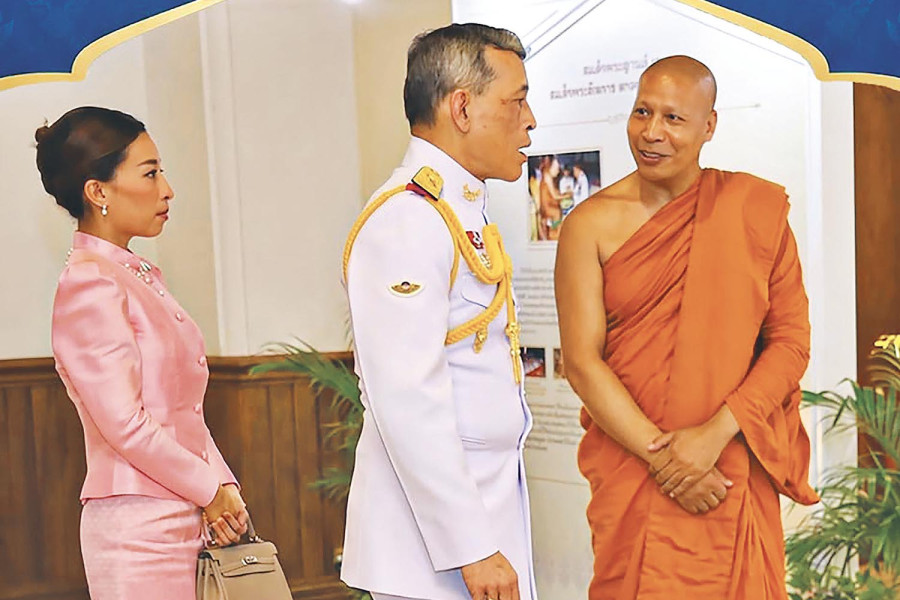
Dr Anilman Shakya, a Nepali monk educated on a Thai royal scholarship, rose through the ranks of Thailand’s Sangha while teaching at prisons, Oxford and leading global universities. Bhikkhu Sugandha, born Anilman Shakya, talks with the King of Thailand, Vajiralongkorn. Photo provided to the Post
Clad in saffron robes, Bhikkhu Sugandha is often found teaching in places as contrasting as high-security correctional facilities and prestigious academic institutions such as the University of Oxford in the United Kingdom and Santa Clara University in the United States.
Born Anilman Shakya, the 66-year-old monk holds a PhD in Social Anthropology from Brunel University of London. Educated on a Thai royal scholarship, he is among the few foreigners to have risen to the highest ranks of Thailand’s monastic order, or Sangha.
A devoted follower of peace, compassion and loving-kindness, Bhikkhu Sugandha is widely respected for his deep understanding of the Buddha, the Dhamma and the Sangha. To an ordinary observer, his saffron robes, or chivara, may represent a life devoted entirely to monastic practice. But his journey extends far beyond religious service. He is a scholar, author, researcher and academic who has built a distinguished career at the intersection of Buddhism and social sciences.
Although born in Nepal, he has spent most of his life in Thailand, where he has emerged as a prominent figure in Theravada Buddhism. Known within the monastic community as Bhikkhu Sugandha, he has been conferred the royal religious title of Phra Brahma Shakayavansa Vishuddhi Shahi in Thailand and is regarded as one of the country’s most respected monks.
His journey to Thailand began at the age of 14, when he was ordained as a novice monk, or Sramanera.
Diligent, curious and deeply committed to learning, Anilman quickly earned the opportunity to work closely with the Thai Sangha. Over the years, he developed close ties with the Supreme Patriarch (Sangharaja) and the Deputy Supreme Patriarch of Thailand. His humility and dedication led to his appointment as assistant secretary to the Supreme Patriarch.
His influence grew steadily thereafter. Today, he is recognised as a leading authority on Theravada Buddhism and serves as a think-tank expert on sustainable development under the United Nations. He is the first foreign national to reach the upper echelons of the Thai Sangha, ranking third in the hierarchy after the Supreme Patriarch and the Deputy Supreme Patriarch.
Having moved to Thailand in 1975 at the age of 15, Anilman has spent 51 years in the country.
The historic encounter
The foundation of Anilman’s journey was laid after a historic meeting between senior Buddhist leaders from Thailand and Nepal.
In 1972, the then Deputy Supreme Patriarch of Thailand, Somdet Phra Nyanasamvara, visited Bangladesh to assess the impact of devastating floods on the Buddhist community there. On his return, he stopped in Nepal, where he met the revered Nepali monk Bhikkhu Amritananda.
During the meeting, the Thai prelate asked Bhikkhu Amritananda how Thailand could support the revival of Buddhist education in Nepal, according to Anilman.
“I have heard that the state of Buddhist education and discourse is not robust in the very land where the Buddha was born and raised. How can I assist?” Somdet Phra Nyanasamvara asked.
The Deputy Supreme Patriarch also expressed Thailand’s gratitude towards Nepal, noting that Thailand had flourished by following the teachings of the Buddha, a messenger of peace born on Nepali soil. He credited the influence of Buddhism and Nepal’s goodwill for strengthening Thailand’s global standing.
When asked how Thailand could help, Bhikkhu Amritananda made two requests, Anilman recalled during a conversation with Kantipur.
“First, he requested that Thai Dhamma emissaries be sent to Nepal to spread Buddhist education at the grassroots level in villages,” Anilman said. “Second, he urged Thailand to take young Nepali boys to teach them the Dhamma, education and wisdom.”
The Deputy Supreme Patriarch agreed to immediately fulfil the second request and assured that the first would be presented before the Thai Sangha.
“That is how I was selected from Nepal to go to Thailand,” Anilman recalled.
After nine months of training in Nepal, Anilman and two other Nepali youths travelled to Thailand. The Deputy Supreme Patriarch personally took Anilman under his guidance. The prelate was also the royal spiritual preceptor of the late King Bhumibol Adulyadej.
Of the two youths who travelled with Anilman, one later married and settled in Thailand, while the other returned to Nepal. Sharp-minded and exceptionally disciplined, Anilman remained close to his mentor.
The monastery frequently hosted the King, the Crown Prince, princesses, prime ministers and cabinet ministers. Through these interactions, Anilman gradually came to the attention of Thailand’s most influential figures.
Anilman graduated from Mahamakut Buddhist University, located within the monastery, in 1980. The same year, he received higher ordination, or Upasampada, becoming a full bhikkhu under Thailand’s 19th Supreme Patriarch, the late Somdet Phra Nyanasamvara.
With a rare combination of academic achievement, Buddhist scholarship and administrative experience, Anilman received teaching offers from institutions in the United States. However, out of gratitude to the Thai King, he returned to Thailand in 2000 and dedicated his knowledge and international experience to teaching within the kingdom.
His fame spread further, in the Buddhist community almost all over the world.
Today, Bhikkhu Anilman Shakya teaches at Thailand’s most prestigious institutions, including Chulalongkorn University and Mahidol University. He serves as an adviser to Mahamakut Buddhist University and the World Buddhist University.
Beyond Buddhist philosophy, he also teaches anthropology, economics and law as a visiting professor. He travels two to four times a year to lecture at Santa Clara University and the University of California in the United States, as well as the University of Oxford in the United Kingdom.
He alternates his teaching schedule, lecturing undergraduate students in the US one year and in the UK the next. In Thailand, he regularly conducts sessions for judicial judges and lectures at the staff college for senior government officials, training senior-level decision-makers.
He has also delivered motivational and mindfulness masterclasses to 1,500 business CEOs in San Diego, USA, and frequently serves as an external thesis examiner for universities in Sri Lanka and Myanmar.
Reaching the apex of the Sangha
Anilman has served as the deputy rector of Mahamakut Buddhist University and rector of the World Buddhist University. After retiring from academic administration at the age of 60, he joined the secretariat of the Supreme Sangha Council of Thailand, where he handled key administrative responsibilities.
Today, he remains the first foreign national to have reached such a senior position within the Thai Sangha, ranking third in the hierarchy after the Supreme Patriarch and the Deputy Supreme Patriarch.
Thailand has more than 40,000 monasteries, and the Sangha Council is responsible for bringing them under legal frameworks, formulating policies and regulating monastic affairs. After serving four years at the secretariat, Anilman now works as an adviser and oversees eight northern zones as a zonal head under the Thai Sangha.
“For a foreigner to penetrate the decision-making level of the Thai Sangha is incredibly difficult,” Bhikkhu Anilman said. “It was my knowledge, integrity, dedication and the underlying goodwill towards Nepal that enabled me to reach this height.”
He was recently awarded the prestigious Sao Sema Dhammachakka (Golden Pillar of Dhamma) by Her Royal Highness Princess Maha Chakri Sirindhorn. The highly regarded honour is awarded by the Department of Religious Affairs under Thailand’s Ministry of Culture. Over the decades, he has received numerous medals, decorations and citations.
Anilman was also the principal collaborator of the late Thai Princess Bajrakitiyabha, who died at the age of 47, on her royal initiatives related to crime prevention, prison reform and inmate rehabilitation. At the princess’s request, he developed a pioneering approach for inmates called Cognitive Transformation Therapy, a psychological and spiritual framework aimed at cognitive rehabilitation and mental restructuring.
Since Thai prisons accommodate inmates from across the world, he found that a uniform rehabilitation approach was ineffective. He therefore designed a culturally diverse and inclusive counselling model, particularly for death row inmates and those convicted of serious crimes.
Through his sessions, he helps inmates reform their thinking, discover meaning in life and prepare for reintegration into society after release. The prisons, which operate under the Ministry of Justice, facilitate his access to high-security facilities.
Once a week, from 9:00 am to 3:00 pm, he remains inside prison facilities to provide counselling. One session each month is dedicated to foreign female inmates at the central prison, while the remaining weeks are spent counselling hardened criminals and death row prisoners.
“Stepping right up to the cells of these inmates carried immense risk and fear,” he said. “But I gathered my courage. I even succeeded in motivating a notorious Canadian serial killer, ranked among the top six most dangerous criminals globally.”
He regularly visits Rayong Central Prison, a maximum-security facility housing more than 7,000 inmates, to conduct Cognitive Transformation Therapy sessions.
His more than two decades of work in changing inmates’ mindsets and helping them return to society drew the attention of BBC Thailand, which produced a special feature on him. Around 2020, a BBC team from the United Kingdom visited Thailand to prepare television and radio reports on his work, bringing international attention to his efforts.
“According to a study conducted in Thailand, one-third of released prisoners reoffend within three years,” he said. “However, out of every ten inmates who attended my rehabilitation sessions, nine have successfully avoided recidivism and stayed out of prison.”
Deputy abbot of a royal monastery
Anilman serves as assistant abbot (deputy chief) of the prestigious Wat Bowonniwet Vihara in Bangkok. The royal monastery holds immense significance for Thailand’s monarchy, as kings and crown princes traditionally receive monastic training and ordain there. Several monks from the monastery have later risen to become Supreme Patriarchs.
Anilman said Thai people hold deep reverence for Lumbini and feel a profound sense of pride simply by touching its soil. Reflecting this spiritual connection, Thailand has built a park named after Lumbini.
“It is the largest park in Bangkok. There is a deep-seated belief among Thais that Lumbini possesses an extraordinary reserve of spiritual energy,” he said. “That is why they are incredibly eager to visit. They believe a pilgrimage to Lumbini earns them immense spiritual merit. They want to visit Lumbini to experience compassion, friendliness and universal brotherhood.”
At a time of growing global conflicts and instability, many Thai Buddhists wish to visit Lumbini to pray for world peace. It is widely believed among them that visiting the four major Buddhist pilgrimage sites—Lumbini, Sarnath, Bodh Gaya and Kushinagar—brings immense merit and lifelong happiness.
In Thailand, civil servants are entitled to four months of paid leave to observe the rain retreat, or Vassa. It is also a long-standing cultural tradition that Thai men ordain as monks for at least 15 days once in their lifetime.
Bhikkhu Maitri Mahasthavir, spiritual adviser to the Lumbini Development Trust, said it was a matter of immense pride for Nepal that a Nepali citizen had attracted the attention of the Thai Sangha, studied on a royal scholarship and achieved such a respected position in Thailand.
“Having worked closely with the late King Bhumibol Adulyadej, Anilman shares an excellent rapport with his son, the current King Vajiralongkorn,” he said. “Due to Anilman’s integrity and dedication, he effectively serves as an unofficial spiritual adviser to the King.”
He receives major state decorations from the Thai government annually.
Bhikkhu Siri Vajir, assistant professor at Lumbini Buddhist University, said Anilman’s role as a religious preceptor and spiritual adviser to the Thai royal family was an honour of the highest order for Nepalis.
“He travels worldwide to deliver major Dhamma discourses,” he said. “This fills Nepal and Nepalis with immense pride.”




 16.45°C Kathmandu