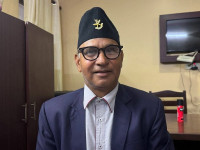
Bank president Kanda says funding will support jobs, infrastructure and economic reforms.ADB President Masato Kanda calls on Prime Minister Balendra Shah at Singha Durbar, Tuesday. Photo: PM’s secretariat
The Asian Development Bank (ADB) will scale up its financial assistance to Nepal by an additional $2.4 billion over the next four years, ADB President Masato Kanda announced on Tuesday.
Kanda, who is currently in the capital on an official visit, made the announcement following a high-level meeting with Prime Minister Balendra Shah in Singha Durbar.
“Nepal is at a defining moment, with an opportunity to build a more dynamic and resilient economy,” said Kanda.
“ADB is stepping up as Nepal’s largest multilateral development partner, and our support is expected to reach $2.4 billion by 2029. Our focus is on results for people, more jobs, stronger businesses, and better livelihoods for communities across Nepal.”
Nepal and ADB have already agreed on a country partnership strategy (CPS) for 2025- 2029, under which the bank has committed $2.4 billion in lending over the five-year period. Nepal and ADB also mark 60 years of partnership this year.
ADB’s active portfolio in Nepal currently stands at $3.9 billion.
During the meeting, Kanda congratulated Prime Minister Shah on the strong mandate he received in the recent elections and affirmed ADB’s strong commitment to supporting the government’s ambitious reforms towards economic transformation, job creation, and investment.
“ADB is stepping up as Nepal’s largest development partner, with additional support of $2.4 billion through 2029 to help translate the Prime Minister’s vision into results on the ground,” an ADB statement issued after the meeting said.
“For 60 years, Nepal and ADB have worked together through hardship, recovery, and progress, delivering safer schools, cleaner energy, stronger infrastructure, and better opportunities,” the statement added.
During Kanda’s ongoing visit, ADB has signed two loan agreements totalling $165 million as part of its annual commitment.
A $115 million project will provide reliable, safely managed water and sanitation services to more than 850,000 people, while a $50 million policy-based loan will modernise the systems that move goods across Nepal’s borders and help businesses reduce costs, improve efficiency, as well as enhance competitiveness through digitalization and streamlined procedures.
Looking ahead, ADB plans to scale up its support, with annual lending expected to reach up to $660 million this year and $2.4 billion under ADB’s country partnership strategy for Nepal 2025-2029, said the ADB’s statement.
This support will prioritise employment creation, private sector development, sustainable infrastructure, public service delivery, resilience, empowerment of women and disadvantaged and vulnerable groups, and digital transformation, while mobilising additional resources through co-financing and innovative instruments such as green and local currency bonds, according to the statement.
According to the prime minister’s private secretariat, during the meeting, both sides reaffirmed their commitment to strengthening the six-decade-long development partnership between the government of Nepal and the ADB.
According to Deepa Dahal, press and research advisor to the prime minister, the half-hour meeting included the prime minister expressing confidence that Nepal would make a new leap in development through good governance and transparency.
The two sides also discussed promoting hydropower and tourism as the backbone of Nepal's economy, as well as cooperating on digitalisation and tourism-related road infrastructure.
During the meeting, Kanda also praised Nepal's strong economic potential, solid public mandate, and young leadership, reiterating that the ADB would continue to stand by Nepal in its journey towards success.
According to Kanda, Nepal's young leadership and its commitment to reforms are inspiring.
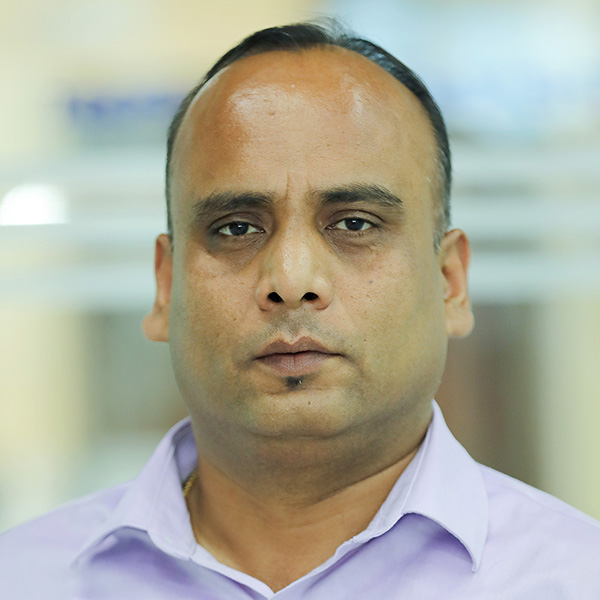
Anil Giri is a Chief Sub Editor covering diplomacy, international relations and national politics for The Kathmandu Post. Giri has been working as a journalist for more than two decades, contributing to numerous national and international media outlets.




 26.87°C Kathmandu