Blind students in Achham battle distance, poverty and barriers to learning
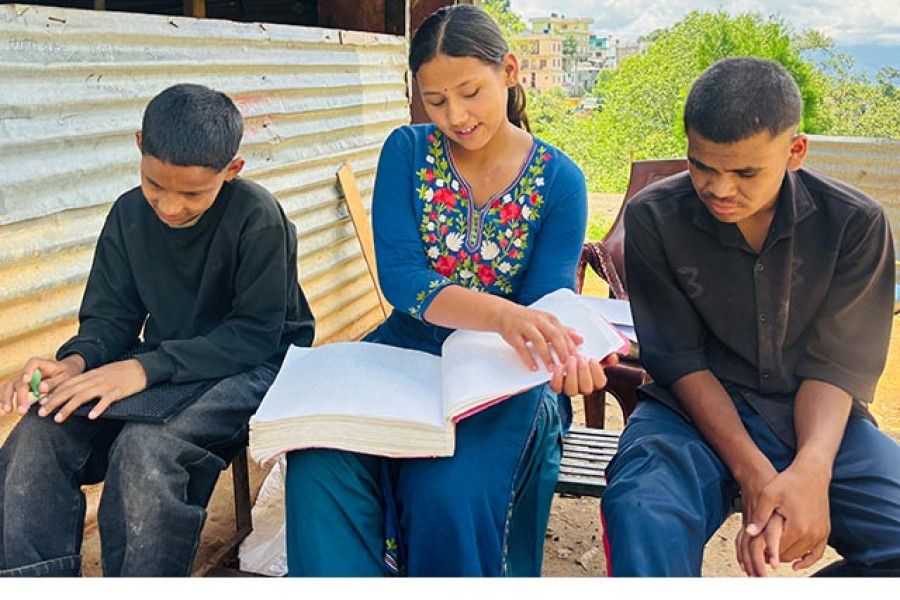
Despite Nepal’s inclusive education policy, many children with visual impairment lose years of schooling because poetry, remoteness and lack of accessible facilities keep them away from classrooms. Visually impaired students enrolled at Shodasha Secondary School in Mangalsen, Achham. Menuka Dhungana/TKP
Fourteen-year-old Lal Bahadur BK, from Rahaf in ward 1 of Turmakhand Rural Municipality in Achham, has been visually impaired since birth. Yet, even after entering his teenage years, he remained out of school for a long time. Living far from the district headquarters of Mangalsen, his family had no idea where or how a blind child could get an education.
It was only seven years ago that they learned the Shodasha Secondary School in Mangalsen offered classes for visually impaired children. With support from his family, BK eventually moved to the district headquarters to begin his studies.
But the journey from learning about the school to attending it regularly proved difficult. Poverty and geography stood in the way. His father is also visually impaired, and the family’s financial hardship made travelling to the school, located nearly 200 kilometres from his village a serious challenge.
After enrolling, BK would return home during school holidays but often could not make it back on time.
“There are still no vehicles that reach my village. My father can’t see either, so someone has to carry me on their back to where the buses run, and that costs Rs4,000 to Rs5,000. I could not always afford it,” BK said.
“When the school found out that I was enrolled but absent, they searched for me. After a year, I somehow managed the expenses and reached Mangalsen. But after the next holiday, I missed another six months of school because I couldn’t afford to pay someone to carry me along the trails.”
At 14, Lal Bahadur is currently in grade three. According to school authorities, teaching visually impaired children basic literacy skills requires considerable time in the initial stages. It took Lal Bahadur nearly five years to develop the finger sensitivity required to read Braille, starting with sorting large grains and gradually moving to smaller ones.
He now studies alongside other students, but learning remains challenging.
“Learning Braille has helped me, but it is still not as easy for me as it is for sighted students,” he said.
Fourteen-year-old Deepa Budha from ward 5 of Ramaroshan Rural Municipality faces similar difficulties. She studied at her village school until grade two but dropped out after struggling to see letters and experiencing eye pain in bright sunlight.
Although her family later learned about the specialised classes in Mangalsen, financial difficulties delayed her move to the school for years.
After arriving in Mangalsen, Deepa received Braille training and was later integrated into regular classes. However, she continues to struggle in overcrowded classrooms where teachers must divide their attention among many students.
“I cannot see what is written on the whiteboard, so I have to depend entirely on my classmates. There are 71 students in my class. It is difficult for teachers to focus on one student,” Deepa said.
“Asking questions repeatedly during class disturbs the other students. Sometimes I wish students like me had separate classrooms and dedicated teachers.”
Beyond classroom difficulties, the school infrastructure remains another challenge. The classrooms and toilets are not designed to accommodate visually impaired students, making everyday activities difficult.
“I need help from my friends even to use the toilet. We use the same facilities as everyone else. It becomes even more difficult during my periods,” Deepa said.
Thirteen-year-old Bhupendra Budha from ward 4 Turmakhand Rural Municipality was also born blind. He first enrolled at Kalikeshwari Secondary School in his village, but the school lacked Braille instruction and suitable teaching-learning materials.
Unable to learn through conventional methods, he eventually dropped out. Years later, his family discovered the programme at Shodasha Secondary School and brought him to Mangalsen seven months ago.
Bhupendra is currently at the initial stage of learning Braille and has not yet been formally placed in a regular grade. Being older than other students in the introductory lessons has left him feeling out of place.
“I haven’t even started grade one yet, and all my classmates are much younger than me. I regret not being able to study on time,” he said.
Brikesh Bogati, headteacher of Shodasha Secondary School, stated that the government has allocated 10 seats for visually impaired students at the school, with seven currently enrolled.
The school has hired two visually impaired teachers to provide initial Braille training. However, Bogati said a lack of awareness and poor accessibility mean many children arrive at the school only after they are already much older than the ideal age for enrolment.
Although the school integrates visually impaired students into regular classrooms, Bogati said limited infrastructure and budget constraints have prevented it from creating a fully accessible learning environment.
“The school does not have blind-friendly infrastructure. State support is limited to residential facilities and teaching. Structural improvements have been ignored,” Bogati said. “The lack of inclusive design makes daily life extremely difficult for these students.”




 13.8°C Kathmandu