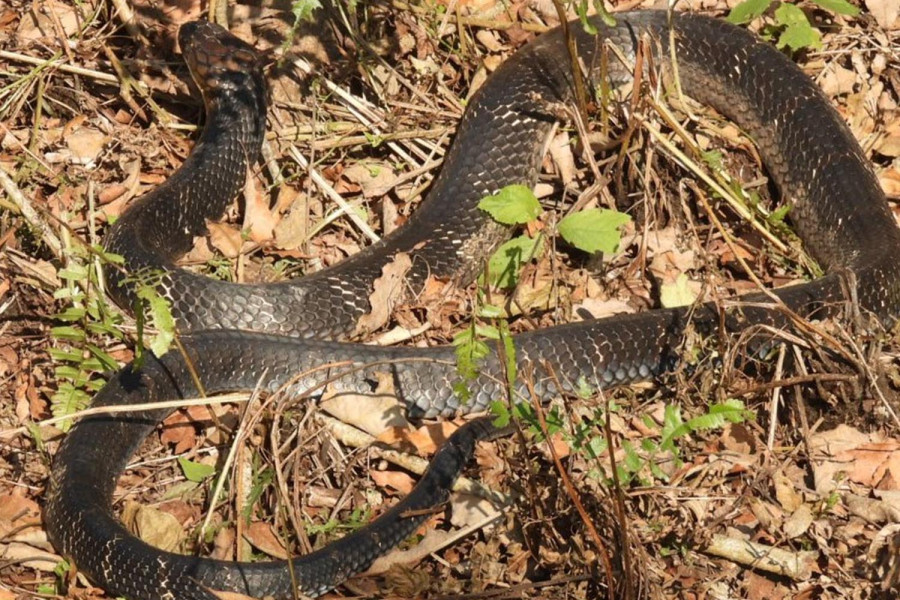
An increasing number of highly venomous snakes entering settlements around Chitwan National Park has raised fresh concerns among conservationists, snake experts and local residents, prompting calls for stronger rescue systems and wider public awareness to reduce the risk of deadly snakebites.
Among the most alarming are king cobras and cobras, two of the world's most venomous snakes. Last fiscal year alone, park authorities rescued five king cobras and 17 cobras after they entered homes and settlements in the park's buffer zone.
On June 1, a king cobra entered a house at Barauli in ward 17 of Kawasoti Municipality in Nawalparasi East. The snake was rescued by park staff and released into a dense forest near the park headquarters at Kasara. Another king cobra was found in ward 10 of Kawasoti the following day.
According to snake expert Dev Prasad Pandey, a king cobra bite can be fatal unless treatment begins immediately. Even when victims survive, recovery often takes a long time. However, Pandey says, king cobras differ slightly from other venomous snakes because they do not always inject their full venom during a bite.
“There have not been many confirmed human deaths from king cobra bites in Nepal, partly because they often do not release all their venom,” said Pandey, who completed his doctoral research on venomous snakes in Germany. “But the presence of king cobras and cobras in villages is a serious concern because these snakes are highly venomous and are easily noticed by people rather than hiding from them.”
According to Pandey, cobra bites can become fatal if treatment does not begin within three to four hours.
Park records show that two king cobras were rescued from Kawasoti, two from Meghauli in Chitwan and one from Madi during the last fiscal year of 2025-26.
Abinash Thapa Magar, the park's information officer, said that the snakes had to be rescued after entering villages and residential compounds in the buffer zone. Besides king cobras, the park also rescued 17 cobras during the same period.
Manesh Limbu of Meghauli, Chitwan, has been rescuing snakes from villages for the past 15 years. A professional nature guide, he is increasingly called to rescue king cobras from distant settlements, including Madi.
“I have rescued one king cobra so far this year. Last year I rescued six," said Limbu. “People call whenever such snakes appear because they are frightened.”
Limbu says his knowledge comes from years of working in forests and studying books by Indian snake specialists. He has bought rescue equipment costing between Rs15,000 and Rs20,000 with his own money.
“Even when I rescue king cobras or cobras, I do it entirely on a voluntary basis,” he said. “I earn my living as a nature guide. Snake rescue is not something I do for income.”
People sometimes reimburse his fuel expenses when he travels long distances. The largest king cobra he has rescued weighed 10.3 kilograms and measured 3.35 metres. “When people see such a huge snake inside their yard, they panic. The relief on their faces after the rescue is the biggest reward,” he said.
Thapa Magar said park staff based at the Gharial Conservation Centre respond to reports of snakes and pythons entering settlements. The park also receives help from trained volunteers working through buffer zone forest user committees.
The park is now planning to strengthen its rescue programme with technical support from ranger Yam Raut, who has expertise in snakes.
“Rescue work requires training and proper equipment,” said Thapa Magar. “We have not had a dedicated programme until now, but we plan to develop one.”
Pandey welcomed the initiative but said Nepal still lacked a scientific rescue system. “People are doing rescue work with good intentions, but it needs to become more scientific,” he said. “Rescuers must understand snake behaviour and ensure safe capture, transport and release in suitable habitats.”
According to conservationists and snake experts, snakes usually enter villages between mid-February and mid-October. Pandey informed that forest fires and monsoon floods often force snakes out of forests into nearby settlements. He stressed that authorities should analyse why snakes move into villages and educate communities about seasonal risks and preventive measures.
Chitwan National Park, the country’s first protected area, has long focused on conflict involving tigers, rhinos and wild elephants, which regularly enter settlements around the park. The park launched compensation schemes, rapid response teams and awareness campaigns aimed at reducing human-wildlife conflict. Pandey believes venomous snakes deserve similar attention because they also pose a significant threat to human life.
Last fiscal year, the park also rescued 87 pythons from buffer zone settlements. Although pythons are non-venomous, they are among the reptiles most frequently reported in villages.
Experts urge for better awareness, trained rescue teams, quicker medical response and closer cooperation between the park, local governments and communities are essential to reducing snakebite risks in Chitwan's buffer zone while ensuring the conservation of protected snake species.




 25.92°C Kathmandu
1.jpg)