A month on, Chief Justice’s promise to fix judge vacancies unfulfilled
Manoj Kumar Sharma assured lawmakers he would set up a system for timely appointment of judges, but more than a month into office he has yet to call a Judicial Council meeting. RSS
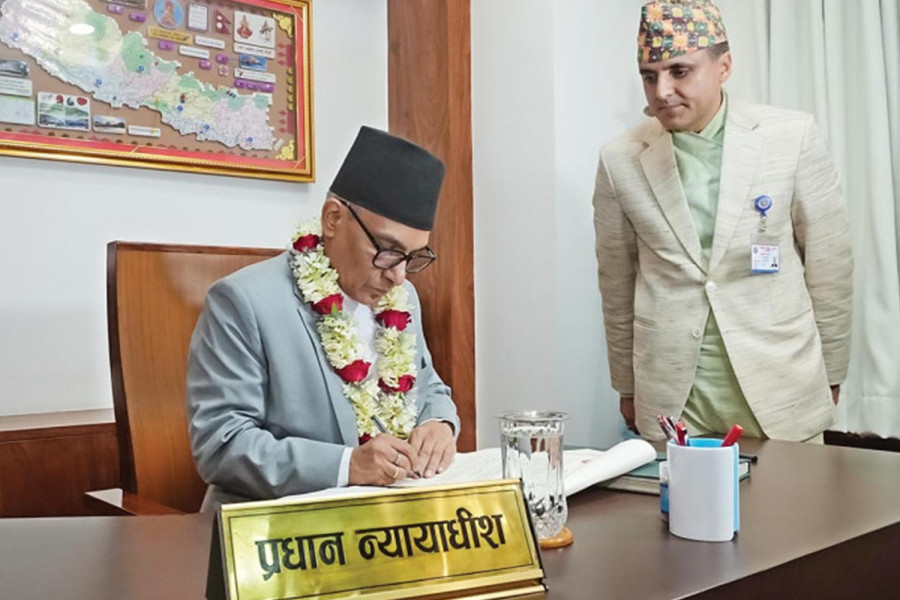
Despite pledging during his parliamentary hearing to establish a system for appointing judges before vacancies arise, Chief Justice Manoj Kumar Sharma has yet to initiate the appointment process, more than a month after taking office.
Sharma explicitly assured to address the structural crisis in the judicial system, mainly triggered by a shortage of judges. He committed to establishing a proactive system ensuring that judicial vacancies would be filled well before sitting judges retired. Despite these public assurances, more than a month has passed since his appointment, and the formal process to fill empty seats has not even commenced.
Long before Sharma took the oath of office and secrecy on May 19, three justices on the Supreme Court and five judges in High Courts—including chief judge vacancies—were already vacant. Currently, three High Courts do not have chief judges.
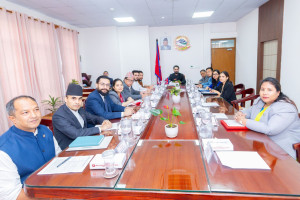
The Judicial Council, tasked with making these crucial recommendations, is chaired by the Chief Justice and includes Senior Justice Sapana Pradhan Malla, Law Minister Sobita Gautam, and members Mahesh Kumar Nepal and Damodar Khadka. While traditional practice requires the Chief Justice to convene the council’s meetings, no such meeting has taken place under Sharma’s leadership, except for a brief introductory gathering immediately following his appointment.
The Judicial Council Secretariat confirmed that no new names have been forwarded to replace recently retired Supreme Court Justices Prakash Man Singh Raut, Prakash Kumar Dhungana, and Kumar Chudal. Justice Chudal retired in November 2025, followed by Justice Raut in April, 2026.
The last appointments to the Supreme Court occurred over a year ago on June 10, 2025, when the council recommended Megh Raj Pokharel, alongside High Court judges Shrikanta Poudel for High Court in Janakpur and Shanti Singh Thapa for High Court in Dipayal.
Ram Prasad Bhandari, the acting secretary of the Judicial Council, acknowledged not convening the council’s meeting for a long time. He confirmed that no date has been set for an upcoming meeting.
A Judicial Council member, speaking on condition of anonymity, asserted that the deadlock stems directly from internal friction. The source revealed a deep-seated professional tension between Chief Justice Sharma and Senior Justice Malla.
Sharma’s nomination from his position as the fourth senior-most justice drew immediate criticism from senior colleagues, who expressed deep dissatisfaction during a full-court meeting, calling it a violation of judicial tradition and an instance of interference by the executive. This friction has paralysed the council, with reports indicating that certain administrative staff even delayed registering sensitive writ petitions, apparently to shield the leadership from embarrassment.
Compounding the administrative paralysis, Senior Justice Malla was on leave during the first twenty days of Sharma's tenure, returning briefly to the bench before taking leave again. "The senior-most justice (Malla) has returned to the bench," said the council member. "We hope a formal discussion to convene the Council will finally take place within the coming days."
According to official statistics, by mid-June 2026, the Supreme Court was inundated with 27,739 pending cases. This backlog includes 15,979 appeals, 4,900 regular writ petitions, 243 constitutional writ petitions, 400 reviews, and 5,133 revision petitions. Crucially, 10,234 of these cases have been languishing for over two years, while 1,442 have remained unresolved for more than five years.
Bijay Prasad Mishra, president of the Nepal Bar Association, calls for immediate action to clear the backlog. "To clear this massive volume of pending litigation within a reasonable timeframe, qualified judges must be appointed without any delay," said Mishra. "Delaying appointments directly compromises the public's constitutional right to timely justice."
The failure to recommend judicial candidates in a timely manner is a longstanding problem within the country’s judiciary. Mishra alleged that Chief Justice Sharma is merely continuing the “flawed administrative habits of his predecessors.”
The Judicial Council Act 2016 explicitly designed a mechanism to avoid prolonged vacancies. Section 4(1) of the Act mandates that the council must identify upcoming vacancies due to age-limit retirements and recommend replacements at least one month before the sitting judge steps down. Furthermore, Section 4(2) states that if a vacancy occurs due to unforeseen circumstances, the Council must forward a recommendation within one month. For High Courts, Section 4(3) allows a maximum window of three months to fill vacant judge and chief judge positions.
Despite these clear statutory requirements, the Judicial Council has repeatedly operated in violation of both the constitution and other related laws. For the past three and a half years, the apex court has consistently operated below its full statutory strength of twenty-one justices including the chief justice, a deficit that has severely crippled daily courtroom operations.
Ironically, the Supreme Court has previously issued several mandamus orders directing the Judicial Council to adhere to the law. The most recent order was issued on June 1 by a division bench of justices Hari Prasad Phuyal and Binod Sharma, following a public interest litigation filed by advocate Deepak Bikram Mishra.
"The rising volume of cases across all levels of the judiciary has caused unreasonable delays in the administration of justice," the division bench noted in its full judgment. "Therefore, an order of mandamus is hereby issued to the Judicial Council Secretariat to execute the legally prescribed procedures and complete appointments within the statutory timelines whenever vacancies arise."
The apex court's ruling underlined that the council possesses a mandatory obligation to maintain updated rosters of eligible law professionals, issue public notifications for interested candidates, and execute selection processes objectively and transparently. Despite this judicial directive, nearly a month has passed without a single step taken by the council's leadership.




 24.21°C Kathmandu