West Asia conflict slows down intake of Nepalis in foreign jobs
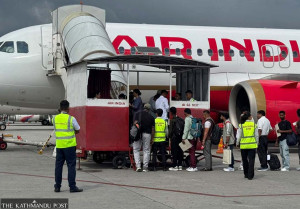
New labour permits fall nearly 19 percent as job opportunities shrink in Gulf countries, labour regulations tighten, and geopolitical tensions rise in West Asia. Post file photo
Indra Dev Yadav from ward 5 of Bariyarpatti in Siraha has spent the past two months visiting manpower companies in search of overseas employment.
He arrived in Kathmandu in the third week of March, hoping to secure a job in the United Arab Emirates (UAE).
Since then, he has attended interviews at four different recruiting firms, but his name has not appeared on any selection list.
“I thought paying the money would guarantee me a job abroad, but that’s not how it works,” he said on Friday while waiting in line for an interview at a manpower agency in Basundhara, Kathmandu. “I keep failing the interviews. This is my fifth attempt.”
Yadav was attending an interview for a job in Malaysia after responding to a recruitment notice issued by the manpower company.
His experience reflects that of many young Nepalis seeking employment overseas. The outflow of Nepali migrant workers has slowed in recent months amid shrinking job opportunities especially in West Asia following the start of the US-Israeli war on Iran in February, and tighter labour regulations in others. According to World Bank data, Nepal’s youth unemployment rate stands at 20.6 percent, the highest in South and Southeast Asia.
Sharp decline in new labour permits
Data from the Department of Foreign Employment show that the number of new labour approvals fell by nearly 19 percent in the first 10 months of the current fiscal year compared with the same period last year.
During the corresponding period of the fiscal year 2024-25, 452,311 people received new labour permits. That figure fell to 367,100 during the same period of the current fiscal year.
The top 10 destinations for Nepali workers are the UAE, Saudi Arabia, Qatar, Kuwait, Romania, Japan, South Korea, Malaysia, Croatia and Bahrain.
Department records show that from mid-November to mid-June of the fiscal year 2024-25, the number of new labour approvals continued to rise. Between mid-June and mid-July alone, 53,646 workers received permits, the highest monthly figure of that fiscal year.
By contrast, in the current fiscal year, labour approvals exceeded 40,000 only during the periods from mid-July to mid-August, mid-August to mid-September, and mid-April to mid-May. During the remaining seven months, monthly approvals ranged between 22,000 and 31,000.
Also, recruitment agencies say demand from major labour destinations has weakened since the Gen Z protests of September 8-9, 2025.
Rajendra Bhandari, former president of the Nepal Association of Foreign Employment Agencies, said the sector has come under sustained pressure.
“After the Gen Z movement, we have been going through a very difficult period,” he said. “The UAE, our largest destination, was closed for some time. Then a rule requiring police report verification from UAE embassies was introduced. At the same time, tensions in West Asia escalated.”
The UAE has long been a major destination for Nepali workers across both skilled and unskilled occupations. Last fiscal year, nearly 200,000 of the 500,000 Nepalis who obtained new labour permits went to the UAE, accounting for 39.76 percent of the total. That share has now fallen to 25 percent.
Following the Gen Z uprisings, the UAE tightened visa rules for Nepali workers and imposed a nearly three-month suspension on labour and visit visas.
On December 4, it introduced a policy requiring police report certification from the UAE embassy, adding an extra financial burden of around Rs14,000 for workers.
At the same time, the UAE has continued to tighten its Emiratisation policy to boost domestic employment in the private sector. By 2026, companies with 50 or more employees are required to ensure that 10 percent of skilled positions are filled by Emirati nationals. Companies that fail to comply face heavy penalties, prompting many employers to reduce foreign recruitment.
The US-Iran conflict has also affected the UAE economy, further reducing labour demand.
“Most hotels are not even 20 percent booked right now,” said Suraj Sharma, a Nepali working at a major hotel in the UAE. “This leaves us with only two options: stay without salary and benefits, or return to Nepal on unpaid leave.”
Saudi Arabia also slows recruitment
The flow of Nepali workers to Saudi Arabia has also declined.
Several major projects under the ambitious NEOM initiative have already been halted, with workers either reassigned to other large projects or sent home.
Around 80,000 Nepalis were previously employed on the project alone.
Saudi Arabia’s introduction of the mandatory Skills Verification Programme (SVP) has further complicated recruitment.
Under the programme, which came into effect on June 17, workers in five occupations must pass a skills assessment before visas are issued.
Manpower agencies have opposed the policy, arguing that it was introduced without Nepal’s consent and could encourage certification fraud while adding about Rs15,000 in extra costs per worker.
Following protests, the planned implementation was suspended, and the testing company later issued a notice formally putting the programme on hold.
Qatar demand remains weak after World Cup 2022 peak
Qatar’s labour market also remains sluggish.
Before the FIFA World Cup 2022, Qatar was one of the largest destinations for Nepali migrant workers, with around 100,000 Nepalis travelling there each year.
At its peak, Qatar recruited as many as 30,000 foreign workers every month. That figure has now dropped to just 2,000 to 3,000.
Most Nepalis currently working in Qatar are existing employees rather than newly recruited workers. Since the World Cup ended, the absence of major construction projects has reduced employment opportunities even for those already in the country.
“Most employers are cutting workforce numbers,” said an official at the Nepali embassy in Doha.
Malaysia offers partial relief amid regional decline
Malaysia has reduced its foreign worker quota from 15 percent to 10 percent.
Its labour market has remained unstable over the past five years, and recruitment from Nepal had been suspended for two years before resuming only recently in the manufacturing sector.
Official records show that only around 9,000 Nepali workers travelled to Malaysia between mid-April and mid-May, significantly fewer than in previous years. However, with opportunities shrinking across the Persian Gulf, Malaysia is expected to provide some relief.
Malaysia’s Human Resources Minister Ramanan Ramakrishnan said global geopolitical instability has disrupted energy markets and international supply chains, leading to widespread job losses.
Local media outlet Bernama quoted Ramanan as saying: “In the first five months of this year [2026] alone, the number of Malaysian citizens who lost their jobs across various economic sectors reached 38,953.”
Ramanan said the sectors most affected include manufacturing, wholesale and retail trade, motor vehicle repair, and administrative and support services.
Malaysia’s unemployment rate currently stands at three percent. The government is shifting displaced workers into sectors facing labour shortages, a move expected to further limit opportunities for foreign workers.
Malaysia currently offers one of the highest minimum wages among major destinations for Nepali workers, at 1,700 ringgit (about Rs63,000).
Global shocks deepen labour market risks
According to a May 18 report by the International Labour Organisation (ILO), conflicts involving the US, Israel and Iran have had a greater impact on employment than the Covid pandemic.
The report says nearly 40 percent of jobs in Gulf countries are at high risk, particularly in construction, manufacturing, transport, trade and hospitality.
Following the conflict, the Department of Foreign Employment suspended labour approvals for West Asian countries from March 1 to April 20. During that period, thousands of workers were unable to use visas that had already been issued, while some employers refused to renew expired visas.
The ILO report further states that the conflict in West Asia has slowed production, reduced recruitment and cut overtime work across multiple industries.
Around 60 percent of Nepali migrant workers are employed in Gulf countries.
According to the Ministry of Foreign Affairs, around 1.9 million Nepalis were working in the region before the conflict began.
ILO chief economist and report author Sangheon Lee described the crisis as a potentially long-term shock.
“This crisis could leave a deep scar by weakening the foundations of decent, safe and protected work,” he said. “Its full impact is yet to unfold.”
Hom Karki is a reporter with two decades experience covering migrant workers issues and the Nepali diaspora. He was previously based in the Gulf for Kantipur Daily.




 25.9°C Kathmandu