Global tensions keep Nepali students in home universities as enrolment climbs
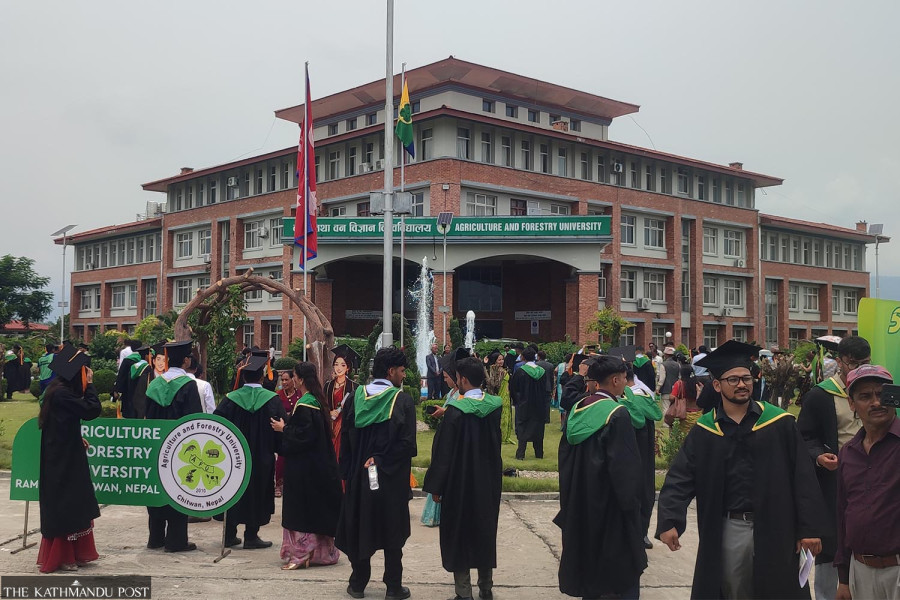
Education ministry figures show that 749,392 students are currently enrolled in universities and academies across the country. Data from the Ministry of Education show that 749,392 students are currently enrolled in universities and academies across the country. Ramesh Kumar Paudel/TKP
The number of students enrolling in higher education institutions across the country has continued to rise. Yet the surge has reinforced a long-standing trend—management studies remain overwhelmingly the preferred choice among university students, while education and humanities continue to lose ground.
Data from the Ministry of Education show that 749,392 students are currently enrolled in universities and academies across the country. The figure represents an increase of 76,903 students compared to the previous fiscal year of 2024-25, when 672,489 students were enrolled in higher education programmes.
The expansion coincides with growth in the higher education sector itself. Nepal now has 30 universities and academies, operating through 1,608 constituent and affiliated campuses nationwide.
According to the government’s latest Economic Survey, student enrolment in universities and academies increased by nearly 10 percent compared to the previous fiscal year. According to officials at the ministry, enrolment rose across all major universities.
The increase becomes even more striking when viewed over a longer period. The annual report of the University Grants Commission (UGC) in 2015 showed only around 407,000 students studying in 12 universities and academies. In ten years, the number of students in higher education has nearly doubled.
Despite the emergence of new universities, Tribhuvan University continues to dominate the sector. As in the past, it remains the destination for the vast majority of students.
The UGC records show that around 89 percent of university students are enrolled at the bachelor’s level, 10 percent at the master’s level, and only 1 percent in MPhil and PhD programmes.
Devraj Adhikari, a former UGC chairperson, said several factors have contributed to the rise in enrolment. “One reason is that students whose overseas education plans were disrupted by wars and geopolitical instability in different countries have remained in Nepal,” said Adhikari. “Another reason is the academic backlog created during and after the Covid pandemic. Many students took longer to complete courses, which increased the overall enrolment figures.”
He added that universities have gradually improved academic management and implemented academic calendars more effectively than in previous years, helping attract and retain students. Improved performance in the Grade 12 examinations has also contributed to the growth.
Professor Dilliram Sharma, former dean of the Faculty of Management at Tribhuvan University, said the increase in the number of students passing secondary education has naturally expanded the pool of university entrants.
Last year, 61.71 percent of students passed the Grade 12 examinations, an improvement of nine percentage points over the previous year. According to the National Examination Board, 242,465 of the 396,347 candidates who appeared passed the examinations. Results from supplementary examinations also showed pass rates of around 60 percent.
This year, the pass rate improved further. Results published on Friday showed that 64.13 percent of Grade 12 students successfully passed the examinations.
Sharma also linked the rise in domestic enrolment to stricter student visa policies adopted by countries that traditionally attract large numbers of Nepali students.
“Compared to previous years, countries such as Australia and Canada have tightened student visa regulations. As a result, more students are choosing to enrol in Nepali universities,” he said.
Nevertheless, outward student migration remains significant. By mid-April of the current fiscal year, 91,638 students had obtained no-objection certificates to pursue higher education abroad. Although substantial, the figure is lower than the approximately 123,000 students who obtained such permits during the previous fiscal year.
Government statistics show that around 34,500 students are studying at colleges operating in Nepal under affiliation with foreign universities. A total of 57 such colleges currently operate with the ministry’s approval.
Higher education in Nepal is delivered through 21 universities—15 central and six provincial—and eight health sciences academies, including six central and two provincial institutions.
Students studying management remain dominant
Management has long been the most popular field of study in Nepal, and its dominance has become even more pronounced. According to UGC data, 39 percent of higher education students were enrolled in management programmes in 2015. By 2025, that share had climbed to 47.1 percent.
Management, education and humanities rank first, second and third respectively in terms of enrolment. However, the gap between them is considerable. Statistics show that around 350,000 students are enrolled in management studies, about 150,000 in education and roughly 70,000 in humanities.
An analysis of enrolment patterns over the past decade indicates that management has emerged as the clear winner among academic disciplines. Engineering programmes have also recorded notable growth.
In contrast, education, humanities, agriculture and medical studies have seen their shares decline. In the medical sector, enrolment has been affected by the gradual phase-out of proficiency certificate level programmes and stricter implementation of quota systems since 2018.
Former UGC chairperson Adhikari attributes management’s popularity to its practical and market-oriented curriculum. “Students believe management studies offer better employment prospects in both the public and private sectors. The programmes are closely linked to market needs and skills development,” he said.
Prof Sharma agrees. “Management education is closely connected with entrepreneurship, employment and self-employment,” he said. “That has made it attractive to students for many years.”
He also pointed to the introduction of new programmes such as Bachelor of Business Administration, Bachelor of Business Management, Information Technology-related management courses and hotel management degrees.
“These programmes have expanded opportunities both inside Nepal and abroad. Students see clear career pathways after graduation,” he said.
Management programmes are currently offered by the TU, Kathmandu University, Pokhara University, Purbanchal University, Far Western University, Mid-West University and Nepal Open University.
Demand is particularly intense at established campuses in Kathmandu.
Jitendra Prasad Upadhyay, chief of the Nepal Commerce Campus at Minbhawan, said the institution receives far more applications than available seats. “Applications consistently exceed the approved quota,” he said. “Students are especially interested in newer programmes.”
According to Upadhyay, the campus stopped admissions after enrolling around 1,300 students in BBS and 700 in MBA programmes last year. “For just 99 seats in BBA, we received more than 500 applications,” he said. “Demand for these programmes continues to grow.”
Students themselves cite employment prospects as the primary attraction.
Sandhya Lamichhane, a management student, said the field offers diverse career opportunities. “After graduation, I can prepare for civil service examinations or work in banks and financial institutions,” she said. “There are opportunities in both government and private sectors.”
Declining trend in education, humanities
Although the number of university enrolment increases, student numbers in education and humanities have declined significantly.
In 2015, 31.6 percent of university students were enrolled in education programmes. By 2025, the share had fallen to 20.8 percent. Similarly, humanities enrolment dropped from 11.3 percent to 9.4 percent over the same period.
While enrolment in science, technology, engineering and medical subjects has grown, the increase has not been sufficient to significantly raise their share of total student numbers.
Law, however, has emerged as a growing area of interest. Around 9,500 students enrolled in law programmes last year. The expansion of law education to constituent campuses outside Kathmandu and the introduction of law programmes by newer institutions, including Nepal Open University, are expected to further increase enrolment.
Bedraj Acharya, dean of the Faculty of Education at TU, believes government policies have contributed to declining interest in education studies. “It appears that interest in becoming a teacher is declining across society. The state has not given sufficient priority to education faculties,” he said.
Acharya argued that the absence of mandatory professional education qualifications for teaching jobs has weakened demand for education programmes.
“Students do not see a clear advantage in studying education,” he said.
Acharya also pointed to the declining prestige of the teaching profession.
“Even candidates who pass examinations for teaching positions often leave if they secure administrative jobs in the civil service,” he said. “The state has not treated teaching as a respected profession.”
Meanwhile, colleges affiliated with foreign universities present a different pattern. Of the 34,465 students enrolled in such institutions, 66 percent—around 22,764 students—are studying science and technology-related subjects. Even so, management remains the second-largest field, attracting around 10,000 students.
Weak graduation rates raise concerns
Despite rising enrolment, graduation rates remain a major concern in many universities.
According to the UGC, the average pass rate across nine faculties at TU stands at only 47.25 percent. The figures are 55.15 percent at Purbanchal University and 56.66 percent at Pokhara University.
Across 12 central universities, the average pass rate is only 62 percent.
In contrast, health science institutions perform far better. The Patan Academy of Health Sciences reports a pass rate of 100 percent, while the National Academy of Medical Sciences, Bir Hospital records 98 percent. Kathmandu University has a pass rate of 67 percent.
Lumbini Buddhist University reports an 85 percent pass rate, while the Agriculture and Forestry University records 66.75 percent. Mid-West University and Far Western University have pass rates of 50.17 percent and 39.87 percent respectively.
Former UGC chairperson Adhikari said many students fail to complete their studies because they do not attend classes regularly or drop out midway through programmes.
The government allocated Rs19 billion to higher education in the current fiscal year, reflecting growing public investment in the sector. However, concerns have emerged regarding efficiency and outcomes.
The auditor general’s annual report for the fiscal year 2025-26 questioned whether universities are producing satisfactory results relative to public spending. The report noted that state investment per student ranges widely across institutions, yet graduation rates often remain weak.
“The outcome indicators do not appear satisfactory in relation to state investment and student enrolment,” the report stated, recommending a review of grant allocation policies.
For the upcoming fiscal year, the government has allocated Rs16.92 billion to the UGC, around Rs2 billion less than the current year.




 23.32°C Kathmandu