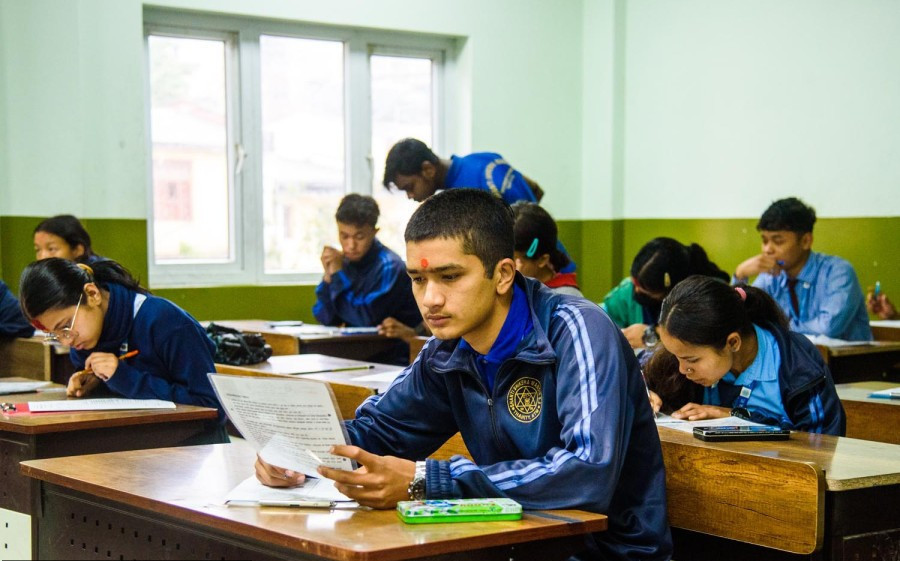
Results of the Grade 12 examinations have shown improvement for the third consecutive year, with this year’s overall pass rate rising by around 3 percentage points from last year to 64.13 percent.
In a departure from the practice of taking more than two months to publish the Grade 12 results, the outcome of the examinations, held from April 27 to May 10 this year, was made public on Friday, just 40 days after the exams concluded.
The National Examinations Board said the overall pass rate under both the regular and partial categories stood at 64.13 percent, compared to 61.17 percent last year. Pass rates were 69.75 percent in the regular category and 42.38 percent in the partial category, board spokesperson Jayanti Satyal said.
The board had also recorded an improvement last year compared to 2023, when 52.15 percent of students passed the Grade 12 examinations.
This year, 332,241 students appeared in the regular category examinations. Of them, 231,770 students secured passing grades, while 100,471 failed to obtain the passing grades.
The improvement in results is reportedly due to more effective teaching and learning methods in schools. The board announced that supplementary examinations for students who failed to secure the minimum passing grades will be held on July 18 and 19. Only regular-category students will be eligible to sit the chance examinations.
According to a notice issued by the board, examinees who obtained a “D” or higher grade in all other theoretical subjects but received a Non-Graded (NG) status or were marked absent in a maximum of two subjects will be eligible to participate in the supplementary examinations. Students wishing to take the grade-increment examinations must apply online.
Applications can be submitted until July 3 by paying a fee of Rs 800.
Students who are dissatisfied with their results may apply for re-totaling by paying Rs 1,000.
Among those who passed, 17,786 students secured a GPA between 3.61 and 4.0. A total of 64,821 students obtained a GPA between 3.21 and 3.60.
The largest group of students fell in the 2.81 to 3.20 GPA range, with 94,249 students. Another 50,597 students scored between 2.41 and 2.80. A total of 4,308 students obtained a GPA between 2.01 and 2.40. Only nine students received a GPA between 1.61 and 2.0.
A total of 85,929 students appeared in the partial category examinations, of whom 36,420, or 42.38 percent, passed.
The board said 30 regular-category papers and 10 partial-category papers were cancelled, affecting a total of 40 candidates.
Students whose results contain errors may apply to the board within six months for corrections. Errors related to result status, absence marking, subject discrepancies, name, surname, registration number and similar issues can be corrected, Satyal said.
Although the government had directed the board to publish the results within 45 days, it completed the process in 40 days. The board said the early publication was made possible by increasing the number of answer script evaluation centres and running multiple processes simultaneously.
The number of evaluation centres was increased from 28 to 42, Examination Controller Krishna Prasad Sharma said.
“We worked according to a planned schedule. Rechecking of answer scripts was also done at the evaluation centres themselves,” he said. “All processes were run in parallel while preparing for publication.”
Previously, the board used to publish the results within 70 days.
Girls outperform boys in Grade 12 results
According to the results, girls performed slightly better than boys.
The pass rate among girls stood at 70.39 percent, compared to 69.17 percent among boys. More boys than girls appeared in the examinations, with 172,248 boys and 159,964 girls sitting the tests.
In terms of failures, 53,100 boys and 47,361 girls failed to secure passing grades, indicating a higher overall pass rate among female students.
However, boys led in the highest GPA bracket. Among the 17,786 students who secured a GPA between 3.61 and 4.0, 10,067 were boys and 7,719 were girls.
Similarly, in the 3.21 to 3.60 GPA bracket, boys also outnumbered girls, with 33,405 boys and 31,411 girls.
While boys outnumbered girls in both participation and the top GPA categories, the overall pass rate and proportional performance were stronger among girls, officials said.
Sharma said girls have consistently performed better in recent years.
“The results appear better because girls are more diligent and committed to learning,” he said.
Bagmati best, Karnali weakest among provinces
Bagmati province recorded the best performance in the examinations, while Karnali posted the weakest results.
In terms of participation, Bagmati had the highest number of students, while Karnali had the lowest. A total of 103,513 students, or 31.15 percent of the total, appeared from Bagmati, while 22,672 students, or 6.8 percent, appeared from Karnali.
Across the country, 332,241 students appeared in the regular category examinations. Of them, 231,770 students, or 69.75 percent, passed, while 100,471, or 30.25 percent, failed.
Bagmati province achieved a pass rate of 78.17 percent, the highest among all provinces. It has consistently recorded the best results in previous years as well.
Bagmati also led in high GPA achievers, with 11,052 students securing a GPA between 3.61 and 4.0.
Karnali recorded the weakest performance, with only 62.17 percent of students passing. Only 252 students from Karnali secured the highest GPA bracket, the lowest among all provinces.
The gap in pass rates between Bagmati and Karnali stood at around 16 percentage points. The number of top-grade students in Bagmati was nearly 44 times higher than in Karnali.
Dhruba Kumar Gautam, former vice-chancellor of Mid-West University, Surkhet, said limited state investment in education is a key reason behind Karnali’s weak performance.
“The state seems to focus only on physical infrastructure. Investment in capacity and human resource development in Karnali districts is extremely limited,” he said. “There is also a lack of subject teachers and teacher training.”
He added that private schools also play a major role in performance differences, noting that provinces with more private schools tend to perform better.
“In Karnali, there are very few private schools offering Grades 11 and 12, except in Surkhet. In remote districts, private schools are rare,” he said. “Most students appear from community schools. The results of private and community schools should be analysed separately.”
He further said many top-performing students from Karnali move to Kathmandu and other cities for higher education, which affects the results in Grades 11 and 12.
In the recently published SEE results, Sudurpaschim, Karnali and Madhesh provinces also performed below the national average.
Among the other provinces, Gandaki performed close to the national average with a pass rate of 69.72 percent. It was followed by Lumbini, Koshi, Madhesh and Sudurpaschim in descending order.
Sudurpaschim recorded a pass rate of 64.31 percent, Madhesh 64.77 percent, Koshi 65.98 percent and Lumbini 67.82 percent.
Last year’s results also showed Karnali, Madhesh, Sudurpaschim, Lumbini and Koshi below the national average, while Bagmati and Gandaki were above it.
Sharma said studies have been initiated to identify schools, districts and local levels with weak performance.
“The board has also signed agreements with municipalities to improve results in low-performing schools. Experts will be deployed to work directly with teachers and students,” he said. “Teaching and learning processes need to be improved to raise overall results.”




 26.08°C Kathmandu